Loading…


Loading…
Loading…
Loading…
Edexcel GCSE Combined Science · 1SC0
Edexcel 1SC0 · Acids Acids Check the specification (PDF) (opens in a new tab)
Recall that acids in solution provide hydrogen ions, while alkalis in solution provide hydroxide ions.
Recall that neutral solutions have a pH of 7, acidic solutions have pH values below 7, and alkaline solutions have pH values above 7.
Recall the specific colour changes of indicators, including litmus, methyl orange, and phenolphthalein, when exposed to acids and alkalis.
Understand the inverse relationship between hydrogen ion concentration and pH in acidic solutions, and the direct relationship between hydroxide ion concentration and pH in alkaline solutions.
Recall that a tenfold increase in hydrogen ion concentration corresponds to a decrease of 1 on the pH scale.
Investigate the change in pH when adding powdered calcium hydroxide or calcium oxide to a fixed volume of dilute hydrochloric acid.
Explain the terms dilute and concentrated concerning the amount of solute in a solution.
Explain the difference between weak and strong acids based on their degree of dissociation into ions in solution.
Understand that a base is a substance that reacts with an acid to produce only a salt and water.
Recall that alkalis are defined as soluble bases.
Explain the general reactions of aqueous acids with metals, metal oxides, metal hydroxides, and metal carbonates to produce specific salts.
Describe the standard chemical tests for hydrogen gas and carbon dioxide gas (using limewater).
Describe a neutralisation reaction as the chemical interaction between an acid and a base.
Explain acid-alkali neutralisation as the reaction where hydrogen ions from the acid combine with hydroxide ions from the alkali to form water.
Explain the steps and reasoning for preparing soluble salts from an acid and an insoluble reactant, including adding excess reactant, removing the excess, and isolating the salt and water.
Explain the steps and reasoning for preparing soluble salts from an acid and a soluble reactant using titration methods.
Investigate the preparation of pure, dry hydrated copper sulfate crystals from copper oxide, utilizing a water bath.
Describe the procedure for conducting an acid-alkali titration using a burette, pipette, and indicator to prepare a pure, dry salt.
Recall the general solubility rules for common substances in water, covering sodium, potassium, ammonium salts, nitrates, chlorides, sulfates, carbonates, and hydroxides.
Predict the formation of a precipitate when specific solutions are mixed, using solubility rules, and identify the resulting precipitate.
Describe the experimental method required to prepare a pure, dry sample of an insoluble salt.
An ion is an electrically charged particle. When an acid dissolves in water, it produces hydrogen ions, . These ions give the solution its acidic properties. An alkali produces hydroxide ions, , in water. Hydrogen ions have a positive charge; hydroxide ions have a negative charge.
The words in solution matter: these descriptions concern substances dissolved in water. Such solutions are called aqueous solutions.
The pH scale tells us how acidic or alkaline a solution is. The usual school scale runs from 0 to 14:
A lower pH means a more acidic solution; a higher pH means a more alkaline solution. For example, a solution at pH 2 is more acidic than one at pH 5, while a solution at pH 12 is more alkaline than one at pH 9. Neutral does not mean weakly acidic or weakly alkaline: it is a separate description.
An indicator changes colour according to the acidity or alkalinity of a solution. Adding a small amount of indicator therefore gives visible evidence about the solution without needing to see its ions.
Litmus, methyl orange and phenolphthalein are indicators used to distinguish acidic and alkaline conditions. Litmus is commonly used as indicator paper, which is dipped into a solution. Methyl orange and phenolphthalein are commonly added as indicator solutions. Different indicators do not all give the same colour in an acid or an alkali:
| Indicator | Colour in acid | Colour in alkali |
|---|---|---|
| Litmus | Red | Blue |
| Methyl orange | Red | Yellow |
| Phenolphthalein | Colourless | Pink |
Litmus paper comes in red and blue versions. In an acid, blue litmus turns red, while red litmus stays red. In an alkali, red litmus turns blue, while blue litmus stays blue. A neutral solution changes neither red nor blue litmus paper.
For example, if a solution turns blue litmus red and makes methyl orange red, both observations indicate acidic conditions. If phenolphthalein changes from colourless to pink as conditions change from acidic to alkaline, the pink colour indicates alkaline conditions. These indicators distinguish acidic from alkaline conditions; their colours do not give an exact pH.
Concentration describes how much of a substance is present in a given volume. In an acidic solution, a higher concentration of hydrogen ions means a lower pH. In an alkaline solution, a higher concentration of hydroxide ions means a higher pH.
The pH scale does not change in equal steps of hydrogen ion concentration. Every tenfold increase in hydrogen ion concentration decreases the pH by 1. Conversely, reducing the hydrogen ion concentration to one-tenth increases the pH by 1.
For example, comparing two solutions at pH 3 and pH 2, the pH 2 solution has ten times the hydrogen ion concentration. Comparing pH 3 with pH 1 involves two steps, so the hydrogen ion concentration increases by times. This relationship concerns the concentration of hydrogen ions, not simply the amount of acid added.
A solution forms when a solute, the dissolved substance, dissolves in a solvent, such as water. A dilute solution contains relatively little solute in a given volume of solution. A concentrated solution contains relatively much solute in the same volume.
Imagine two equal-sized samples containing the same dissolved substance. If one contains more solute, it is more concentrated. Comparing equal volumes is important: a large container may contain more solute overall without having a higher concentration.
Adding water to an acid solution makes it more dilute because the dissolved acid is spread through a larger volume.
Acid strength is about the degree of dissociation into ions, not the amount of acid dissolved.
A strong acid completely dissociates in water. Hydrochloric acid is an example: its dissolved hydrogen chloride produces hydrogen ions and chloride ions.
A weak acid only partially dissociates. Ethanoic acid is an example: some dissolved acid molecules produce ions, while others remain as intact molecules.
At the same concentration, a strong acid produces a higher concentration of hydrogen ions than a weak acid and therefore has a lower pH. A weak acid is still acidic: it produces hydrogen ions, but only some of its molecules dissociate.
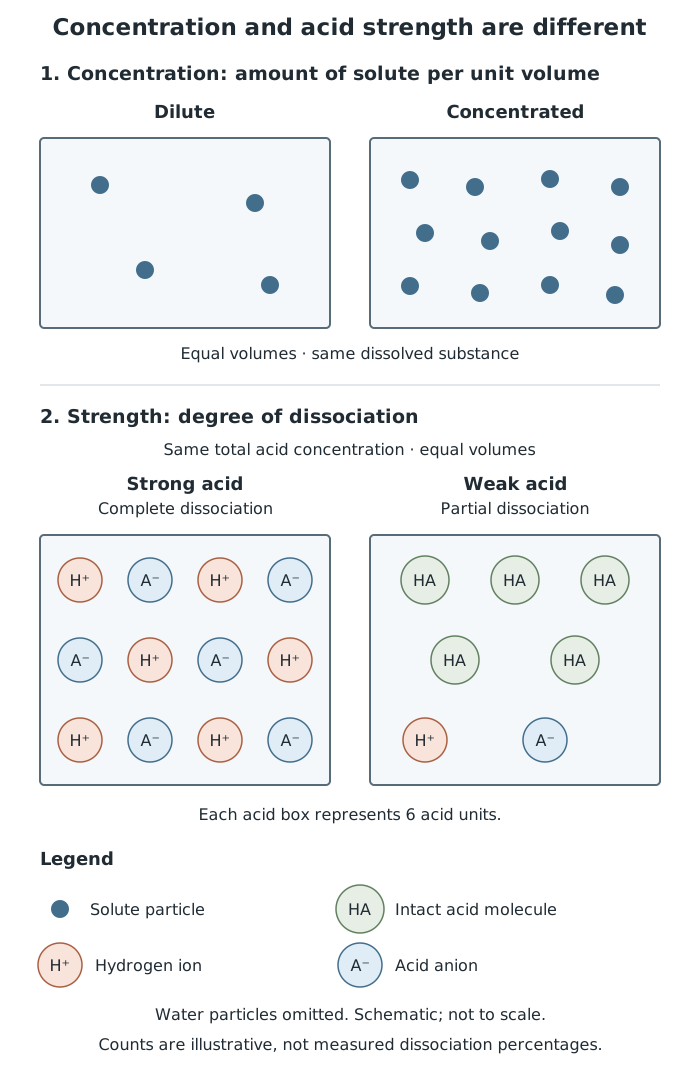
Concentration describes the amount dissolved per unit volume; acid strength describes how completely the acid dissociates.
Strength and concentration answer two different questions: How much acid is dissolved per unit volume? and How completely does that acid dissociate? A strong acid can be dilute, and a weak acid can be concentrated. Adding water makes a strong acid more dilute; it does not turn it into a weak acid.
Get unlimited access to all revision notes, key terms, and exam tips.
| Indicator | Acid | Alkali |
|---|---|---|
| Litmus | Red | Blue |
| Methyl orange | Red | Yellow |
| Phenolphthalein | Colourless | Pink |
Acid turns blue litmus red; alkali turns red litmus blue. Neutral solutions change neither paper.
Get unlimited access to all revision notes, key terms, and exam tips.
Use the ion charges correctly: hydrogen ions are H⁺ and hydroxide ions are OH⁻.
Strong and concentrated mean different things: strength describes dissociation; concentration describes the amount of dissolved substance per unit volume.
For Higher Tier comparisons, a fall of two pH units means a 100-fold increase in hydrogen ion concentration, not a twofold increase.
Compare strong and weak acids at the same concentration when explaining their different pH values.
State both the starting and finishing colours when describing a litmus-paper change. Acid turns blue litmus red; alkali turns red litmus blue.
Acid
A substance that produces hydrogen ions, , in aqueous solution.
Alkali
A soluble base that produces hydroxide ions, , in aqueous solution.
pH
A numerical measure of how acidic or alkaline a solution is; neutral solutions have a pH of 7.
Indicator
A substance that changes colour depending on the acidity or alkalinity of its surroundings.
Dilute solution
A solution containing a relatively small amount of dissolved substance per unit volume of solution.
Concentrated solution
A solution containing a relatively large amount of dissolved substance per unit volume of solution.
Dissociation
The separation of a substance into ions when it dissolves; an acid dissociates to produce hydrogen ions.
Strong acid
An acid that completely dissociates into ions in aqueous solution.
Weak acid
An acid that only partially dissociates into ions in aqueous solution.
Put your knowledge into practice — try past paper questions for Combined Science
Acid
A substance that produces hydrogen ions, , in aqueous solution.
Alkali
A soluble base that produces hydroxide ions, , in aqueous solution.
pH
A numerical measure of how acidic or alkaline a solution is; neutral solutions have a pH of 7.
Indicator
A substance that changes colour depending on the acidity or alkalinity of its surroundings.
Dilute solution
A solution containing a relatively small amount of dissolved substance per unit volume of solution.
Concentrated solution
A solution containing a relatively large amount of dissolved substance per unit volume of solution.
Dissociation
The separation of a substance into ions when it dissolves; an acid dissociates to produce hydrogen ions.
Strong acid
An acid that completely dissociates into ions in aqueous solution.
Weak acid
An acid that only partially dissociates into ions in aqueous solution.