Loading…


Loading…
Loading…
Loading…
Edexcel GCSE Combined Science · 1SC0
Edexcel 1SC0 · Methods of separating and purifying substances Methods of separating and purifying substances Check the specification (PDF) (opens in a new tab)
Explain the distinction between the everyday use of the term 'pure' and its specific definition in chemistry regarding pure substances and mixtures.
Interpret melting point data to distinguish between pure substances, which have sharp melting points, and mixtures, which melt over a temperature range.
Explain which types of mixtures can be separated using specific experimental techniques: simple distillation, fractional distillation, filtration, crystallisation, and paper chromatography.
Describe and select the most appropriate experimental technique to separate a specific mixture based on the properties of its components.
Describe paper chromatography as a separation technique for mixtures of soluble substances, relying on a mobile phase solvent running through a stationary phase paper.
Interpret a paper chromatogram to distinguish between pure and impure substances, identify substances by comparison, and calculate Rf values.
Investigate the composition of inks using simple distillation and paper chromatography techniques.
Describe the processes required to make waste and ground water potable, including sedimentation, filtration, and chlorination.
Describe how sea water can be made potable using distillation.
Understand that water used in chemical analysis must be free from any dissolved salts to ensure accurate results.
An ink can look like a single colour while containing several dissolved dyes. Paper chromatography separates mixtures of soluble substances, allowing us to investigate which substances are present.
Chromatography uses two phases. The mobile phase is the solvent that moves through the paper, carrying dissolved substances with it. The stationary phase stays in place and is contained in the paper.
The solvent rises through the paper by capillary action. Different dyes have different solubilities in the solvent and different attractions to the stationary phase. A dye that dissolves readily in the solvent and is less strongly held by the stationary phase moves further. These differences make the dyes travel at different rates, separating an initial ink spot into several spots. The resulting pattern is called a chromatogram.
You need chromatography paper, a pencil, ink samples, a capillary tube or pipette, a beaker, a suitable solvent and a support to hold the paper upright. Water is suitable for water-soluble inks. An ink that is insoluble in water needs a different solvent in which its dyes dissolve.
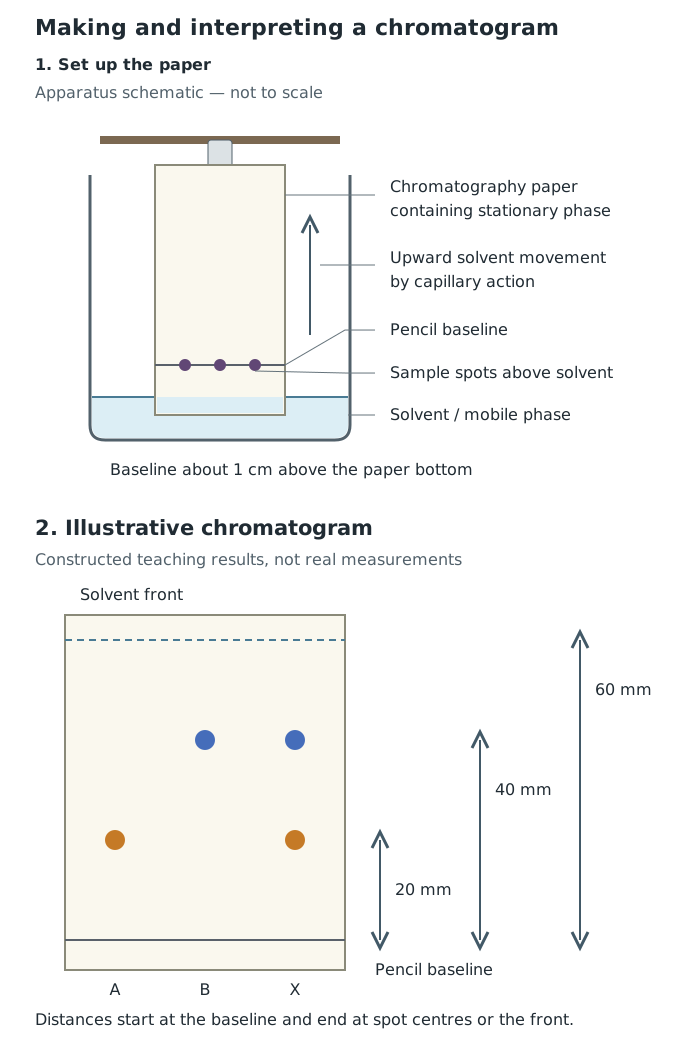
Keep the ink spots above the solvent. In this example, ink X separates into two spots matching known substances A and B.
A pure soluble substance produces one spot. A mixture that separates produces two or more spots, showing that more than one substance is present. One spot is evidence of purity under the test conditions, rather than an absolute guarantee: different substances can sometimes travel together.
To identify a substance, compare the unknown with known substances run under the same conditions. Spots of the same colour at the same height provide evidence that they are the same substance. Comparing the whole pattern also helps you decide whether two inks contain the same dyes.
In an example chromatogram, known substance A produces one spot 20 mm above the baseline, and known substance B produces one spot 40 mm above it. Unknown ink X produces spots at both heights. X is therefore a mixture, and the matching positions support the conclusion that it contains A and B.
An Rf value, or retention factor, expresses how far a substance travelled compared with the solvent front:
Measure both distances from the baseline, measuring to the centre of the substance spot. Because the distances are divided, their units cancel: Rf has no unit. Values lie between 0 and 1.
In the example chromatogram, the solvent front has travelled 60 mm. The upper spot has travelled 40 mm, so its Rf is . This means the spot travelled about two-thirds as far as the solvent front. The lower spot has an Rf of .
Rf values can be compared with reference values for known substances to help identify an unknown. The comparison must use the same conditions, especially the same solvent: changing the solvent can change how far a substance travels and therefore change its Rf value.
The ink investigation has two complementary parts. Chromatography separates the dissolved dyes; simple distillation separates and collects the solvent. For a water-based ink, the solvent collected is water.
A suitable school arrangement uses a conical flask containing about 20 ml of ink, anti-bumping granules, a bung carrying a thermometer and delivery tube, and a receiving test tube cooled in a beaker of ice. The flask is supported above a Bunsen burner using a tripod and gauze on a heat-resistant mat. Anti-bumping granules help the liquid boil smoothly.
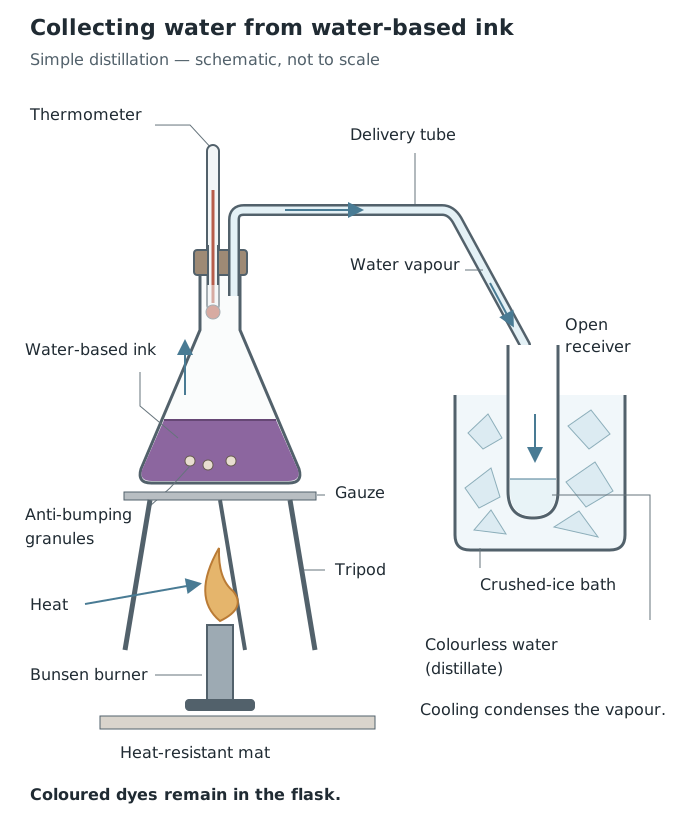
Water evaporates from the ink and condenses in the cooled receiver; the coloured dyes remain in the flask.
Heat the ink until it boils, then reduce the heating to maintain a gentle boil. Water evaporates and its vapour passes along the delivery tube. Cooling turns the vapour back into liquid, which collects in the receiving tube as the distillate. Collect a small sample, then turn off the burner.
The coloured dyes remain in the flask, so the collected water should be colourless while the remaining ink stays coloured. This shows that the original ink contained a solvent as well as dissolved colouring substances. The vapour temperature can also be compared with the boiling point of the suspected solvent; water boils at about at normal atmospheric pressure.
Wear eye protection, secure hair and loose clothing, and allow hot apparatus to cool before handling it. Keep flammable chromatography solvents away from the Bunsen flame. Together, the two techniques reveal different parts of the ink's composition: its solvent and its dyes.
Get unlimited access to all revision notes, key terms, and exam tips.
Measure from the baseline to the spot centre and solvent front. Rf has no unit and lies between 0 and 1. Changing the solvent can change Rf.
Chromatography: pencil baseline → small ink spots → solvent below baseline → allow solvent to rise → remove paper and mark solvent front → dry, compare and measure.
Simple distillation: gently boil water-based ink → water evaporates → vapour cools and condenses → collect colourless water. Coloured dyes remain in the flask.
Wear goggles, let hot apparatus cool and keep flammable solvents away from flames.
Get unlimited access to all revision notes, key terms, and exam tips.
Explain why the baseline is drawn in pencil: ink could dissolve and separate, interfering with the sample.
Keep the sample spots above the solvent level so they do not wash directly into the solvent.
For Rf, measure both distances from the baseline, using the centre of the substance spot. Use the same distance units; Rf has no unit.
Compare spots or Rf values obtained under the same conditions, especially using the same solvent.
Distillation collects the solvent, not the dyes: the solvent evaporates and then condenses.
Paper chromatography
A technique that separates soluble substances in a mixture because they move at different rates as a solvent travels through paper.
Mobile phase
The moving solvent that carries dissolved substances through the stationary phase during chromatography.
Stationary phase
The phase that stays in place during chromatography; in paper chromatography, it is contained in the paper.
Chromatogram
The pattern of separated substances produced by chromatography.
Solvent front
The furthest position reached by the solvent during chromatography.
Rf value
The ratio of the distance travelled by a substance to the distance travelled by the solvent front, both measured from the baseline: .
Simple distillation
A separation technique in which a liquid is evaporated and its vapour is cooled to collect the liquid again.
Distillate
The liquid collected after vapour condenses during distillation.
Put your knowledge into practice — try past paper questions for Combined Science
Paper chromatography
A technique that separates soluble substances in a mixture because they move at different rates as a solvent travels through paper.
Mobile phase
The moving solvent that carries dissolved substances through the stationary phase during chromatography.
Stationary phase
The phase that stays in place during chromatography; in paper chromatography, it is contained in the paper.
Chromatogram
The pattern of separated substances produced by chromatography.
Solvent front
The furthest position reached by the solvent during chromatography.
Rf value
The ratio of the distance travelled by a substance to the distance travelled by the solvent front, both measured from the baseline: .
Simple distillation
A separation technique in which a liquid is evaporated and its vapour is cooled to collect the liquid again.
Distillate
The liquid collected after vapour condenses during distillation.