Loading…


Loading…
Loading…
Loading…
Edexcel GCSE Combined Science · 1SC0
Edexcel 1SC0 · Methods of separating and purifying substances Methods of separating and purifying substances Check the specification (PDF) (opens in a new tab)
Explain the distinction between the everyday use of the term 'pure' and its specific definition in chemistry regarding pure substances and mixtures.
Interpret melting point data to distinguish between pure substances, which have sharp melting points, and mixtures, which melt over a temperature range.
Explain which types of mixtures can be separated using specific experimental techniques: simple distillation, fractional distillation, filtration, crystallisation, and paper chromatography.
Describe and select the most appropriate experimental technique to separate a specific mixture based on the properties of its components.
Describe paper chromatography as a separation technique for mixtures of soluble substances, relying on a mobile phase solvent running through a stationary phase paper.
Interpret a paper chromatogram to distinguish between pure and impure substances, identify substances by comparison, and calculate Rf values.
Investigate the composition of inks using simple distillation and paper chromatography techniques.
Describe the processes required to make waste and ground water potable, including sedimentation, filtration, and chlorination.
Describe how sea water can be made potable using distillation.
Understand that water used in chemical analysis must be free from any dissolved salts to ensure accurate results.
In everyday language, ‘pure’ often means natural, clean or having nothing added. Milk might be described as ‘pure milk’ because nothing has been added to it. That does not mean it contains just one chemical substance.
In chemistry, a pure substance is a single element or compound, with no other substances mixed into it. A compound can be pure even though it contains more than one element: pure water contains only molecules, in which hydrogen and oxygen are chemically bonded together.
A mixture contains two or more substances that are not chemically combined with one another. Adding salt to water produces a mixture, not a new compound. The salt and water retain their chemical properties and can be separated using physical methods. Air is another mixture: it contains nitrogen, oxygen and other gases.
A pure substance has a sharp melting point: it melts at a particular temperature rather than over a broad range. A mixture melts over a range of temperatures. Impurities also commonly lower the melting temperature compared with the pure substance.
To interpret melting point data, look at both the temperature at which melting starts and the temperature at which it finishes. Compare these with the known melting point of the pure substance, if it is provided.
For example, consider these results for two samples of a substance whose pure melting point is 80 °C:
| Sample | Starts melting | Finishes melting | Interpretation |
|---|---|---|---|
| A | 80 °C | 80 °C | A sharp melting point matching the pure substance |
| B | 74 °C | 79 °C | A melting range, indicating a mixture |
Sample B is not simply ‘a substance with a lower melting point’: it melts across several temperatures. That range is the key evidence of impurity.
Separation methods work because the components of a mixture have different physical properties. First identify what is present and what you want to collect.
A solution forms when a solute dissolves in a solvent. In salt solution, salt is the solute and water is the solvent. A dissolved solid needs a different separation method from an insoluble solid such as sand.
Filtration separates an insoluble solid from a liquid or solution. For example, it can separate sand from water, or collect an insoluble solid formed during a reaction.
Place filter paper in a funnel above a collecting beaker, then pour in the mixture. The liquid passes through the paper, but the undissolved solid is trapped. The solid left on the paper is the residue; the liquid collected below is the filtrate.
Dissolved substances pass through with the liquid. Filtering salt solution therefore does not separate the salt from the water.
Crystallisation is used to obtain a dissolved solid from its solution. Copper sulfate solution is a useful example because copper sulfate is more soluble in hot water than in cold water.
Gently heat the solution in an evaporating basin so that some water evaporates. This makes the solution more concentrated. Continue until it is saturated: it contains as much dissolved solute as it can hold at that temperature. Crystals forming on a clean, cold glass rod dipped into the solution can indicate that it is ready.
Leave the concentrated solution to cool. As the temperature falls, less copper sulfate can remain dissolved, so crystals form. Filter off the crystals, wash them with a little cold distilled water and allow them to dry. Cold water removes remaining solution while limiting how much of the crystals dissolves.
If you want the water from salt solution rather than the salt, use simple distillation. It separates a solvent from a solution by vaporising the solvent and then condensing its vapour.
Heat the salt solution in a distillation flask. Water vaporises, while the dissolved salt remains in the flask because it does not vaporise at the temperature used. The water vapour enters a condenser, where a surrounding flow of cold water cools it. It condenses into liquid water and runs into a collecting vessel. The collected liquid is called the distillate.
As water leaves the flask, the remaining salt solution becomes more concentrated. Evaporation alone would lose the water to the surroundings; distillation allows it to be collected.
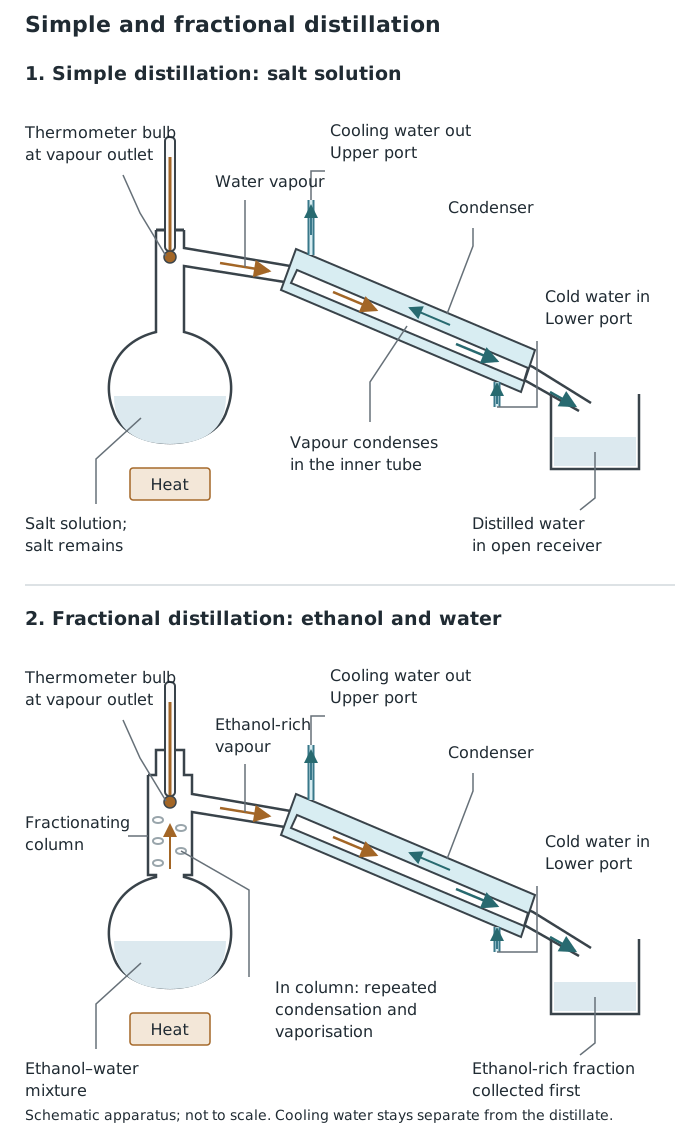
Both methods collect a liquid by vaporising it and then condensing its vapour. Fractional distillation adds a fractionating column to improve the separation of mixed liquids.
Fractional distillation separates liquids that mix together and have different boiling points, such as ethanol and water. Ethanol boils at about 78 °C, whereas water boils at about 100 °C at atmospheric pressure.
The apparatus includes a fractionating column between the heated flask and the condenser. As vapour rises through the column, repeated condensation and vaporisation improve the separation. The vapour reaching the condenser first is richer in the lower-boiling liquid, ethanol. It cools and condenses, allowing an ethanol-rich fraction to be collected.
As the lower-boiling component is removed, the temperature rises. Different fractions can then be collected separately. The important distinction is that simple distillation is suitable for collecting a solvent from a dissolved solid, whereas fractional distillation improves the separation of mixed liquids.
Paper chromatography is suitable for separating a mixture of soluble substances, such as the dyes in an ink. The components travel at different rates as a solvent moves through the paper.
Put a small sample spot on a pencil line near the bottom of chromatography paper. Stand the paper in a suitable solvent with the sample line above the solvent level. As the solvent rises through the paper, it carries the soluble components with it. Their different movement rates separate them into spots.
This method is useful for separating and investigating small samples of dyes. It is not the method to choose when you want to collect a beaker of water from salt solution.
Use the properties of the components, not just the mixture’s name:
| Mixture and desired product | Suitable method | Property used |
|---|---|---|
| Sand and water: collect sand | Filtration | Sand is insoluble |
| Copper sulfate solution: collect crystals | Crystallisation | Solubility decreases on cooling |
| Salt solution: collect water | Simple distillation | Water vaporises while salt remains |
| Ethanol and water: separate the liquids | Fractional distillation | Different boiling points |
| A mixture of soluble dyes | Paper chromatography | Different movement rates through paper |
Sometimes more than one method is needed. To separate sand, salt and water, first filter out the insoluble sand. The filtrate still contains dissolved salt. You can then crystallise the salt or distil the water, depending on which substance you want to collect.
Get unlimited access to all revision notes, key terms, and exam tips.
| What needs separating? | Method | Essential process |
|---|---|---|
| Insoluble solid from liquid | Filtration | Solid remains as residue; liquid passes through as filtrate |
| Dissolved solid from solution | Crystallisation | Evaporate some solvent, cool, collect and dry crystals |
| Solvent from solution | Simple distillation | Vaporise solvent, cool vapour, collect condensed liquid |
| Mixed liquids with different boiling points | Fractional distillation | Use a fractionating column; collect lower-boiling fraction first |
| Mixture of soluble substances | Paper chromatography | Solvent carries components through paper at different rates |
Choice depends on the desired product: crystallise to collect a dissolved solid; distil to collect its solvent.
Get unlimited access to all revision notes, key terms, and exam tips.
When interpreting melting point data, state whether melting occurs at one sharp temperature or over a range, and use the temperatures given as evidence.
Choose a separation method by naming the relevant property: solubility, whether a solid is dissolved, or a difference in boiling points.
Filtration cannot remove a dissolved salt: the salt passes through the filter paper with the solution.
For salt solution, choose crystallisation to collect the salt and simple distillation to collect the water.
In a distillation diagram, cooling water enters the lower end of the condenser and leaves from the upper end.
Pure substance
A single element or compound that is not mixed with any other substance.
Mixture
Two or more substances physically mixed together, rather than chemically combined with one another. Each substance retains its chemical properties.
Solute
A substance that dissolves in a solvent to form a solution.
Solvent
A liquid in which a solute dissolves.
Solution
A mixture formed when a solute dissolves in a solvent.
Filtration
Separation of an insoluble solid from a liquid using a filter.
Residue
The solid left on the filter paper after filtration.
Filtrate
The liquid or solution that passes through the filter paper.
Saturated solution
A solution containing the maximum amount of dissolved solute at a particular temperature.
Crystallisation
Separation of a dissolved solid from a solution by forming and collecting crystals.
Distillation
Separation and collection of a liquid by vaporising it and then cooling its vapour so that it condenses.
Fractional distillation
A separation technique using a fractionating column to separate liquids with different boiling points.
Paper chromatography
A technique that separates soluble substances because they move at different rates as a solvent travels through paper.
Put your knowledge into practice — try past paper questions for Combined Science
Pure substance
A single element or compound that is not mixed with any other substance.
Mixture
Two or more substances physically mixed together, rather than chemically combined with one another. Each substance retains its chemical properties.
Solute
A substance that dissolves in a solvent to form a solution.
Solvent
A liquid in which a solute dissolves.
Solution
A mixture formed when a solute dissolves in a solvent.
Filtration
Separation of an insoluble solid from a liquid using a filter.
Residue
The solid left on the filter paper after filtration.
Filtrate
The liquid or solution that passes through the filter paper.
Saturated solution
A solution containing the maximum amount of dissolved solute at a particular temperature.
Crystallisation
Separation of a dissolved solid from a solution by forming and collecting crystals.
Distillation
Separation and collection of a liquid by vaporising it and then cooling its vapour so that it condenses.
Fractional distillation
A separation technique using a fractionating column to separate liquids with different boiling points.
Paper chromatography
A technique that separates soluble substances because they move at different rates as a solvent travels through paper.