Loading…


Loading…
Loading…
Loading…
Edexcel GCSE Combined Science · 1SC0
Edexcel 1SC0 · Types of substance Types of substance Check the specification (PDF) (opens in a new tab)
Explain the classification of elements and compounds into ionic, simple molecular (covalent), giant covalent, and metallic substances.
Explain how the structure and bonding of these substances dictate their physical properties, including relative melting and boiling points, solubility in water, and electrical conductivity.
Explain the properties of ionic compounds, specifically their high melting and boiling points due to strong forces between ions, and their electrical conductivity behaviour as solids, liquids, and aqueous solutions.
Explain the properties of typical simple molecular covalent compounds, including their low melting and boiling points due to weak intermolecular forces, and their poor electrical conductivity.
Understand that graphite and diamond are distinct forms of carbon and represent examples of giant covalent substances.
Describe the internal atomic structures of both graphite and diamond.
Explain how the structure and bonding of graphite make it suitable for use as electrodes and lubricants, while diamond's structure makes it ideal for cutting tools.
Explain the properties of fullerenes, including C60 and graphene, based on their distinct structures and chemical bonding.
Describe simple polymers, using poly(ethene) as an example, as large molecules consisting of long chains of carbon atoms.
Explain the physical properties of metals, such as malleability and high electrical conductivity, in terms of their structure.
Describe the limitations of various molecular representations and models, including dot and cross diagrams, ball and stick models, and two- and three-dimensional representations.
Describe most metals as shiny solids with high melting points, high density, and good electrical conductivity, contrasting them with non-metals which typically have low boiling points and poor electrical conductivity.
Diamond and graphite both contain only carbon atoms, yet diamond is extremely hard while graphite is soft and slippery. They are allotropes: different structural forms of the same element. Their different properties come from how their atoms are arranged and bonded, not from containing different elements.
A covalent bond is a shared pair of electrons between atoms. Diamond and graphite are both giant covalent substances: very many carbon atoms are linked together by strong covalent bonds in an extended network. They are not made of separate small molecules.
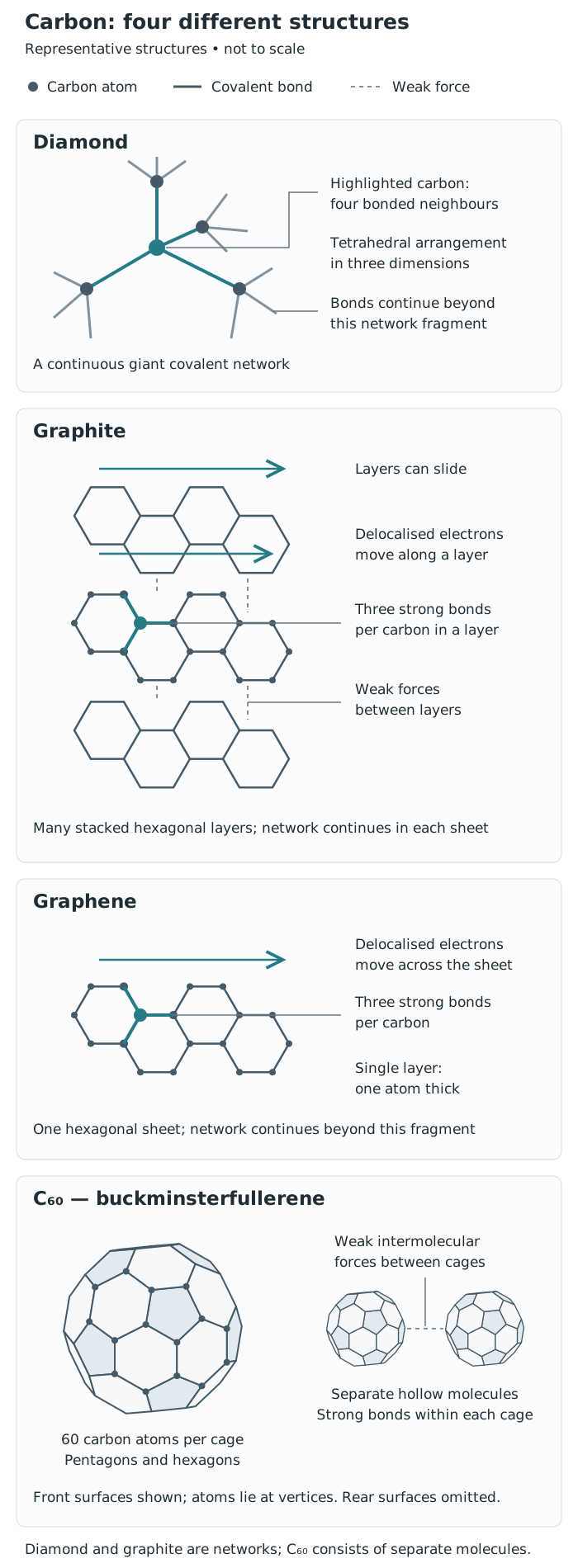
Carbon's properties depend on its bonding arrangement: a three-dimensional network, stacked layers, a single sheet or separate hollow cages. Representative structures, not to scale.
In diamond, each carbon atom forms four covalent bonds with four other carbon atoms. These neighbours are arranged tetrahedrally around it, and the bonding continues throughout a three-dimensional lattice.
The strong bonds hold the atoms firmly in position throughout the structure. This makes diamond extremely hard, so diamond-tipped cutting tools can cut materials such as bricks and concrete. Its usefulness depends on its resistance to being scratched or worn away.
Diamond also has a very high melting point because a large amount of energy is needed to break its many strong covalent bonds. It does not conduct electricity: all four outer electrons of each carbon atom are involved in bonding, so there are no freely moving electrons to carry charge.
In graphite, each carbon atom forms three covalent bonds with other carbon atoms. These bonds produce flat layers of linked hexagons. The covalent bonds within each layer are strong, but the forces between neighbouring layers are weak.
The layers can therefore slide over one another easily. This makes graphite soft and slippery, allowing it to act as a lubricant: a material that reduces friction between moving surfaces. Sliding the layers does not require breaking the strong covalent bonds within them.
Each carbon atom also contributes one electron that is delocalised rather than held in a particular bond. These electrons can move along the layers and carry charge. Graphite therefore conducts electricity and can be used to make electrodes, which carry current into or out of an electrolyte during electrolysis.
Graphite has a very high melting point despite being soft. Melting requires overcoming its strong covalent bonding, whereas its softness comes from the weak forces between layers. These properties depend on different parts of the structure.
Fullerenes are forms of carbon with hollow cage-like or tube-like molecules. Buckminsterfullerene, C₆₀, contains 60 carbon atoms arranged in a hollow, roughly spherical cage. Its pentagons and hexagons give it a football-like shape, with each carbon bonded to three others.
Unlike diamond and graphite, C₆₀ consists of separate molecules. There are strong covalent bonds within each cage but weak intermolecular forces between cages. The rounded molecules can move past one another, making them useful as lubricants.
Although C₆₀ has some delocalised electrons within its molecules, these cannot move freely throughout the bulk material as they can through graphite's layers. C₆₀ therefore conducts electricity poorly.
The hollow cage can enclose other substances, giving fullerenes potential uses as carriers in drug delivery. Their surface also provides places for catalyst particles to attach, making them useful as catalyst supports.
Get unlimited access to all revision notes, key terms, and exam tips.
Both are carbon allotropes and giant covalent substances with very high melting points.
| Substance | Structure and bonding | Property and use |
|---|---|---|
| Diamond | Each carbon bonds to four others in a tetrahedral, three-dimensional network | Very hard → cutting tools; no mobile electrons → does not conduct electricity |
| Graphite | Each carbon bonds to three others in hexagonal layers; weak forces between layers | Layers slide → lubricant; delocalised electrons carry charge → electrodes |
Link structure → property → use: graphite has mobile delocalised electrons, so it conducts electricity and can be used for electrodes.
For graphite, distinguish strong covalent bonds within each layer from weak forces between layers. The layers slide without breaking the covalent bonds.
Diamond is hard, meaning it resists scratching and cutting; this does not mean it cannot shatter.
Do not describe C₆₀ as a giant covalent lattice: it consists of separate molecules. A poly(ethene) chain is also a molecule, although a very large one.
Allotrope
One of two or more different structural forms of the same element.
Covalent bond
A bond formed when atoms share a pair of electrons.
Giant covalent structure
A continuous network of very many atoms joined by strong covalent bonds, rather than separate small molecules.
Delocalised electron
An electron that is not confined to one atom or one covalent bond and can move through part of a structure.
Fullerene
A form of carbon whose molecules have hollow cage-like or tube-like structures.
Graphene
A single layer of carbon atoms, one atom thick, with each atom covalently bonded to three others in a hexagonal network.
Polymer
A very large molecule made from many smaller units joined together by covalent bonds.
Lubricant
A substance that reduces friction between surfaces moving past one another.
Put your knowledge into practice — try past paper questions for Combined Science
Allotrope
One of two or more different structural forms of the same element.
Covalent bond
A bond formed when atoms share a pair of electrons.
Giant covalent structure
A continuous network of very many atoms joined by strong covalent bonds, rather than separate small molecules.
Delocalised electron
An electron that is not confined to one atom or one covalent bond and can move through part of a structure.
Fullerene
A form of carbon whose molecules have hollow cage-like or tube-like structures.
Graphene
A single layer of carbon atoms, one atom thick, with each atom covalently bonded to three others in a hexagonal network.
Polymer
A very large molecule made from many smaller units joined together by covalent bonds.
Lubricant
A substance that reduces friction between surfaces moving past one another.
Graphene is a single layer of graphite, only one atom thick. Each carbon atom is covalently bonded to three others in a hexagonal network.
Its strong carbon–carbon bonds make the sheet extremely strong, while its one-atom thickness makes it very light. These properties make graphene useful for reinforcing composite materials.
Like graphite, graphene has delocalised electrons that can move through its structure, so it conducts electricity. Its thin, flexible sheets have potential uses in electronics, including flexible displays. Graphene also conducts heat well.
The important comparison is that graphite contains many stacked layers, whereas graphene is just one layer. Both have strong bonding within a sheet and mobile electrons.
Carbon atoms can also form long chains. Simple polymers consist of very large molecules containing chains of carbon atoms. Poly(ethene) is an example, made by joining many small ethene molecules together.
In a poly(ethene) molecule, carbon atoms are joined by covalent bonds along the chain, with hydrogen atoms attached to them. A short section can be represented as:
The dots show that the chain continues; an actual molecule contains many more carbon atoms than this short section shows. Each carbon has four bonds in total: two to neighbouring carbon atoms and two to hydrogen atoms within the chain.
A piece of poly(ethene) contains many separate long-chain molecules. This differs from diamond's continuous three-dimensional giant covalent network, and poly(ethene) is not an allotrope of carbon because it contains hydrogen as well as carbon.
Get unlimited access to all revision notes, key terms, and exam tips.