Loading…


Loading…
Loading…
Loading…
Edexcel GCSE Combined Science · 1SC0
Edexcel 1SC0 · Types of substance Types of substance Check the specification (PDF) (opens in a new tab)
Explain the classification of elements and compounds into ionic, simple molecular (covalent), giant covalent, and metallic substances.
Explain how the structure and bonding of these substances dictate their physical properties, including relative melting and boiling points, solubility in water, and electrical conductivity.
Explain the properties of ionic compounds, specifically their high melting and boiling points due to strong forces between ions, and their electrical conductivity behaviour as solids, liquids, and aqueous solutions.
Explain the properties of typical simple molecular covalent compounds, including their low melting and boiling points due to weak intermolecular forces, and their poor electrical conductivity.
Understand that graphite and diamond are distinct forms of carbon and represent examples of giant covalent substances.
Describe the internal atomic structures of both graphite and diamond.
Explain how the structure and bonding of graphite make it suitable for use as electrodes and lubricants, while diamond's structure makes it ideal for cutting tools.
Explain the properties of fullerenes, including C60 and graphene, based on their distinct structures and chemical bonding.
Describe simple polymers, using poly(ethene) as an example, as large molecules consisting of long chains of carbon atoms.
Explain the physical properties of metals, such as malleability and high electrical conductivity, in terms of their structure.
Describe the limitations of various molecular representations and models, including dot and cross diagrams, ball and stick models, and two- and three-dimensional representations.
Describe most metals as shiny solids with high melting points, high density, and good electrical conductivity, contrasting them with non-metals which typically have low boiling points and poor electrical conductivity.
A substance’s structure is the arrangement of its particles. Its bonding describes what holds those particles together. These two ideas help explain why one substance melts easily while another needs intense heating, or why one conducts electricity while another does not.
Two questions are especially useful. For melting and boiling, what attractions must be overcome, and how strong are they? For electrical conduction, are there charged particles that can move through the substance?
Elements contain only one type of atom; compounds contain atoms of different elements chemically combined. This is a different classification from structure type. For example, non-metal elements can form simple molecular or giant covalent substances, while compounds can be ionic or covalent. The four main structure types are ionic, simple molecular, giant covalent and metallic.
Ionic compounds contain positive and negative ions. An ion is an atom or group of atoms with an overall electrical charge. Typical ionic compounds form between metals and non-metals.
In a solid ionic compound, the ions form a giant ionic lattice: a regular, repeating arrangement extending throughout the crystal. Strong electrostatic attractions act between oppositely charged ions in all directions. There are no separate small molecules.
Ionic compounds have high melting and boiling points because a large amount of energy is needed to overcome these strong attractions. This is very different from separating molecules held together by weak forces.
Their electrical conductivity depends on their state:
Many ionic compounds dissolve in water, although not all do. Dissolving separates ions from the lattice and allows them to mix throughout the water. A molten compound is the compound itself in its liquid state; an aqueous solution contains the compound dissolved in water.
A simple molecular substance contains separate small molecules. Within each molecule, atoms are joined by strong covalent bonds, formed by shared pairs of electrons. Between molecules there are much weaker intermolecular forces.
When a simple molecular substance melts or boils, molecules move apart from one another. The intermolecular forces are overcome, but the covalent bonds within the molecules remain intact. Relatively little energy is needed, so these substances typically have low melting and boiling points. Many are gases or liquids at room temperature.
For example, when water boils, water molecules separate from one another: they do not split into hydrogen and oxygen atoms. This shows why strong covalent bonds can exist in a substance with a relatively low boiling point.
Typical simple molecular substances are poor electrical conductors. Their molecules are uncharged, and they have neither mobile ions nor delocalised electrons to carry charge. Being able to move is not enough: the moving particles must also carry electrical charge.
Many simple molecular substances are insoluble in water, but some dissolve because their molecules can form sufficient attractions with water molecules. Carbon dioxide and ammonia are examples that dissolve. Dissolving alone does not guarantee electrical conduction: a solution needs mobile charged particles. Some molecular substances form ions when they interact with water, allowing their solutions to conduct.
In a giant covalent substance, atoms are joined by strong covalent bonds throughout an extended network. This is not a collection of separate small molecules.
These substances have very high melting points because many strong covalent bonds must be broken to disrupt the structure. Large amounts of energy are needed. Diamond and graphite are examples; their detailed structures explain their different properties.
Giant covalent substances are generally insoluble in water. Attractions to water cannot overcome the strong covalent bonding that holds the network together.
Electrical conductivity depends on whether the structure contains mobile charged particles. Diamond does not conduct because it has no delocalised electrons or mobile ions. Graphite does conduct because it has delocalised electrons. ‘Covalent’ therefore does not automatically mean ‘non-conducting’: the particular structure matters.
A metal has a giant structure of closely packed positive metal ions surrounded by delocalised electrons. These electrons come from the outer shells of metal atoms and are not attached to one particular atom. Metallic bonding is the strong electrostatic attraction between the positive ions and the delocalised electrons.
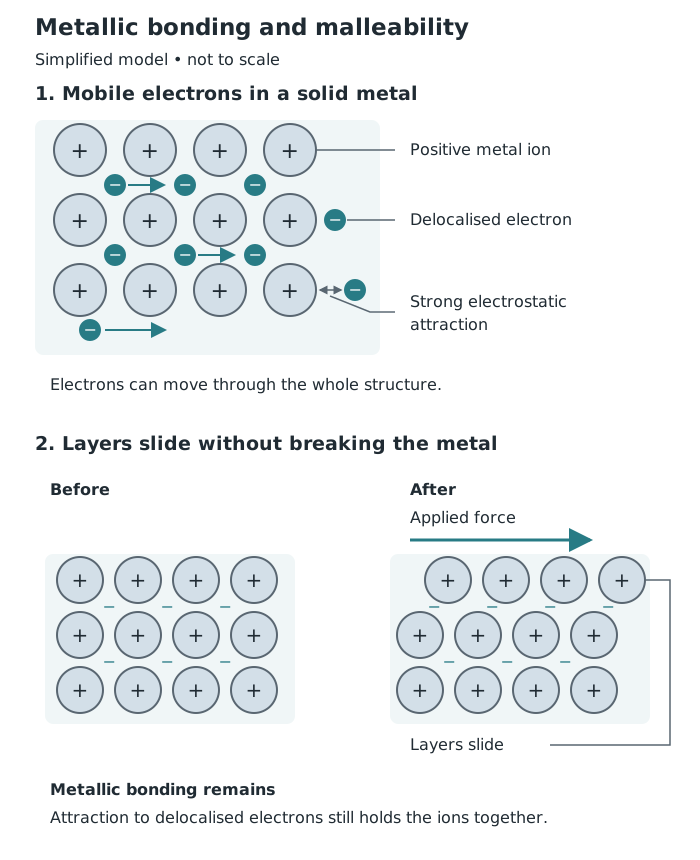
Mobile electrons carry charge; sliding layers allow a metal to change shape while metallic bonding remains.
Most metals have high melting and boiling points because considerable energy is needed to overcome strong metallic bonding. Metals conduct electricity as solids and when molten because their delocalised electrons can move through the structure and carry charge. Unlike a solid ionic compound, a solid metal already has mobile charge carriers.
Metals are malleable: they can be hammered or bent into different shapes without breaking. Layers of metal ions can slide past one another while attraction to the delocalised electrons continues to hold the structure together.
Metals are insoluble in water, although some react with it. Reacting is a chemical change that produces new substances; it is not simply dissolving an unchanged metal.
Most metals are shiny solids at room temperature, have high density and conduct electricity well. High density means a large mass in a given volume. Most non-metals, by contrast, have low boiling points and are poor electrical conductors. These are general patterns, not definitions: solid giant covalent non-metals and conducting graphite show why exceptions matter.
Atoms and electrons are too small to see directly in ordinary classroom observations. Models make selected features understandable, but no single model gives a complete picture.
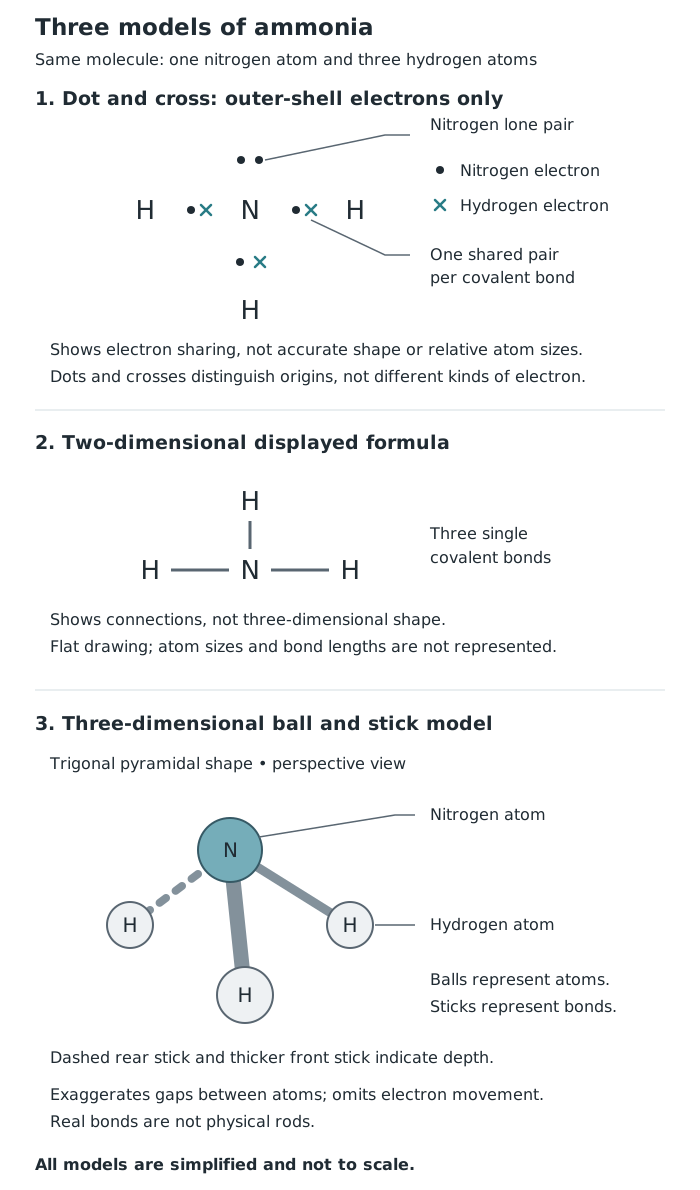
Different models of ammonia reveal electron sharing, atom connections or spatial arrangement—but none shows every feature accurately.
A dot and cross diagram shows electrons involved in bonding. Different symbols indicate which atom the electrons originally came from; they do not mean that there are two kinds of electron. In ammonia, three shared pairs represent three covalent bonds, while nitrogen also has a lone pair. However, this diagram does not show the molecule’s three-dimensional shape or the relative sizes of its atoms accurately.
A two-dimensional displayed formula uses element symbols and lines for covalent bonds. It clearly shows which atoms are joined. For ammonia, it shows one nitrogen atom connected to three hydrogen atoms. It does not accurately show relative atom sizes, bond lengths or the molecule’s three-dimensional shape. A flat drawing should not be taken as evidence that the real molecule is flat.
A three-dimensional ball and stick model helps show the spatial arrangement of atoms and the shape of a molecule. The balls represent atoms and the sticks represent bonds. However, real bonds are not physical rods, and the model exaggerates the gaps between atoms to make connections visible. It also does not show electron movement.
Three-dimensional models can make spatial arrangements clearer than flat diagrams, but they are still simplified and usually static. A small model of a giant structure shows only a fragment, not the whole lattice. Choose a model according to the information needed: electron sharing, connections between atoms, or three-dimensional arrangement.
Get unlimited access to all revision notes, key terms, and exam tips.
| Type | Structure and bonding | Melting and boiling | Electrical conductivity | Water solubility |
|---|---|---|---|---|
| Ionic | Giant lattice; strong attractions between opposite ions | High: much energy needed to overcome attractions | Solid: no. Molten or aqueous: yes, because ions move | Many dissolve; not all |
| Simple molecular | Strong covalent bonds within molecules; weak intermolecular forces between them | Low: only intermolecular forces are overcome | Typically poor: no mobile ions or delocalised electrons | Many insoluble; some soluble |
| Giant covalent | Extended network of strong covalent bonds | Very high: many strong bonds must be broken | Depends on structure: diamond no, graphite yes | Generally insoluble |
| Metallic | Positive ions attracted to delocalised electrons | Usually high: strong metallic bonding | Solid and molten: mobile electrons carry charge | Insoluble; some react with water |
Get unlimited access to all revision notes, key terms, and exam tips.
Link each property to the particles, the forces or bonds between them, and either the energy needed or the ability of charged particles to move.
For ionic conductivity, identify mobile ions—not electrons. State clearly whether the substance is solid, molten or dissolved in water.
For simple molecular melting and boiling, say that intermolecular forces are overcome, not covalent bonds.
Use qualifiers such as ‘most metals’ and ‘many ionic compounds’: these patterns are not universal rules.
When describing a model’s limitation, name the information it cannot show accurately, such as three-dimensional shape, relative sizes or electron movement.
Giant ionic lattice
A large, regular, repeating arrangement of positive and negative ions held together by strong electrostatic attractions.
Ionic bond
A strong electrostatic attraction between oppositely charged ions.
Covalent bond
A bond formed when two atoms share a pair of electrons.
Simple molecular substance
A substance consisting of separate, small molecules, with covalent bonds within each molecule and intermolecular forces between molecules.
Intermolecular force
An attractive force between molecules, rather than a bond joining atoms within a molecule.
Giant covalent structure
An extended network of atoms joined by strong covalent bonds, rather than separate small molecules.
Metallic bond
The strong electrostatic attraction between positive metal ions and delocalised electrons.
Delocalised electron
An electron that is not attached to one particular atom or bond and can move through a structure.
Malleability
The ability of a material to be hammered or bent into a different shape without breaking.
Aqueous solution
A solution in which water is the solvent.
Put your knowledge into practice — try past paper questions for Combined Science
Giant ionic lattice
A large, regular, repeating arrangement of positive and negative ions held together by strong electrostatic attractions.
Ionic bond
A strong electrostatic attraction between oppositely charged ions.
Covalent bond
A bond formed when two atoms share a pair of electrons.
Simple molecular substance
A substance consisting of separate, small molecules, with covalent bonds within each molecule and intermolecular forces between molecules.
Intermolecular force
An attractive force between molecules, rather than a bond joining atoms within a molecule.
Giant covalent structure
An extended network of atoms joined by strong covalent bonds, rather than separate small molecules.
Metallic bond
The strong electrostatic attraction between positive metal ions and delocalised electrons.
Delocalised electron
An electron that is not attached to one particular atom or bond and can move through a structure.
Malleability
The ability of a material to be hammered or bent into a different shape without breaking.
Aqueous solution
A solution in which water is the solvent.