Loading…


Loading…
Loading…
Loading…
Edexcel GCSE Combined Science · 1SC0
Edexcel 1SC0 · Earth and atmospheric science Earth and atmospheric science Check the specification (PDF) (opens in a new tab)
Recall that gases emitted by intense volcanic activity formed the Earth's early atmosphere.
Describe the proposed composition of the Earth's early atmosphere, including a lack of oxygen, high levels of carbon dioxide, water vapour, and trace gases, and interpret relevant geological evidence.
Explain how the cooling of the Earth allowed the condensation of water vapour to form the first oceans.
Explain how atmospheric carbon dioxide levels decreased as it dissolved into the newly formed oceans.
Explain how the emergence and growth of primitive plants reduced atmospheric carbon dioxide and progressively increased oxygen levels through the process of photosynthesis.
Describe the standard chemical test used to identify oxygen gas.
Describe the greenhouse effect as the process where atmospheric gases like carbon dioxide, methane, and water vapour absorb and re-radiate heat from the Earth, thereby warming the planet.
Evaluate the scientific evidence suggesting human activity is responsible for modern climate change, analyzing correlations between fossil fuel consumption and temperature changes while considering measurement uncertainties and historical accuracy.
Describe the gas composition of the Earth's current atmosphere.
Describe the potential climatic impacts of elevated carbon dioxide and methane levels driven by human activities such as fossil fuel combustion and livestock farming.
Evaluate potential mitigation strategies for climate change, considering their scale, associated risks, and broader environmental implications.
The Sun supplies energy to the Earth as electromagnetic radiation. Much of this radiation passes through the atmosphere and is absorbed by the Earth's surface, warming it. The warm surface then emits energy as infrared radiation.
Some outgoing infrared radiation escapes into space. Some is absorbed by greenhouse gases, including carbon dioxide, , methane, , and water vapour, . These gases subsequently release energy by emitting radiation in different directions, including back towards the Earth's surface. This keeps the surface and lower atmosphere warmer than they would otherwise be.
This natural process is the greenhouse effect. It helps maintain temperatures suitable for life. Increasing the concentration of greenhouse gases strengthens this warming process: this is the enhanced greenhouse effect.
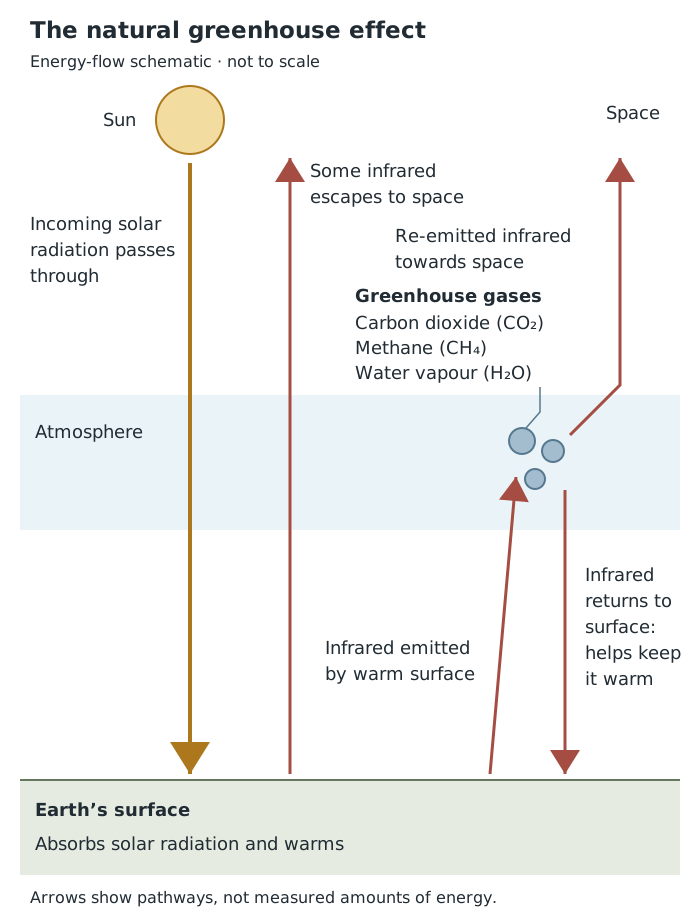
Greenhouse gases absorb some outgoing infrared radiation and re-emit energy in different directions, including towards the Earth's surface.
Burning fossil fuels such as coal, oil and natural gas releases carbon dioxide. This happens in petrol and diesel vehicles and in power stations that burn fossil fuels to generate electricity. Using electricity therefore contributes to carbon dioxide emissions when its generation involves fossil fuel combustion; electricity use itself is not a combustion reaction.
Livestock farming increases methane emissions. Methane is produced during the digestive processes of animals such as cattle. Decomposing organic waste in landfill sites is another source of methane.
Deforestation also contributes to increasing atmospheric carbon dioxide. Trees remove carbon dioxide through photosynthesis, so removing trees reduces this uptake. Together, greater emissions and reduced removal can increase the concentration of greenhouse gases in the atmosphere.
An enhanced greenhouse effect can increase the Earth's average surface temperature: global warming. Climate change is broader than warming alone. It includes long-term changes in weather patterns, such as the distribution of rainfall.
Potential consequences include melting land ice contributing to rising sea levels, increased flooding risk, and changes in water availability. Some regions may face drought and greater difficulty obtaining fresh water. Changing temperatures and rainfall can disrupt ecosystems and make existing farming methods or crops less suitable.
These effects are not identical everywhere. A rise in the global average temperature does not mean that every place warms by the same amount or that every year is warmer than the previous one. The scale of the problem is global, but the risks experienced by particular communities and ecosystems vary.
Since industrialisation, fossil fuel consumption has increased, atmospheric carbon dioxide concentration has risen, and global average temperatures have increased. These linked trends provide evidence for human activity causing modern climate change.
When interpreting graphs, first identify what each axis measures and which period is shown. Then compare the trends over the same period. Increasing fossil fuel consumption alongside increasing carbon dioxide concentration supports a link between combustion and atmospheric change. Increasing carbon dioxide concentration alongside increasing global temperature is a positive correlation.
Correlation alone does not prove causation. Two quantities could change together because of another factor. Here, however, there is also a physical explanation connecting the observations: fossil fuel combustion releases carbon dioxide, and carbon dioxide absorbs infrared radiation emitted by the Earth. The observed trends and the known mechanism together provide stronger evidence than a correlation on its own.
A measurement represents a particular place and time. Temperature records from one location cannot, on their own, establish a change in the global average. A local carbon dioxide measurement may also be influenced by nearby sources. Measurements from many locations are needed to build a more representative picture.
Older records generally cover fewer locations and were collected using less accurate instruments and methods than those available today. This makes comparisons over long periods more uncertain.
Scientists can also investigate past conditions using indirect evidence. Gas bubbles trapped in ice provide evidence about past atmospheric gases, while tree rings and fossil records help scientists estimate past climate conditions. Such records are valuable, but interpreting and dating them introduces uncertainty, and a record from one region may not represent the whole Earth.
A balanced judgement recognises both the evidence and its limitations. Uncertainty affects how precisely scientists can establish past changes or predict future effects; it does not automatically invalidate the combined evidence for a human contribution. Climate models also simplify a complex system, so the exact size and regional pattern of future changes remain uncertain.
The effects of climate change can be reduced by limiting greenhouse gas emissions or increasing carbon dioxide removal. Choosing a response involves considering scale, risk and environmental implications, not just whether it works in principle.
Replacing fossil fuels with wind or solar energy reduces carbon dioxide emissions from electricity generation. This can operate at the scale of individual buildings or national electricity supplies. Manufacturing and constructing the equipment still produces emissions and uses resources, so the environmental comparison should consider the whole system rather than only its operation. Nevertheless, overall emissions are lower than those from fossil fuel generation.
Reducing energy use can reduce the amount of fossil fuel burned. Individual changes have a small effect, but widespread changes across homes, transport and industry can produce a much larger reduction. Because the atmosphere is shared, coordinated action across countries is important.
Planting trees increases carbon dioxide removal through photosynthesis. Its contribution depends on how much planting takes place and how the trees are managed. Large-scale planting also requires decisions about land use, so its wider environmental implications must be considered.
Carbon capture and storage can prevent some carbon dioxide from entering the atmosphere by capturing it and storing it underground. Its potential benefit depends on how widely it can be used. It is expensive, and uncertainty about long-term storage creates a risk: if stored carbon dioxide escapes, the intended benefit is reduced.
Communities can also limit harm through adaptation. Flood defences can reduce local flooding risk, while suitable crops and improved irrigation can help farming cope with changed rainfall. These measures address consequences rather than removing greenhouse gases. They can protect particular places, but they do not replace action to reduce the underlying causes.
Get unlimited access to all revision notes, key terms, and exam tips.
Sunlight warms the surface → the Earth emits infrared radiation → carbon dioxide, methane and water vapour absorb some of it → gases re-emit energy, including towards the surface.
Linked trends: fossil fuel consumption ↑, atmospheric ↑, global average temperature ↑.
Correlation alone does not prove causation; the known greenhouse mechanism strengthens the causal explanation.
Limitations: measurement locations may not represent global conditions; historical records are less precise and geographically limited; indirect records require interpretation.
Get unlimited access to all revision notes, key terms, and exam tips.
Describe greenhouse gases as absorbing and re-emitting infrared radiation from the Earth, not as reflecting heat or blocking sunlight.
For evidence questions, connect all three: fossil fuel consumption, atmospheric carbon dioxide concentration and temperature change.
Evaluate uncertainty specifically: explain why measurement location or the accuracy of historical records affects the conclusion.
When considering a response to climate change, link its benefit to its scale, risks and environmental implications rather than simply calling it ‘good’ or ‘bad’.
Greenhouse gas
An atmospheric gas that absorbs infrared radiation emitted by the Earth and subsequently releases energy. Examples include carbon dioxide, methane and water vapour.
Greenhouse effect
The natural warming of the Earth caused by atmospheric gases absorbing outgoing infrared radiation and re-emitting some energy towards the surface.
Enhanced greenhouse effect
Additional warming caused by increased concentrations of greenhouse gases in the atmosphere.
Global warming
An increase in the Earth's average surface temperature.
Climate change
A long-term change in climate, including average temperatures and patterns of rainfall.
Positive correlation
A relationship in which two measured quantities tend to increase together or decrease together. This alone does not establish that one causes the other.
Mitigation
Action that reduces the causes of climate change, for example by reducing greenhouse gas emissions.
Adaptation
Action that reduces harm from climate change by adjusting to its effects, such as constructing flood defences.
Carbon capture and storage
A process that captures carbon dioxide before it enters the atmosphere, then stores it, for example underground.
Put your knowledge into practice — try past paper questions for Combined Science
Greenhouse gas
An atmospheric gas that absorbs infrared radiation emitted by the Earth and subsequently releases energy. Examples include carbon dioxide, methane and water vapour.
Greenhouse effect
The natural warming of the Earth caused by atmospheric gases absorbing outgoing infrared radiation and re-emitting some energy towards the surface.
Enhanced greenhouse effect
Additional warming caused by increased concentrations of greenhouse gases in the atmosphere.
Global warming
An increase in the Earth's average surface temperature.
Climate change
A long-term change in climate, including average temperatures and patterns of rainfall.
Positive correlation
A relationship in which two measured quantities tend to increase together or decrease together. This alone does not establish that one causes the other.
Mitigation
Action that reduces the causes of climate change, for example by reducing greenhouse gas emissions.
Adaptation
Action that reduces harm from climate change by adjusting to its effects, such as constructing flood defences.
Carbon capture and storage
A process that captures carbon dioxide before it enters the atmosphere, then stores it, for example underground.