Loading…


Loading…
Loading…
Loading…
Edexcel GCSE Combined Science · 1SC0
Edexcel 1SC0 · Earth and atmospheric science Earth and atmospheric science Check the specification (PDF) (opens in a new tab)
Recall that gases emitted by intense volcanic activity formed the Earth's early atmosphere.
Describe the proposed composition of the Earth's early atmosphere, including a lack of oxygen, high levels of carbon dioxide, water vapour, and trace gases, and interpret relevant geological evidence.
Explain how the cooling of the Earth allowed the condensation of water vapour to form the first oceans.
Explain how atmospheric carbon dioxide levels decreased as it dissolved into the newly formed oceans.
Explain how the emergence and growth of primitive plants reduced atmospheric carbon dioxide and progressively increased oxygen levels through the process of photosynthesis.
Describe the standard chemical test used to identify oxygen gas.
Describe the greenhouse effect as the process where atmospheric gases like carbon dioxide, methane, and water vapour absorb and re-radiate heat from the Earth, thereby warming the planet.
Evaluate the scientific evidence suggesting human activity is responsible for modern climate change, analyzing correlations between fossil fuel consumption and temperature changes while considering measurement uncertainties and historical accuracy.
Describe the gas composition of the Earth's current atmosphere.
Describe the potential climatic impacts of elevated carbon dioxide and methane levels driven by human activities such as fossil fuel combustion and livestock farming.
Evaluate potential mitigation strategies for climate change, considering their scale, associated risks, and broader environmental implications.
The atmosphere is the mixture of gases surrounding the Earth. It has not always had the composition we breathe today. During the Earth’s early history, intense volcanic activity released gases from its interior. These gases formed the early atmosphere.
Scientists think this atmosphere contained a large amount of carbon dioxide and water vapour, with little or no oxygen. There were also smaller amounts of other gases, including nitrogen, and possibly methane and ammonia. Nitrogen gradually built up in the atmosphere.
This early mixture would not have supported animals that depend on oxygen for respiration. The appearance of an oxygen-rich atmosphere required major changes involving both the cooling Earth and living organisms.
There are no direct measurements of the Earth’s earliest atmosphere, so its composition must be inferred from evidence. Volcanoes release gases from inside the Earth, supporting the explanation that volcanic activity supplied the early atmosphere. The carbon-dioxide-rich atmospheres of Mars and Venus also provide useful comparisons, although they do not prove that the Earth had exactly the same atmosphere.
Minerals in ancient rocks provide another line of evidence. Their chemical composition helps scientists work out which gases were present when the minerals formed. To interpret this kind of evidence, connect the conditions needed to form a mineral with what its presence suggests about the atmosphere at that time.
These are indirect clues rather than samples of the whole early atmosphere. Several lines of evidence can support a proposed composition, but they do not establish exact percentages of every gas. This is why the early atmosphere is described as thought to contain these gases.
While the Earth was very hot, water remained in the atmosphere as water vapour. As the Earth cooled sufficiently, the vapour condensed: it changed from a gas into liquid water. Water fell to the surface and accumulated to form oceans.
The state symbols show the change clearly: means gas and means liquid. The substance remained water; condensation was a physical change, not the production of a new substance.
The new oceans also changed the atmosphere. Carbon dioxide is soluble in water, so some atmospheric carbon dioxide dissolved in the oceans. It moved from the atmosphere into the water, decreasing the amount left in the air. Carbonate substances also precipitated from the water, forming solid sediments and storing carbon outside the atmosphere.
Primitive plants and algae began to carry out photosynthesis. Using light energy, they took in carbon dioxide and water to make glucose, releasing oxygen.
The balanced symbol equation is:
Carbon dioxide is a reactant, so photosynthesis removes it. Oxygen is a product, so photosynthesis releases it. As primitive plants and algae grew and spread, these processes gradually reduced atmospheric carbon dioxide and increased atmospheric oxygen. This happened over a very long period, rather than in one sudden change, and eventually allowed oxygen-dependent animals to evolve.
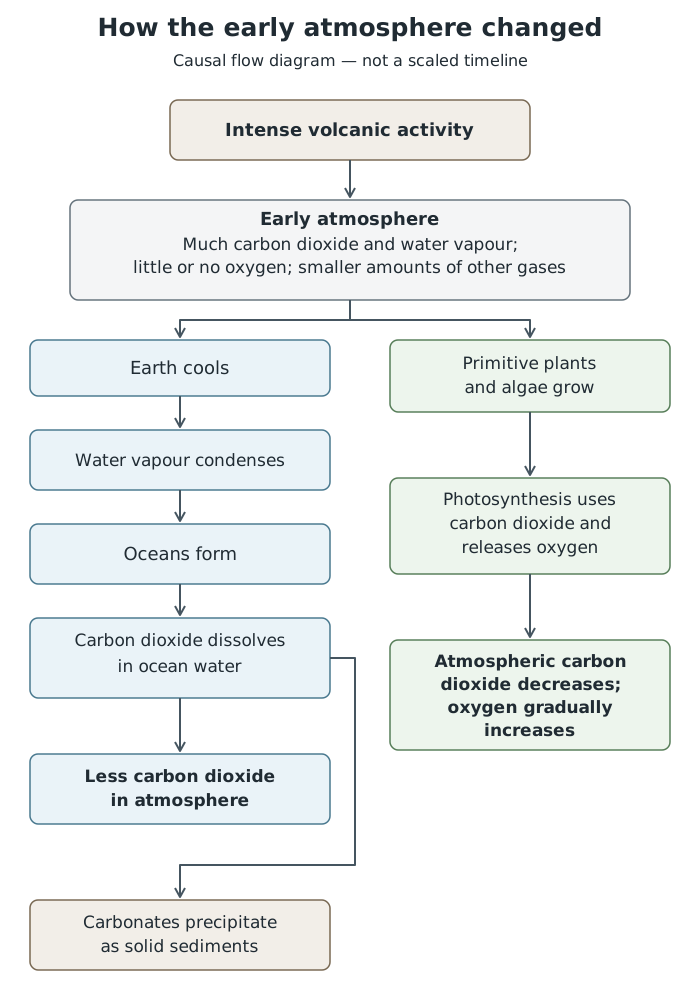
Ocean formation removed carbon dioxide from the atmosphere; photosynthesis removed carbon dioxide and released oxygen.
Two different processes therefore reduced carbon dioxide: dissolving in the oceans and its use in photosynthesis. Of these, photosynthesis also supplied oxygen.
Oxygen is identified using a glowing splint. Light a wooden splint, then blow out the flame so that its tip is still glowing. Insert the glowing tip into a test tube containing the gas.
If the gas is oxygen, the glowing splint relights. The starting condition matters: the splint is glowing, not already burning with a flame.
Today’s atmosphere is mainly nitrogen and oxygen. The approximate composition of dry air is:
| Gas | Approximate percentage |
|---|---|
| Nitrogen | 78% |
| Oxygen | 21% |
| Argon | 0.9% |
| Carbon dioxide | 0.04% |
There are also very small amounts of other gases. Air contains a variable amount of water vapour, so water vapour does not have one fixed percentage.
The contrast with the early atmosphere is substantial: carbon dioxide is now only a small proportion, while oxygen makes up about one fifth of the air. Ocean formation and photosynthesis help explain this change.
Get unlimited access to all revision notes, key terms, and exam tips.
Insert a glowing splint into the gas. It relights in oxygen.
Dry air: approximately 78% nitrogen, 21% oxygen, 0.9% argon and 0.04% carbon dioxide. Water vapour varies; other gases occur in very small amounts.
Get unlimited access to all revision notes, key terms, and exam tips.
For the oxygen test, state both the method and the positive result: insert a glowing splint into the gas; the splint relights.
Distinguish condensation from dissolving: water vapour condenses to form liquid water, then carbon dioxide dissolves in that water.
Link photosynthesis to both changes in atmospheric composition: carbon dioxide is used up and oxygen is released.
When interpreting evidence about the early atmosphere, explain what the observation supports rather than claiming it proves the exact composition.
Atmosphere
The mixture of gases surrounding the Earth.
Water vapour
Water in its gaseous state.
Condensation
The change of state from a gas to a liquid.
Dissolving
The process in which a substance mixes into a liquid to form a solution.
Precipitation
The formation of an insoluble solid from a solution.
Photosynthesis
The process by which plants and algae use light energy to convert carbon dioxide and water into glucose, releasing oxygen.
Put your knowledge into practice — try past paper questions for Combined Science
Atmosphere
The mixture of gases surrounding the Earth.
Water vapour
Water in its gaseous state.
Condensation
The change of state from a gas to a liquid.
Dissolving
The process in which a substance mixes into a liquid to form a solution.
Precipitation
The formation of an insoluble solid from a solution.
Photosynthesis
The process by which plants and algae use light energy to convert carbon dioxide and water into glucose, releasing oxygen.