Loading…


Loading…
Loading…
Loading…
Edexcel GCSE Combined Science · 1SC0
Edexcel 1SC0 · Obtaining and using metals Obtaining and using metals Check the specification (PDF) (opens in a new tab)
Deduce the relative reactivity of various metals by observing their reactions with water, acids, and salt solutions.
Explain displacement reactions as redox reactions, specifically detailing the gain and loss of electrons.
Explain the reactivity series of metals in terms of their tendency to form cations when reacting with water and dilute acids.
Recall that most metals are extracted from ores found in the Earth's crust, whereas unreactive metals exist as uncombined elements.
Explain oxidation as the gain of oxygen and reduction as the loss of oxygen in a chemical context.
Recall that the extraction of metals from their ores inherently involves reduction processes.
Explain how a metal's position in the reactivity series and extraction costs determine its extraction method, comparing heating with carbon to electrolysis.
Evaluate alternative biological methods for metal extraction, specifically bacterial extraction and phytoextraction.
Explain the relationship between a metal's position in the reactivity series and its relative resistance to oxidation.
Evaluate the economic and environmental advantages of recycling metals, including the preservation of raw materials.
Describe the purpose and stages of a life-cycle assessment for a product, from raw material extraction to final disposal.
Evaluate provided data from a life-cycle assessment to determine the environmental impact of a product.
Metals do not all react equally readily. Potassium reacts violently with water, whereas copper does not react with cold water. Comparing reactions allows us to arrange metals in a reactivity series.
When metals react with water or dilute acids, their atoms form positive ions called cations. A neutral atom becomes positively charged when it loses negatively charged electrons. The more reactive a metal is, the more readily its atoms lose electrons and form cations.
The required order, from most reactive to least reactive, is:
Potassium → sodium → calcium → magnesium → aluminium → (carbon) → zinc → iron → (hydrogen) → copper → silver → gold
Carbon and hydrogen are non-metals included as useful reference points. Hydrogen helps us predict which metals react with dilute acids; carbon is useful when considering metal extraction.
Potassium, sodium and calcium react with cold water to produce a metal hydroxide and hydrogen. Their different reactions reveal their relative reactivity: potassium reacts violently, sodium reacts quickly, and calcium reacts less strongly.
For calcium, the reaction is:
The bubbles are hydrogen gas. The calcium atoms become calcium ions as calcium hydroxide forms.
Magnesium, zinc and iron react very slowly, if at all, with cold water under ordinary classroom conditions. Cold water therefore does not give an obvious comparison between every metal. Another reaction, such as a reaction with dilute acid or a salt solution, can provide the evidence needed.
Metals above hydrogen in the series react with dilute hydrochloric acid or dilute sulfuric acid to form a salt and hydrogen:
metal + acid → salt + hydrogen
For example:
Here magnesium chloride is the salt. With dilute sulfuric acid, magnesium sulfate forms instead:
Under comparable conditions, magnesium reacts more vigorously than zinc, and zinc reacts more vigorously than iron. Faster production of hydrogen bubbles is evidence of greater reactivity. Copper is below hydrogen and does not react with these dilute acids to release hydrogen.
A useful comparison keeps the acid concentration and temperature the same and uses metal samples with comparable exposed surface areas. Otherwise, a difference in bubbling could result from the conditions rather than the metal's reactivity. Potassium and sodium react dangerously with acids and are not suitable for this comparison.
A more reactive metal displaces a less reactive metal from a solution of its salt. The added metal enters the solution as ions, while ions of the less reactive metal become solid metal.
For example, magnesium displaces copper from copper sulfate solution:
The blue colour of the copper sulfate solution fades as colourless magnesium sulfate solution forms. Copper coats the magnesium, and some copper may fall to the bottom of the container. These changes show that magnesium is more reactive than copper.
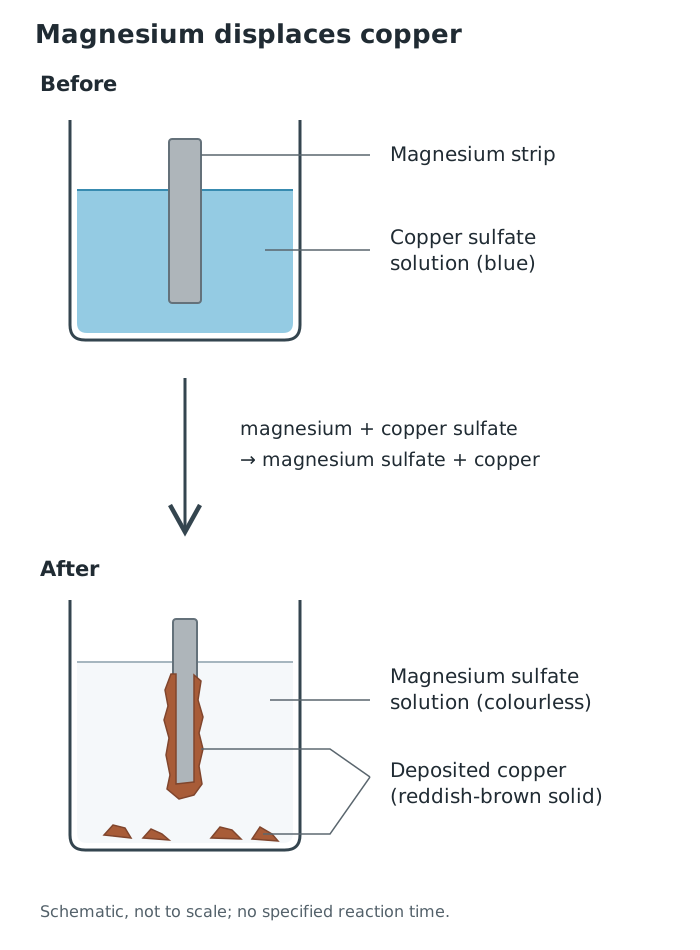
Magnesium displaces copper: the blue solution fades and solid copper forms.
Several comparisons can be combined to build an order. Magnesium displaces iron from iron(II) sulfate solution, so magnesium is more reactive than iron. Iron displaces copper from copper(II) sulfate solution, so iron is more reactive than copper. Together, these observations give:
magnesium > iron > copper
A less reactive metal cannot displace a more reactive one. For example, copper does not displace calcium from calcium chloride solution. This tells us that copper is less reactive than calcium, although that comparison alone cannot tell us where every other metal belongs.
Displacement is not simply one metal taking another metal's place. It involves a transfer of electrons. Oxidation is loss of electrons, and reduction is gain of electrons. Both happen together in a redox reaction.
In the magnesium–copper sulfate reaction, magnesium atoms lose two electrons each and become magnesium ions:
Magnesium is therefore oxidised. Copper ions gain those electrons and become copper atoms:
The copper ions are therefore reduced. The same two electrons lost by magnesium are gained by copper ions.
Combining these half-equations gives the ionic equation:
Sulfate ions remain unchanged in solution, so they do not appear in this ionic equation. Magnesium's greater tendency to form cations explains why it can displace copper.
A metal high in the reactivity series loses electrons readily, so it is readily oxidised. A metal low in the series loses electrons less readily, so it is more resistant to oxidation.
This is the same underlying pattern viewed in two ways: greater reactivity means a greater tendency to form cations and less resistance to oxidation. Gold, near the bottom of the series, is much more resistant to oxidation than a reactive metal such as magnesium.
Get unlimited access to all revision notes, key terms, and exam tips.
Most → least reactive:
K → Na → Ca → Mg → Al → (C) → Zn → Fe → (H) → Cu → Ag → Au
Higher in the series: forms cations more readily; oxidises more readily; is less resistant to oxidation.
Oxidation = electron loss; reduction = electron gain.
In a metal displacement reaction, the added metal is oxidised and the displaced metal ions are reduced. Both changes occur together.
Get unlimited access to all revision notes, key terms, and exam tips.
When deducing an order, link each comparison to an observation: for example, magnesium displaces iron, so magnesium is more reactive than iron.
A lack of reaction with cold water does not prove that a metal is unreactive: zinc and iron react with dilute acids.
Carbon and hydrogen are reference points in the series, not metals.
For Higher Tier redox explanations, identify the particles precisely: metal atoms lose electrons, while the displaced metal ions gain electrons.
Check both atoms and total charge in a half-equation. Electrons appear on the right for oxidation and on the left for reduction.
Reactivity series
An arrangement of metals in order of their reactivity, from most reactive to least reactive.
Cation
A positively charged ion. A metal atom forms a cation by losing electrons.
Displacement reaction
A reaction in which a more reactive element replaces a less reactive element in a compound.
Oxidation
Loss of electrons by an atom or ion.
Reduction
Gain of electrons by an atom or ion.
Redox reaction
A reaction in which oxidation and reduction occur together, with electrons transferred between reacting particles.
Put your knowledge into practice — try past paper questions for Combined Science
Reactivity series
An arrangement of metals in order of their reactivity, from most reactive to least reactive.
Cation
A positively charged ion. A metal atom forms a cation by losing electrons.
Displacement reaction
A reaction in which a more reactive element replaces a less reactive element in a compound.
Oxidation
Loss of electrons by an atom or ion.
Reduction
Gain of electrons by an atom or ion.
Redox reaction
A reaction in which oxidation and reduction occur together, with electrons transferred between reacting particles.