Loading…


Loading…
Loading…
Loading…
Edexcel GCSE Combined Science · 1SC0
Edexcel 1SC0 · Acids Acids Check the specification (PDF) (opens in a new tab)
Recall that acids in solution provide hydrogen ions, while alkalis in solution provide hydroxide ions.
Recall that neutral solutions have a pH of 7, acidic solutions have pH values below 7, and alkaline solutions have pH values above 7.
Recall the specific colour changes of indicators, including litmus, methyl orange, and phenolphthalein, when exposed to acids and alkalis.
Understand the inverse relationship between hydrogen ion concentration and pH in acidic solutions, and the direct relationship between hydroxide ion concentration and pH in alkaline solutions.
Recall that a tenfold increase in hydrogen ion concentration corresponds to a decrease of 1 on the pH scale.
Investigate the change in pH when adding powdered calcium hydroxide or calcium oxide to a fixed volume of dilute hydrochloric acid.
Explain the terms dilute and concentrated concerning the amount of solute in a solution.
Explain the difference between weak and strong acids based on their degree of dissociation into ions in solution.
Understand that a base is a substance that reacts with an acid to produce only a salt and water.
Recall that alkalis are defined as soluble bases.
Explain the general reactions of aqueous acids with metals, metal oxides, metal hydroxides, and metal carbonates to produce specific salts.
Describe the standard chemical tests for hydrogen gas and carbon dioxide gas (using limewater).
Describe a neutralisation reaction as the chemical interaction between an acid and a base.
Explain acid-alkali neutralisation as the reaction where hydrogen ions from the acid combine with hydroxide ions from the alkali to form water.
Explain the steps and reasoning for preparing soluble salts from an acid and an insoluble reactant, including adding excess reactant, removing the excess, and isolating the salt and water.
Explain the steps and reasoning for preparing soluble salts from an acid and a soluble reactant using titration methods.
Investigate the preparation of pure, dry hydrated copper sulfate crystals from copper oxide, utilizing a water bath.
Describe the procedure for conducting an acid-alkali titration using a burette, pipette, and indicator to prepare a pure, dry salt.
Recall the general solubility rules for common substances in water, covering sodium, potassium, ammonium salts, nitrates, chlorides, sulfates, carbonates, and hydroxides.
Predict the formation of a precipitate when specific solutions are mixed, using solubility rules, and identify the resulting precipitate.
Describe the experimental method required to prepare a pure, dry sample of an insoluble salt.
A soluble substance dissolves in water to form a solution. An insoluble substance does not dissolve to an appreciable extent. This distinction determines how we can make and separate different salts.
Salts are ionic compounds containing positive and negative ions. When a soluble salt dissolves, its ions become dispersed through the water. For example, sodium chloride solution contains sodium ions and chloride ions. The salt has not disappeared: its ions are still present, even though we cannot see them individually.
When two solutions are mixed, some of their ions may combine to form an insoluble compound. This appears as a solid called a precipitate. The solubility rules allow us to predict whether this will happen.
The following rules apply to common substances in water. Check both parts of a compound’s name: sodium carbonate, for example, is soluble because it is a sodium salt, despite most carbonates being insoluble.
| Type of substance | Soluble | Insoluble |
|---|---|---|
| Sodium salts | All common sodium salts | None of the common salts |
| Potassium salts | All common potassium salts | None of the common salts |
| Ammonium salts | All common ammonium salts | None of the common salts |
| Nitrates | All nitrates | None |
| Chlorides | Common chlorides except silver and lead chlorides | Silver and lead chlorides |
| Sulfates | Common sulfates except lead, barium and calcium sulfates | Lead, barium and calcium sulfates |
| Carbonates | Sodium, potassium and ammonium carbonates | Other common carbonates |
| Hydroxides | Sodium, potassium and ammonium hydroxides | Other common hydroxides |
The hydroxide rule is a general classification: calcium hydroxide is slightly soluble, so a small amount can dissolve in water.
These rules also help us choose starting solutions. If we need silver ions, silver nitrate is suitable because all nitrates are soluble. If we need chloride ions, sodium chloride is suitable because all common sodium salts are soluble.
To predict what happens when two salt solutions are mixed, identify the positive and negative ions supplied by each solution. Consider the new combinations of positive and negative ions, then check each possible product against the solubility rules. An insoluble product forms a precipitate; soluble substances remain dissolved.
For example, mixing silver nitrate solution with sodium chloride solution gives silver chloride and sodium nitrate:
Silver chloride is one of the insoluble chloride exceptions, so silver chloride is the precipitate. Sodium nitrate stays dissolved because all nitrates are soluble.
The balanced symbol equation makes this distinction clear:
Here, means dissolved in water and means solid. Silver ions and chloride ions form the solid, while sodium ions and nitrate ions remain in solution.
Mixing two solutions does not always produce a precipitate. Consider sodium chloride solution and potassium nitrate solution. The alternative pairings are sodium nitrate and potassium chloride. Both are soluble, so the ions remain dissolved and no precipitate forms.
An insoluble salt can be made by precipitation, then separated from the liquid. To prepare silver chloride, use silver nitrate solution to supply silver ions and sodium chloride solution to supply chloride ions.
The apparatus needed includes a beaker, a stirring rod, a filter funnel and filter paper, a vessel to collect the filtrate, and distilled water for washing. Wear eye protection when handling the solutions.
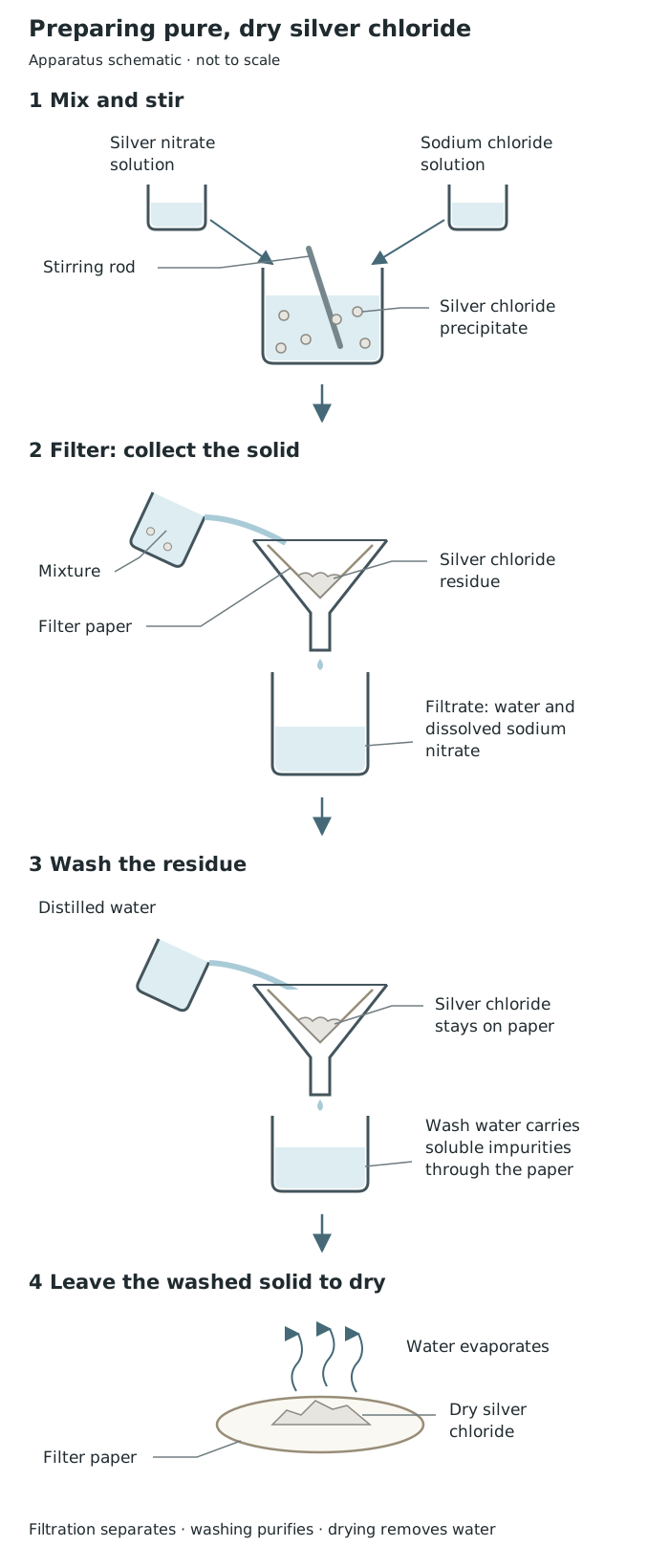
The insoluble salt is collected on the filter paper, washed to remove soluble impurities, then dried.
Filtration, washing and drying do different jobs. Filtration separates the solid from the solution; washing makes it purer by removing soluble contamination; drying removes the remaining water. There is no need to evaporate the whole reaction mixture to obtain the salt: the desired product is already a solid.
Get unlimited access to all revision notes, key terms, and exam tips.
Identify the ions → consider the new pairings → check solubility → name any insoluble product.
An insoluble product forms a precipitate. If all possible products are soluble, no precipitate forms.
Mix → filter → wash with distilled water → dry.
Get unlimited access to all revision notes, key terms, and exam tips.
Name the insoluble product as the precipitate, not either of the starting salts.
Learn the exceptions carefully: silver and lead chlorides; lead, barium and calcium sulfates.
In this preparation, keep the residue on the filter paper. The desired salt is insoluble.
Explain the separate purposes of washing and drying: washing removes soluble impurities; drying removes water.
Aqueous solution
A mixture in which a substance is dissolved in water, shown by the state symbol in a chemical equation.
Precipitate
A solid formed in a solution during a chemical reaction because the product is insoluble.
Precipitation reaction
A reaction in which dissolved substances react to form an insoluble solid.
Filtration
A method of separating an insoluble solid from a liquid using a filter.
Residue
The solid left on the filter paper during filtration.
Filtrate
The liquid that passes through the filter paper during filtration.
Put your knowledge into practice — try past paper questions for Combined Science
Aqueous solution
A mixture in which a substance is dissolved in water, shown by the state symbol in a chemical equation.
Precipitate
A solid formed in a solution during a chemical reaction because the product is insoluble.
Precipitation reaction
A reaction in which dissolved substances react to form an insoluble solid.
Filtration
A method of separating an insoluble solid from a liquid using a filter.
Residue
The solid left on the filter paper during filtration.
Filtrate
The liquid that passes through the filter paper during filtration.