Loading…


Loading…
Loading…
Loading…
Edexcel GCSE Combined Science · 1SC0
Edexcel 1SC0 · Medicines and Non-Communicable Diseases Check the specification (PDF) (opens in a new tab)
A medicine is a substance used to treat disease or relieve symptoms. Discovering a chemical with a useful effect is only the beginning: researchers must develop it and test whether it works, whether it causes harm and what dose should be used. This multi-stage process applies to new medicines, including antibiotics.
Traditionally, many drugs were obtained from plants and microorganisms. These organisms produce chemicals that can have useful effects in the human body. For example, digitalis originated from foxgloves and helps strengthen the heartbeat. Aspirin was developed from chemicals found in willow bark; it relieves pain and reduces fever and inflammation.
The discovery of the antibiotic penicillin shows how an observation can reveal a potential medicine. In 1928, Alexander Fleming noticed that bacteria did not grow near a Penicillium mould contaminating a Petri dish. The mould released penicillin, which killed surrounding bacteria. This suggested that the chemical could be useful against bacterial infections, but discovering its effect did not by itself make it ready for use as a medicine.
Today, scientists at universities and pharmaceutical companies search for new medicines. Most new drugs are synthesised—made through chemical reactions—by chemists, although a chemical from a plant or microorganism may still provide the starting point. Researchers develop promising candidates for further testing. One continuing aim is to find antibiotics that work against bacteria resistant to existing treatments.
Testing addresses three connected questions:
An effective drug is not necessarily a safe one. Researchers therefore seek an optimum dose, balancing benefit against harm and identifying the lowest dose that is effective.
Preclinical testing takes place before a potential medicine is tested in humans. Laboratory tests use cells and tissues to investigate useful effects and toxicity.
Testing on live animals then allows researchers to examine effects in a whole organism rather than only in isolated cells or tissues. These tests investigate efficacy, toxicity and suitable doses. Evidence from preclinical testing helps researchers decide whether the candidate is suitable to progress to human trials.
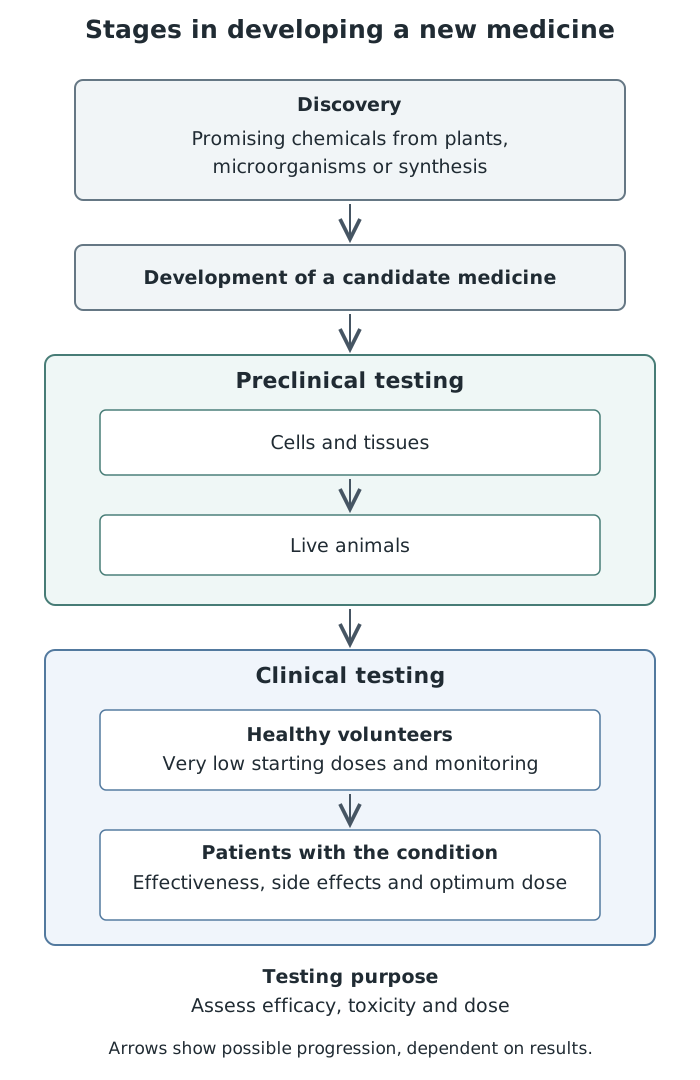
Testing progresses from laboratory studies to human trials, checking benefit, harmful effects and suitable doses.
Clinical trials test potential medicines in humans. Trials generally begin with healthy volunteers, using very low doses to reduce the risk of harmful effects. Researchers monitor the volunteers, and doses can be increased cautiously if the initial results indicate that this is safe.
Further trials involve patients who have the condition the medicine is intended to treat. Researchers investigate whether it works against that condition, monitor side effects and compare doses to establish an optimum dose. Safety testing therefore continues: it is not something checked once and then forgotten.
In some patient trials, one group receives the active drug and another receives a placebo, a treatment containing no active drug. Comparing the groups helps researchers judge whether the active drug provides a benefit beyond changes seen without it.
For example, an improvement in patients receiving a new painkiller is not enough on its own to demonstrate efficacy. Researchers need to compare their improvement with that of the placebo group.
In a double-blind trial, neither the patients nor the doctors assessing them know which treatment each patient receives during the trial. This reduces the influence of expectations on patients' reports and doctors' assessments, helping to reduce bias.
Research findings are peer-reviewed by other scientists before publication in scientific journals. This provides a check on how the research and its results are reported. Developing a medicine therefore involves more than finding a useful chemical: it requires evidence gathered and scrutinised across several stages.
Get unlimited access to all revision notes, key terms, and exam tips.
Get unlimited access to all revision notes, key terms, and exam tips.
Describe the stages in order: discovery and development, preclinical testing, then clinical testing.
For preclinical testing, name cells, tissues and live animals; for clinical testing, name healthy volunteers and patients.
Explain why very low doses are used initially: to reduce the risk of harmful effects.
A placebo comparison and a double-blind trial are different features: the placebo provides a comparison, while double blinding reduces bias.
Medicine
A substance used to treat a disease or relieve its symptoms.
Toxicity
How harmful a substance is to cells or an organism.
Efficacy
How effectively a treatment produces its intended effect.
Dose
The amount of a medicine given at one time.
Preclinical testing
Testing a potential medicine on cells, tissues and animals before testing it in humans.
Clinical trial
A study that tests a potential treatment in human volunteers or patients.
Placebo
A treatment containing no active drug, used as a comparison in a clinical trial.
Double-blind trial
A trial in which neither the participants nor the doctors assessing them know who receives the active drug and who receives the placebo during the trial.
Peer review
Evaluation of research by other scientists before it is published.
Put your knowledge into practice — try past paper questions for Combined Science
Medicine
A substance used to treat a disease or relieve its symptoms.
Toxicity
How harmful a substance is to cells or an organism.
Efficacy
How effectively a treatment produces its intended effect.
Dose
The amount of a medicine given at one time.
Preclinical testing
Testing a potential medicine on cells, tissues and animals before testing it in humans.
Clinical trial
A study that tests a potential treatment in human volunteers or patients.
Placebo
A treatment containing no active drug, used as a comparison in a clinical trial.
Double-blind trial
A trial in which neither the participants nor the doctors assessing them know who receives the active drug and who receives the placebo during the trial.
Peer review
Evaluation of research by other scientists before it is published.