Loading…


Loading…
Loading…
Loading…
Edexcel GCSE Combined Science · 1SC0
Edexcel 1SC0 · Menstrual Cycle and Assisted Reproductive Technology Check the specification (PDF) (opens in a new tab)
Pregnancy normally begins after sperm fertilises an egg and the resulting embryo implants in the lining of the uterus. Contraception prevents pregnancy by interrupting this process. Fertility treatments have the opposite purpose: they help people who have difficulty conceiving.
Hormonal methods change the signals controlling reproduction. Barrier methods instead physically prevent sperm from reaching an egg.
The menstrual cycle is controlled by hormones. FSH encourages an egg to mature in an ovary, while a rise in LH triggers ovulation, the release of the egg. Oestrogen and progesterone help regulate these signals.
The combined contraceptive pill contains oestrogen and a progestogen, which acts like progesterone. These hormones prevent an egg from developing and being released, so there is normally no egg available for fertilisation. This changes the normal menstrual cycle rather than physically blocking sperm.
Other hormonal methods include the progestogen-only pill, implant, injection and intrauterine system (IUS). Progestogen can thicken the mucus at the cervix, making it difficult for sperm to enter the uterus. It can also thin the uterine lining; some methods suppress ovulation too. The exact combination of effects depends on the method, so not every hormonal contraceptive works in precisely the same way.
An implant releases hormone from a small device beneath the skin. An injection delivers hormone that acts over an extended period. An IUS is fitted inside the uterus and releases progestogen. These methods avoid having to remember a pill every day. An IUS is hormonal, whereas a copper IUD is not.
An external condom is a sheath worn over the penis. It collects semen, preventing sperm from entering the vagina. An internal condom is placed inside the vagina and forms a barrier to sperm. Condoms also help protect against sexually transmitted infections (STIs), an important advantage that hormonal contraception does not provide.
A diaphragm or cap covers the cervix, preventing sperm from entering the uterus. It is used with spermicide, a substance that kills sperm. Barrier methods do not alter the hormonal control of the menstrual cycle: ovulation can still occur, but sperm are prevented from reaching the egg.
Perfect use means using a method correctly every time. Typical use includes everyday mistakes, such as forgetting a pill or a condom slipping off. This distinction explains why a method can work very well biologically but be less effective in everyday life.
The figures below describe pregnancy prevention over the first year of use.
| Method | Typical-use effectiveness | Perfect-use effectiveness | Important practical comparison |
|---|---|---|---|
| Implant or hormonal IUS | Over 99% | Over 99% | Does not require daily remembering, but needs fitting and removal. |
| Injection | 94% | Over 99% | No daily pill, but repeat injections must be received on time. |
| Combined or progestogen-only pill | 91% | Over 99% | Effective with correct use, but missed pills reduce protection. |
| External condom | 82% | 98% | Hormone-free and helps protect against STIs, but must be used correctly each time. |
| Internal condom | 79% | 95% | Hormone-free and helps protect against STIs, but correct use matters. |
| Diaphragm or cap | Not established | Estimated 92–96% | Hormone-free, but requires correct positioning and spermicide. |
For example, 91% effectiveness means that about 9 out of every 100 users experience an unintended pregnancy within a year. It does not mean the method fails in 9% of acts of intercourse.
Evaluation means weighing these differences against a person's needs. An implant may be preferable when reliable pregnancy prevention without daily remembering is the priority. A condom has the additional advantage of STI protection. Using a condom alongside a hormonal method can address both needs; there is no single method that is best in every situation.
Infertility can have several causes. One is insufficient reproductive hormone stimulation, so eggs do not mature or are not released regularly. Assisted reproductive technology (ART) uses medical treatments to help people conceive.
Clomifene is a fertility drug that causes more FSH and LH to be released. FSH stimulates egg maturation, and LH stimulates ovulation. If an egg is released, fertilisation may then occur inside the body following intercourse.
Clomifene therefore encourages the egg maturation and ovulation that the combined contraceptive pill prevents. It does not guarantee pregnancy, and stimulating the ovaries can cause several eggs to be released, increasing the chance of a multiple pregnancy.
In vitro fertilisation (IVF) involves fertilisation outside the body. It can help when fertilisation is difficult to achieve naturally, including some problems affecting either partner's fertility.
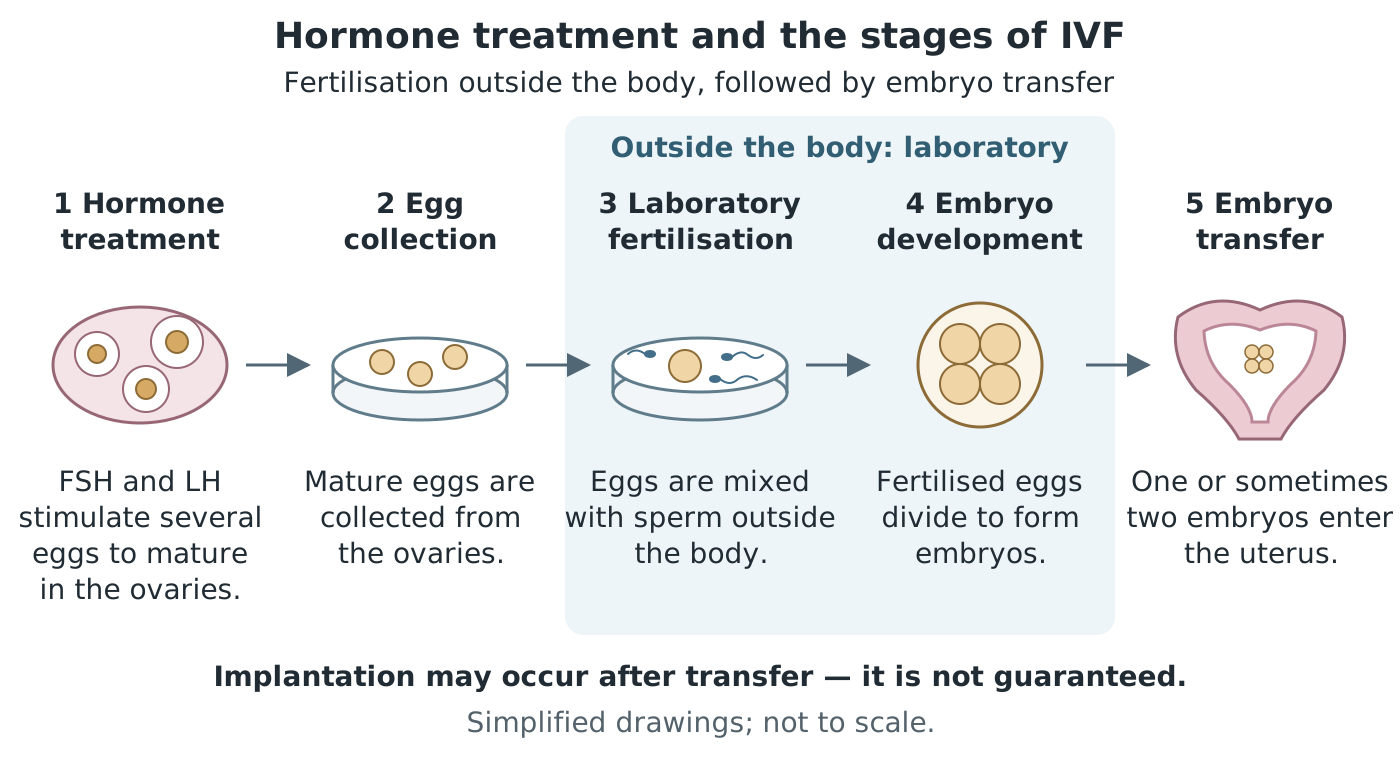
IVF separates fertilisation in the laboratory from embryo transfer into the uterus; implantation is needed for pregnancy to develop.
Stimulating several eggs provides more opportunities for fertilisation and embryo development, but IVF does not guarantee a pregnancy. Treatment can be physically demanding and unsuccessful attempts can be emotionally distressing. Transferring more than one embryo increases the possibility of a multiple pregnancy. These limitations help explain why producing embryos and achieving a successful pregnancy are not the same outcome.
Get unlimited access to all revision notes, key terms, and exam tips.
Clomifene: increased FSH/LH release → egg maturation and ovulation → fertilisation may occur inside the body.
IVF: FSH/LH treatment → several eggs mature → eggs collected → fertilisation in the laboratory → embryos develop → embryo transfer into the uterus.
Neither treatment guarantees pregnancy. Multiple eggs or transferred embryos can increase the chance of a multiple pregnancy.
Get unlimited access to all revision notes, key terms, and exam tips.
Link a contraceptive mechanism to its result: preventing ovulation means no egg is released for sperm to fertilise.
When evaluating contraception, compare effectiveness, correct use, convenience and protection against sexually transmitted infections, then give a reasoned conclusion.
Effectiveness figures refer to pregnancy prevention over a year of use, not the chance of pregnancy from one act of intercourse.
For IVF, distinguish fertilisation in the laboratory from embryo transfer into the uterus. Clomifene stimulates hormone release; it is not itself FSH or LH.
Contraception
A method used to prevent pregnancy.
Ovulation
The release of a mature egg from an ovary.
Barrier method
A contraceptive method that physically prevents sperm from reaching an egg.
Typical use
The effectiveness of a contraceptive method in everyday use, including mistakes such as missed pills.
Perfect use
The effectiveness of a contraceptive method when it is used correctly every time.
Assisted reproductive technology
Medical treatment used to help people conceive, including IVF.
IVF
In vitro fertilisation: eggs are fertilised by sperm outside the body, and an embryo is then transferred into the uterus.
Clomifene therapy
Fertility treatment using a drug that increases the release of FSH and LH, encouraging egg maturation and ovulation.
Put your knowledge into practice — try past paper questions for Combined Science
Contraception
A method used to prevent pregnancy.
Ovulation
The release of a mature egg from an ovary.
Barrier method
A contraceptive method that physically prevents sperm from reaching an egg.
Typical use
The effectiveness of a contraceptive method in everyday use, including mistakes such as missed pills.
Perfect use
The effectiveness of a contraceptive method when it is used correctly every time.
Assisted reproductive technology
Medical treatment used to help people conceive, including IVF.
IVF
In vitro fertilisation: eggs are fertilised by sperm outside the body, and an embryo is then transferred into the uterus.
Clomifene therapy
Fertility treatment using a drug that increases the release of FSH and LH, encouraging egg maturation and ovulation.