Loading…


Loading…
Loading…
Loading…
Edexcel GCSE Business · 1BS0
Edexcel 1BS0 · 2.5.1 Organizational Structures Check the specification (PDF) (opens in a new tab)
An organisational structure sets out employees’ roles, responsibilities and reporting relationships. As a business grows, it needs to be clear who supervises staff, who is responsible for each activity and who can make decisions. Without that clarity, work may be duplicated or important tasks left undone.
An organisation chart represents these relationships. Positions higher up the chart have authority over the positions connected beneath them. The lines show who reports to whom, rather than the order in which work is completed.
Two ideas help you read a chart. The chain of command is the formal line of authority from senior management down through the business. The span of control is the number of employees reporting directly to one manager. A manager might be responsible for an entire department but directly supervise only its team leaders.
A hierarchical, or tall, structure has many levels of authority. It usually has a long chain of command and relatively narrow spans of control: each manager directly supervises a small number of people.
This can suit a large business with complex operations. Separate managers can oversee specialist activities such as production, marketing and finance. Clear reporting relationships make it easier to identify who is responsible for a decision or problem, while narrower spans allow managers to give employees closer supervision.
However, a decision needing senior approval may have to pass through several management levels. This can slow the business’s response to problems or customer requests. A clear structure is useful, but extra layers can make everyday decisions less efficient.
A flat structure has few levels of authority, giving it a shorter chain of command. Managers usually have wider spans of control because more employees report directly to them.
This can suit a small business or start-up where staff work closely together and there is little need for several management layers. Employees have more direct access to senior managers, so ideas and decisions can move more quickly.
The following charts are simplified illustrations, not actual businesses. Both have four frontline employees, but the taller structure places more management layers above them.
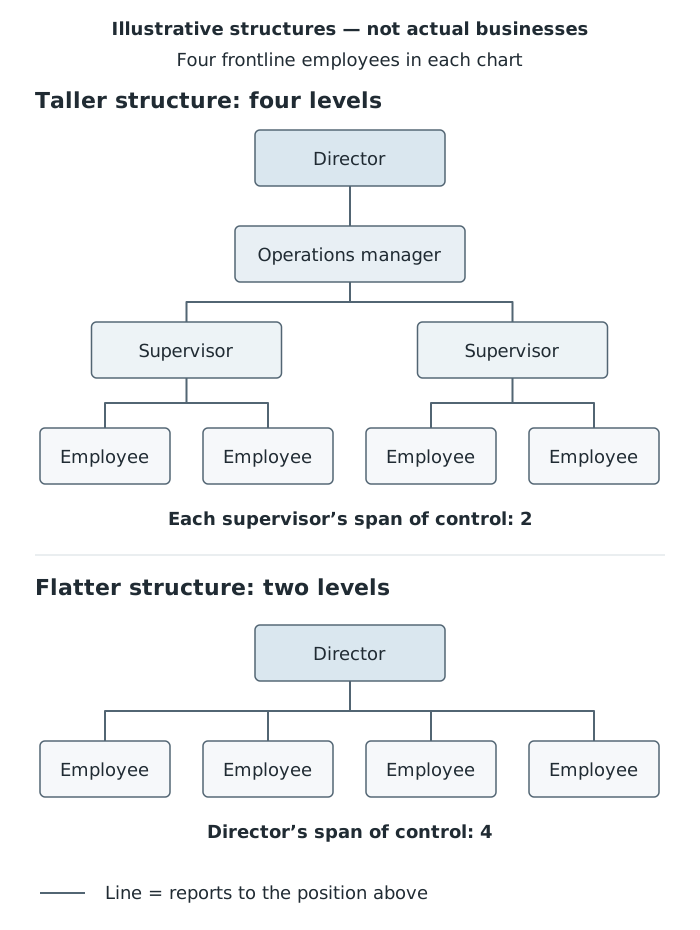
More management layers lengthen the chain of command; fewer layers usually give managers wider spans of control.
In the taller chart, each supervisor directly manages two employees. The director directly manages only the operations manager. In the flatter chart, all four employees report directly to the director, whose span of control is therefore four.
A flatter structure is not automatically better. A wide span of control can leave a manager with too many people to support effectively. Employees may also take on several responsibilities, increasing workload or making roles less clear. It is more suitable where staff can work independently than where they need frequent supervision.
Hierarchical and flat describe the number of layers. Centralised and decentralised describe where decision-making authority sits. These are separate choices: a business can have several management layers while giving branch managers considerable decision-making authority.
In a centralised business, important decisions remain mainly with senior managers. These managers can consider the whole organisation’s objectives and coordinate its different functions. Centralisation also supports consistent policies across branches.
For example, imagine a growing bakery chain whose head office decides the product range and prices for every shop. This can help customers receive a consistent offer and prevent branches from making conflicting decisions. Centralisation is therefore appropriate when coordination and a uniform approach are priorities.
The drawback is that senior managers may become overloaded with requests for approval. They may also know less about local customers or specialist departmental problems than the managers dealing with them daily. Branch managers’ limited freedom can reduce their motivation.
Centralisation can allow a small leadership team to make a decisive business-wide decision quickly. However, it can slow routine decisions if every branch must wait for that team’s approval.
In a decentralised business, senior managers delegate decision-making authority to managers in departments or branches. These managers can use their specialist knowledge and understanding of local conditions.
In the bakery chain, branch managers might be allowed to choose local promotions. A manager who notices changing customer preferences could respond without waiting for head office. This makes decentralisation useful for a growing business operating in different markets, where customer needs vary between locations.
Greater responsibility can also motivate managers and help them develop their decision-making skills. However, branches may make inconsistent decisions or pursue priorities that conflict with the business’s overall objectives. Head office may find it harder to coordinate activities and control budgets.
The choice depends on the business, not simply on its size. A complex operation may benefit from clear management layers; a small, closely connected team may work effectively with a flat structure. Local variation and capable branch managers favour decentralisation, while a strong need for consistency favours centralisation.
Many businesses combine approaches. Senior leaders may retain major decisions about overall strategy and investment while delegating everyday operational decisions. As the business grows, this balance can preserve central control without making senior managers a bottleneck for every local decision.
Get unlimited access to all revision notes, key terms, and exam tips.
Layers of authority ≠ location of decision-making authority. A hierarchical business can be decentralised.
Many businesses keep strategic decisions centralised while decentralising routine operational decisions. Judge suitability using complexity, local customer needs, managerial expertise and the importance of consistency.
Get unlimited access to all revision notes, key terms, and exam tips.
Distinguish the number of management layers from the location of decision-making authority: hierarchical does not automatically mean centralised.
A manager’s span of control counts only employees who report directly to that manager, not everyone below them.
Develop an explanation through a business consequence: local decision-making may allow a quicker response to customer needs, helping protect sales.
When judging which structure is appropriate, use the business’s size, complexity, staff expertise and need for consistency. Avoid claiming that one structure is always best.
Organisational structure
The arrangement of roles, responsibilities and reporting relationships within a business.
Organisation chart
A diagram showing the positions within a business and who reports to whom.
Chain of command
The formal line of authority linking senior management to employees at lower levels of a business.
Span of control
The number of employees who report directly to a particular manager.
Hierarchical structure
An organisational structure with many levels of authority, usually a long chain of command and relatively narrow spans of control.
Flat structure
An organisational structure with few levels of authority, usually a short chain of command and relatively wide spans of control.
Centralisation
Keeping decision-making authority mainly with senior managers at the centre of a business.
Decentralisation
Distributing decision-making authority to managers further down the hierarchy or in different branches or departments.
Delegation
Giving someone at a lower level of a business authority to make decisions or carry out tasks.
Put your knowledge into practice — try past paper questions for Business
Organisational structure
The arrangement of roles, responsibilities and reporting relationships within a business.
Organisation chart
A diagram showing the positions within a business and who reports to whom.
Chain of command
The formal line of authority linking senior management to employees at lower levels of a business.
Span of control
The number of employees who report directly to a particular manager.
Hierarchical structure
An organisational structure with many levels of authority, usually a long chain of command and relatively narrow spans of control.
Flat structure
An organisational structure with few levels of authority, usually a short chain of command and relatively wide spans of control.
Centralisation
Keeping decision-making authority mainly with senior managers at the centre of a business.
Decentralisation
Distributing decision-making authority to managers further down the hierarchy or in different branches or departments.
Delegation
Giving someone at a lower level of a business authority to make decisions or carry out tasks.