

Loading…
Loading…
Loading…
AQA GCSE Religious Studies B · 8063
AQA 8063 · Synagogue and Worship Check the specification (PDF) (opens in a new tab)
Jewish worship is not confined to the synagogue. Prayer, meals, family routines and the study of sacred texts can all express a relationship with God. The home is especially important because it is where children encounter Jewish beliefs and see how they shape daily decisions.
Shabbat brings these activities together. It is the weekly holy day of rest, beginning at sunset on Friday and ending at nightfall on Saturday. Setting this time apart allows Jews to turn from ordinary work towards God, family and community.
The Torah commands, “Remember the Sabbath day by keeping it holy” (Exodus 20:8). Shabbat recalls the creation account: God rested on the seventh day after creating the world. Rest therefore expresses belief in God as Creator and obedience to God's commandments.
Shabbat also recalls freedom from slavery in Egypt. Having time to rest, rather than being forced to work continually, is a sign of freedom. For individuals, Shabbat offers time for prayer and reflection; for families, it creates a regular opportunity to be together; for the community, shared worship strengthens Jewish identity.
Traditional Shabbat observance involves avoiding particular categories of work, not simply taking a day off paid employment. These include lighting or extinguishing fire, writing and repairing things. Orthodox Jews generally observe these restrictions closely and avoid activities such as cooking, driving and operating electrical devices. Preparations beforehand make it possible to enjoy the day without doing this work.
Reform Jews also value Shabbat as sacred time, but approaches to its restrictions vary. Some may drive to synagogue or use electrical devices while still setting aside work and making time for worship and family. These differences reflect differing understandings of how Jewish law should apply today, rather than a simple contrast between observing Shabbat and ignoring it.
Before Shabbat, families may tidy the home, prepare food and set the table. Two candles and two loaves of challah, a special bread, are commonly placed on it. The candles are associated with the commandments to “remember” the Sabbath in Exodus 20:8 and to “observe” it in Deuteronomy 5:12. The two loaves recall God's provision of food for the Israelites during their journey through the wilderness after leaving Egypt.
The candles are lit to welcome Shabbat. Traditionally, the mother lights them, covers her eyes and says a blessing, although household practices vary. Children may receive blessings, and kiddush is recited over wine or grape juice to sanctify the day. A blessing is also said over the bread before it is shared.
The Friday evening meal is both a celebration and an act of worship. Songs, religious stories and conversation bring the family together and help pass on Jewish beliefs. Further meals, Torah study and relaxation continue during Saturday: rest is an opportunity to give attention to what matters, rather than merely to do nothing.
At the end of Shabbat, Havdalah marks the separation between sacred time and the ordinary week. Blessings are said over wine, fragrant spices and a multi-wicked candle. The spices symbolise sweetness as the family moves into the coming week. This ceremony gives Shabbat a clear ending, just as candle-lighting gives it a clear beginning.
Home observance and synagogue worship complement each other. Friday evening worship welcomes Shabbat with special prayers, hymns and psalms. Saturday morning worship brings the community together for prayer and readings from the Torah. A reading from the Nevi’im, called the Haftarah, follows the Torah reading.
There are further prayers and Torah readings later on Saturday, and Havdalah marks Shabbat's ending. Attendance patterns and service arrangements vary between communities and individuals.
The synagogue connects each household to a wider worshipping community. Hearing scripture together encourages shared learning, while common prayers express shared beliefs. The home allows these teachings to be practised through meals, rest and family life, so neither setting needs to replace the other.
Private prayer allows a person to address God personally, using either set prayers or their own words. A siddur, the Jewish prayer book, helps people follow established prayers at home as well as in the synagogue. When praying, Jews traditionally face towards Jerusalem.
Many Jews begin the day with Modeh Ani, a prayer thanking God for returning their soul and giving them another day of life. This turns waking up into an expression of gratitude. Blessings before food and thanksgiving after meals similarly connect ordinary needs with dependence on God. Deuteronomy 8:10 teaches that after eating and being satisfied, people should praise God.
Many Jews recite the Shema morning and evening. Its opening declaration, “Hear, O Israel: the Lord our God, the Lord is one” (Deuteronomy 6:4), affirms monotheism: belief in one God. Repeating it keeps this belief central to daily life. Traditional daily worship includes morning, afternoon and evening prayer, although individual observance varies.
A mezuzah makes this connection visible in the home. It is a parchment scroll containing Torah passages, including the Shema, enclosed in a case on a doorpost. Many Jews touch it when entering or leaving as a reminder of their relationship with God and their responsibility to live by God's commandments. It is not a good-luck charm.
Private worship makes prayer accessible beyond formal services and allows personal reflection. Shared synagogue worship, however, offers communal support and collective study. Both can deepen a person's relationship with God in different ways.
The Tenakh is the collection of Jewish scriptures. Its name brings together its three sections: Torah, Nevi’im and Ketuvim.
The Torah contains Genesis, Exodus, Leviticus, Numbers and Deuteronomy. It includes accounts of creation, the ancestors of the Jewish people, the covenant with God and the commandments. In traditional Jewish belief, God gave the Torah to Moses. It is the holiest part of the Tenakh and provides the foundation of Jewish law, including the Ten Commandments and the traditionally counted 613 mitzvot.
The Nevi’im, or Prophets, contains accounts of Israelite history and prophetic teachings. These explore the Jewish people's relationship with God and call them to faithfulness. Its use in the Haftarah makes it part of regular Shabbat worship.
The Ketuvim, or Writings, contains varied texts, including Psalms, Proverbs and Job. Psalms provide words of praise used in worship; Proverbs offers wisdom; Job explores suffering and challenges the assumption that suffering must result from wrongdoing.
Study therefore involves more than learning rules. Jews study scripture at home, in the synagogue and with teachers to understand their history, develop their relationship with God and consider how to live. Respect for a handwritten Torah scroll is shown by using a pointer called a yad to follow its words rather than touching the parchment directly.
A written commandment can leave practical questions unanswered. The Torah commands rest on Shabbat, but how should people decide which activities count as prohibited work? The oral law explains how commandments are understood and applied.
According to traditional Jewish belief, God gave the oral law to Moses alongside the written Torah. Teachings passed down orally were eventually recorded. The Mishnah collects teachings about applying Jewish law; the Gemara contains rabbinic discussions and commentary on the Mishnah. Together they form the Talmud.
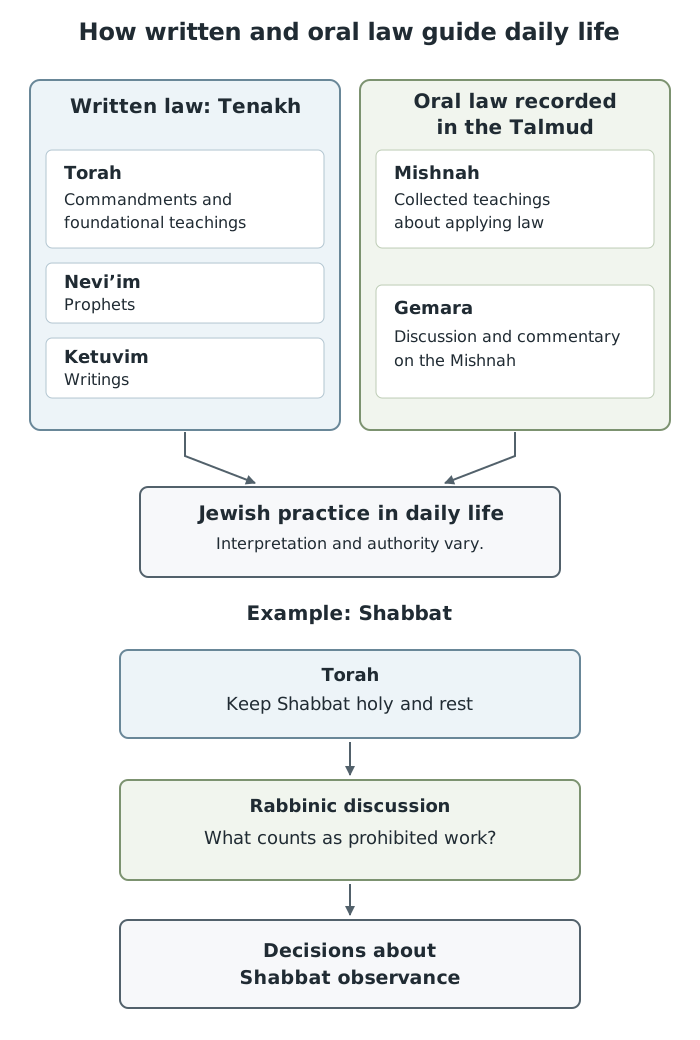
Written commandments and oral-law interpretation work together to guide Jewish practice.
The Talmud includes discussion, disagreement and reasoning, not just a list of instructions. There are Jerusalem and Babylonian versions; the Babylonian Talmud has greater authority within Judaism. Jews continue to study it at home, in synagogues and in religious study institutions called yeshivot.
Shabbat shows how written and oral law work together: the Torah supplies the commandment, while rabbinic discussion explains categories of work and their application. Rabbis also draw on these texts and their principles when considering modern questions, such as contraception or genetic engineering. The ancient Talmud does not directly describe these technologies; its reasoning helps inform later decisions.
For Orthodox Jews, written and oral law are generally authoritative and binding. Study helps people understand how to fulfil their obligations, including those concerning prayer and Shabbat. Reform Jews also study and value these traditions, but generally allow greater scope for interpreting their application in changing circumstances.
An argument for the continuing importance of Jewish law is that its teachings connect daily conduct to God's will. Commands concerning honesty, responsibility and worship remain relevant, and shared practices preserve identity across generations. Interpretation through the oral law also allows ancient principles to address new circumstances.
An alternative argument is that laws developed in very different societies cannot always be applied unchanged. Some Jews therefore consider historical context and distinguish enduring moral principles from practices they believe require adaptation.
A justified judgement should distinguish a text's age from its relevance. Ancient teachings may still guide meaningful lives, while disagreement can concern how to apply them rather than whether they have any value. For many Jews, studying written and oral law is itself a way of participating in a continuing relationship with God and the Jewish community.
| Text | Essential distinction | Daily significance |
|---|---|---|
| Tenakh | Jewish scriptures: Torah, Nevi’im, Ketuvim | Law, history, worship and wisdom |
Connection: the Torah commands Shabbat rest; oral-law discussion explains what counts as prohibited work.
Explain the significance of a practice, not just what happens: lighting Shabbat candles marks the beginning of sacred time, while sharing a meal strengthens family life.
Use relevant teachings precisely: Exodus 20:8 commands Jews to remember the Sabbath and keep it holy; Deuteronomy 6:4 expresses belief in one God.
Distinguish the Tenakh from the Torah: the Torah is the first part of the Tenakh, not the whole collection.
Do not assume that all Jews observe practices identically. Explain Orthodox and Reform approaches without suggesting that Reform Jews have no commitment to Jewish law.
In an evaluation, connect each argument to Jewish beliefs or practices and explain why your conclusion is stronger than the alternative.
It can see this note and what your specification asks for.
Answers are free with an account.
1 free note left this week
Get more free notesYour answer sets when this note comes back for review, or marks it complete.
Was this note helpful?
Log in to tell us whether it helped, or to report a problem.
Last updated
Shabbat
The Jewish weekly holy day of rest, observed from Friday sunset until nightfall on Saturday.
Kiddush
A blessing recited over wine or grape juice that sanctifies Shabbat or a festival.
Havdalah
A ceremony marking the separation of Shabbat from the ordinary week, using blessings, wine, spices and a multi-wicked candle.
Shema
A Jewish declaration of faith beginning with the teaching that God is one, found in Deuteronomy 6:4.
Siddur
A Jewish prayer book containing prayers and orders of worship for use at home and in the synagogue.
Mezuzah
A parchment scroll containing passages from the Torah, including the Shema, placed inside a case attached to a doorpost.
Tenakh
The Jewish scriptures, comprising the Torah, Nevi’im and Ketuvim.
Torah
The first five books of the Tenakh, containing foundational Jewish teachings and commandments. The word can also refer more broadly to Jewish teaching.
Nevi’im
The section of the Tenakh known as the Prophets, containing historical accounts and prophetic teachings.
Ketuvim
The section of the Tenakh known as the Writings, including Psalms, Proverbs and Job.
Talmud
The collection of rabbinic teachings and discussions comprising the Mishnah and Gemara, which explains and interprets Jewish law.
Mishnah
The written collection of teachings of the oral law, explaining how Jewish commandments are applied.
Gemara
Rabbinic discussion and commentary on the Mishnah; together they form the Talmud.
Mitzvah
A commandment in Jewish law; the plural is mitzvot.
Put your knowledge into practice — try past paper questions for Religious Studies B
Shabbat
The Jewish weekly holy day of rest, observed from Friday sunset until nightfall on Saturday.
Kiddush
A blessing recited over wine or grape juice that sanctifies Shabbat or a festival.
Havdalah
A ceremony marking the separation of Shabbat from the ordinary week, using blessings, wine, spices and a multi-wicked candle.
Shema
A Jewish declaration of faith beginning with the teaching that God is one, found in Deuteronomy 6:4.
Siddur
A Jewish prayer book containing prayers and orders of worship for use at home and in the synagogue.
Mezuzah
A parchment scroll containing passages from the Torah, including the Shema, placed inside a case attached to a doorpost.
Tenakh
The Jewish scriptures, comprising the Torah, Nevi’im and Ketuvim.
Torah
The first five books of the Tenakh, containing foundational Jewish teachings and commandments. The word can also refer more broadly to Jewish teaching.
Nevi’im
The section of the Tenakh known as the Prophets, containing historical accounts and prophetic teachings.
Ketuvim
The section of the Tenakh known as the Writings, including Psalms, Proverbs and Job.
Talmud
The collection of rabbinic teachings and discussions comprising the Mishnah and Gemara, which explains and interprets Jewish law.
Mishnah
The written collection of teachings of the oral law, explaining how Jewish commandments are applied.
Gemara
Rabbinic discussion and commentary on the Mishnah; together they form the Talmud.
Mitzvah
A commandment in Jewish law; the plural is mitzvot.
| Torah | First five books; foundational commandments | Guides conduct and Shabbat observance |
| Nevi’im | Prophets | Covenant teachings; Haftarah readings |
| Ketuvim | Writings, including Psalms, Proverbs and Job | Praise, wisdom and reflection |
| Talmud | Mishnah plus Gemara; oral-law teachings and discussion | Explains application of commandments |