

Loading…
Loading…
Loading…
AQA GCSE Religious Studies B · 8063
AQA 8063 · Duties and Festivals Check the specification (PDF) (opens in a new tab)
Hajj is the Muslim pilgrimage to Makkah in Saudi Arabia. A pilgrimage is a journey made for a religious purpose: its value lies not simply in reaching a destination, but in worshipping and deepening faith through the journey and its actions.
Hajj takes place during Dhu’l-Hijjah, the twelfth month of the Islamic calendar. It is the fifth of the Five Pillars of Sunni Islam and one of the Ten Obligatory Acts in Shi’a Islam. Both traditions regard it as a duty once in a lifetime for Muslims who are physically and financially able to undertake it. Some Muslims make additional pilgrimages, and some communities help others meet the cost.
The Qur’an teaches: “Pilgrimage to this House is an obligation by Allah upon whoever is able among the people” (Qur’an 3:97). This connects the duty with ability: someone who cannot afford the journey or is not physically able is not simply failing to obey Allah by remaining at home.
Muslims trace Hajj’s origins to Ibrahim, his wife Hajira and their son Isma’il. In Islamic tradition, Ibrahim left Hajira and Isma’il in Arabia in obedience to Allah. When their water ran out, Hajira searched between the hills of Safa and Marwah. Allah provided water through the spring known as Zamzam. Her story combines determined effort with trust in Allah’s care.
Ibrahim built the Ka’aba, a sanctuary dedicated to Allah. The Qur’an records Allah’s command to Ibrahim to proclaim the pilgrimage to humanity (Qur’an 22:27). Hajj therefore connects Muslims with an earlier tradition of obedience to the one God, rather than beginning only with Muhammad.
Over time, idols were placed at the Ka’aba. Muhammad removed them and restored the sanctuary to the worship of Allah alone. His own pilgrimage provided an example for Muslims to follow. During his Farewell Pilgrimage, he delivered his final sermon at Arafat, emphasising human equality and responsibility towards others.
Before undertaking the rites, pilgrims prepare through washing, prayer and a sincere intention to worship Allah. They enter ihram, a sacred state with rules governing dress and behaviour. Men wear two simple, unstitched white cloths; women wear modest clothing.
Simple dress reduces visible differences of wealth and status. A wealthy pilgrim and a poorer pilgrim undertake the same acts of worship, expressing equality before Allah. The white cloths worn by men also resemble burial cloths, reminding pilgrims of mortality.
While in ihram, pilgrims avoid quarrelling, sexual relations, hunting, and cutting their hair or nails. These restrictions encourage patience and self-control. Pilgrims recite the talbiyah, including “Here I am, O Allah, here I am”, expressing their readiness to answer Allah’s call.
At Makkah, pilgrims perform tawaf, circling the Ka’aba seven times anticlockwise. Their shared movement expresses unity and devotion to Allah. They worship Allah, not the building itself.
Some pilgrims touch or kiss the Black Stone, following Muhammad’s example. The stone is not treated as a god or an independent source of power: the act expresses obedience and continuity with the Prophet’s practice.
Pilgrims also perform sa’y, making seven journeys between Safa and Marwah. This recalls Hajira’s search for water for Isma’il. It teaches perseverance and trust: Hajira actively searched for help rather than simply waiting. Drinking Zamzam water recalls Allah’s provision and human dependence on him.
The main days of Hajj begin on 8 Dhu’l-Hijjah, when pilgrims go to Mina, staying in tents and spending time in prayer. This prepares them for the central day of the pilgrimage.
On 9 Dhu’l-Hijjah, they travel to the plain of Arafat. From noon until sunset, pilgrims pray, reflect on their lives and ask Allah for forgiveness. This is often called the ‘standing at Arafat’, although its religious importance is not simply the physical posture. Muhammad taught, “Hajj is Arafah”, expressing how central this rite is to the pilgrimage.
Arafat is associated with Muhammad’s Farewell Sermon. The gathering also reminds Muslims of the Day of Judgement, when everyone will stand before Allah. Differences in nationality, wealth and social position do not remove anyone’s accountability. Pilgrims seek mercy and resolve to turn away from wrongdoing.
After sunset, pilgrims leave Arafat for Muzdalifah. They pray, spend the night under the open sky and collect small pebbles for the stoning ritual. Sharing these simple conditions encourages humility and a sense of common humanity.
Pilgrims then return to Mina. Beginning on 10 Dhu’l-Hijjah, they throw pebbles towards the jamarat, structures representing Satan’s temptation. Stoning continues over the following days. The ritual recalls Ibrahim’s rejection of Satan when he was commanded to sacrifice his son. For pilgrims, it expresses a determination to reject evil and resist temptation in their own lives.
An animal sacrifice recalls Ibrahim’s willingness to obey Allah and Allah’s provision of a ram in place of his son. Meat is distributed to others, including people in need. This links worship with generosity. The Qur’an teaches that it is not the meat or blood that reaches Allah, but people’s piety (Qur’an 22:37). The sacrifice coincides with Id-ul-Adha, which is also celebrated by Muslims who are not on Hajj.
Pilgrims then shave or trim their hair, expressing renewal. They return to Makkah for further tawaf, including the major tawaf that completes the central rites, and a farewell tawaf before departure.
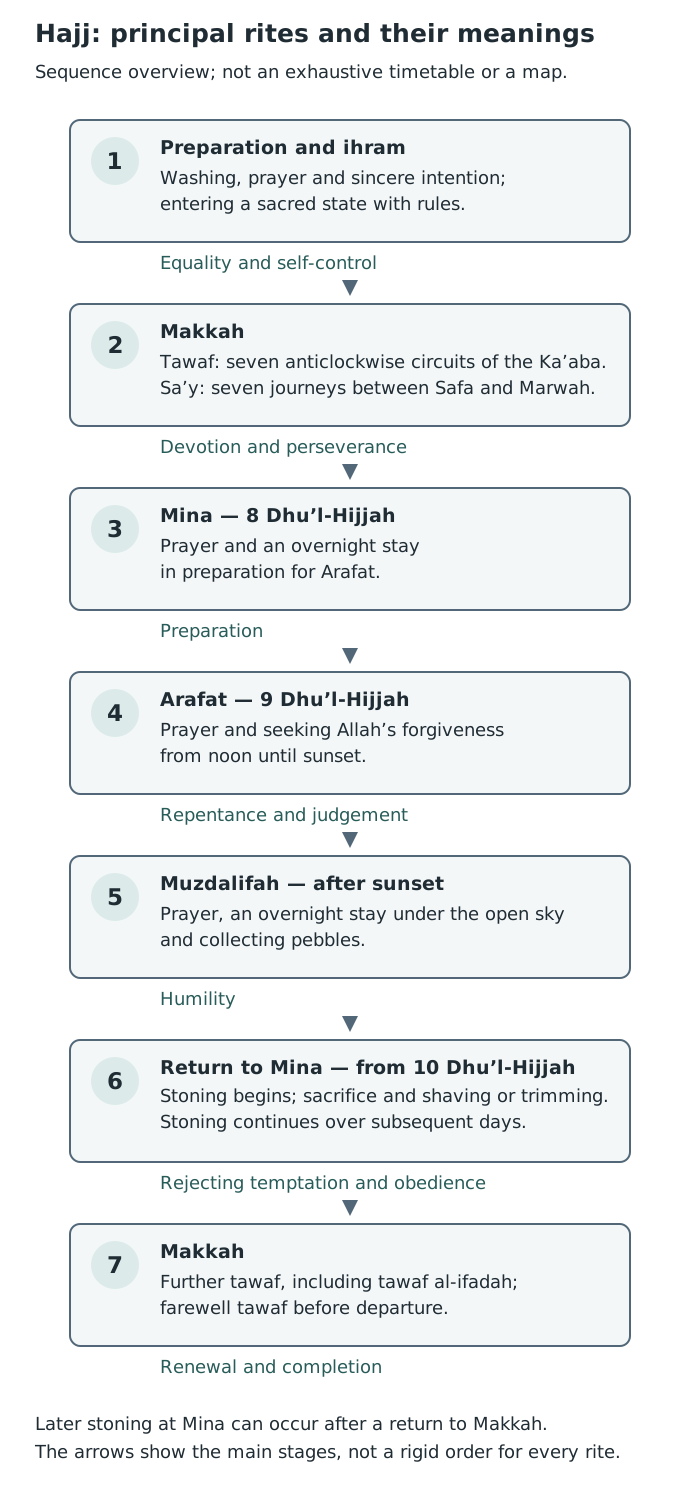
The principal Hajj rites connect sacred places with obedience, repentance and renewal. This is a sequence overview, not a geographical map.
Hajj brings together obedience, repentance and membership of the ummah, the worldwide Muslim community. Shared clothing, accommodation and worship can help pilgrims experience equality rather than merely hear it taught. Meeting Muslims from different countries can strengthen a sense of belonging that crosses national and cultural boundaries.
The pilgrimage also demands patience through travel, crowds, heat and physical effort. Muslims may return with greater self-discipline, gratitude and commitment to treating others kindly. A hadith teaches that someone who performs Hajj sincerely and avoids wrongdoing returns free from sin, like a newborn child. This expresses the hope of forgiveness and a fresh start, not permission to behave badly afterwards.
Hajj’s importance can be judged in more than one way. Its divine command, connection with the prophets and opportunity for spiritual renewal make it deeply significant. However, the qualification concerning ability means that completing the journey cannot be the only measure of a Muslim’s faith. Its moral purpose also matters: outward actions should lead to sincere repentance and better conduct.
A justified conclusion is that Hajj is a major religious duty for those able to perform it, but its significance reaches beyond visiting sacred places. Its lasting value is expressed when pilgrims continue to practise humility, self-restraint, generosity and devotion after returning home.
Link each action to its meaning: throwing pebbles at Mina symbolises rejecting Satan and temptation, rather than simply being a physical activity.
Distinguish Arafat, where pilgrims seek forgiveness, from Muzdalifah, where they spend the night and collect pebbles, and Mina, where the stoning takes place.
Explain the qualification on the duty: Hajj is required once in a lifetime for those physically and financially able to undertake it.
In an evaluation, support judgements with Islamic teachings and specific practices. Consider both Hajj’s spiritual importance and whether its lessons influence life afterwards.
It can see this note and what your specification asks for.
Answers are free with an account.
1 free note left this week
Get more free notesYour answer sets when this note comes back for review, or marks it complete.
Was this note helpful?
Log in to tell us whether it helped, or to report a problem.
Last updated
Hajj
The Muslim pilgrimage to Makkah, required once in a lifetime for those physically and financially able to undertake it.
Pilgrimage
A journey made for a religious purpose, often to a sacred place.
Ka’aba
The sacred building in Makkah associated with Ibrahim and dedicated to the worship of Allah; pilgrims circle it during Hajj.
Ihram
The sacred state entered by a pilgrim, involving restrictions on behaviour and simple clothing.
Tawaf
Circling the Ka’aba seven times anticlockwise as an act of worship.
Sa’y
Making seven journeys between Safa and Marwah, remembering Hajira’s search for water for Isma’il.
Ummah
The worldwide Muslim community, whose unity is expressed through shared worship during Hajj.
Jamarat
The structures at Mina towards which pilgrims throw pebbles, symbolising rejection of Satan and temptation.
Put your knowledge into practice — try past paper questions for Religious Studies B
Hajj
The Muslim pilgrimage to Makkah, required once in a lifetime for those physically and financially able to undertake it.
Pilgrimage
A journey made for a religious purpose, often to a sacred place.
Ka’aba
The sacred building in Makkah associated with Ibrahim and dedicated to the worship of Allah; pilgrims circle it during Hajj.
Ihram
The sacred state entered by a pilgrim, involving restrictions on behaviour and simple clothing.
Tawaf
Circling the Ka’aba seven times anticlockwise as an act of worship.
Sa’y
Making seven journeys between Safa and Marwah, remembering Hajira’s search for water for Isma’il.
Ummah
The worldwide Muslim community, whose unity is expressed through shared worship during Hajj.
Jamarat
The structures at Mina towards which pilgrims throw pebbles, symbolising rejection of Satan and temptation.