

Loading…
Loading…
Loading…
AQA GCSE English Literature · 8702
AQA 8702 Check the specification (PDF) (opens in a new tab)
The Tempest begins with a ship apparently breaking apart in a violent storm. Yet the central story is not a struggle to survive a natural disaster. Prospero has ordered the spirit Ariel to create the storm so that he can bring his enemies under his control.
Twelve years earlier, Prospero was Duke of Milan. While he concentrated on his studies, he entrusted government to his brother Antonio. Antonio seized the dukedom with the support of Alonso, King of Naples. Prospero and his young daughter Miranda were cast out to sea, but Gonzalo, a Neapolitan counsellor, supplied provisions and Prospero's treasured books. They survived and reached the island where they now live.
When his enemies sail nearby, returning from the wedding of Alonso's daughter Claribel in Tunis, Prospero sees an opportunity to recover his position. His magic and Ariel's service allow him to separate the travellers, guide their movements and shape what they believe. The play follows his attempt to turn this opportunity into a resolution of the old betrayal.
Act 1 Scene 1 presents the storm from the ship's perspective. Shouts, thunder and urgent attempts to save the vessel create an opening of apparent chaos. The nobles' titles cannot protect them from danger, and they obstruct the sailors who have the practical skills needed.
Act 1 Scene 2 changes our understanding of that opening. Prospero explains his history to Miranda; Ariel then reports that everyone is safe and the ship is hidden in harbour. What seemed uncontrolled was carefully managed. The audience now knows more than most of the shipwrecked characters. Prospero's announcement to Miranda, “The hour’s now come,”, marks the moment when the concealed past becomes necessary to understanding his present project.
This scene also establishes Prospero's uneasy authority over Ariel, who wants freedom, and Caliban, who claims the island through his mother Sycorax and resents his enforced service. Their dissatisfaction matters because Prospero depends on servants who do not simply share his wishes.
Ariel leads Ferdinand, Alonso's son, to Miranda. They fall in love immediately. Prospero welcomes this privately but pretends to oppose Ferdinand, accusing him of being a spy and making him a prisoner. He wants to test the young man's commitment rather than allow the relationship to seem too easily won. The act therefore establishes both the old political conflict and the new relationship that may help repair it.
In Act 2 Scene 1, Alonso mourns Ferdinand, whom he believes drowned. Gonzalo tries to comfort him and imagines an ideal society on the island, while Antonio and Sebastian mock him.
When Alonso and the others fall asleep, Antonio persuades Sebastian, Alonso's brother, to seize the crown of Naples. They believe Ferdinand is dead, and Antonio argues that Claribel is too far away in Tunis to interfere. Antonio plans to kill Alonso while Sebastian kills Gonzalo, removing a loyal supporter who would oppose them. Ariel wakes Gonzalo before they strike, saving both men.
This conspiracy repeats the pattern of Antonio's earlier usurpation: one brother is encouraged to betray another for political power. Sebastian makes the connection explicit: “as thou got’st Milan, / I’ll come by Naples.” Antonio treats his success in Milan as a model to copy, not a wrong to regret.
In Act 2 Scene 2, Caliban meets Trinculo, the king's jester, and Stephano, his drunken butler. Stephano gives him wine, and Caliban mistakes him for a powerful, godlike figure. Hoping to escape Prospero, Caliban promises to serve Stephano instead. His celebration of freedom is ironic: he has chosen a new master rather than independence.
Act 3 Scene 1 advances the lovers' story. Ferdinand carries logs as part of Prospero's test, but love makes him willing to endure the labour. Miranda offers to help and proposes marriage: “I am your wife if you will marry me;”. Ferdinand accepts. They think they are speaking privately, while Prospero watches unseen and approves. Their mutual devotion is genuine, even though Prospero has arranged their meeting and oversees its development.
Act 3 Scene 2 develops Caliban's rebellion. He urges Stephano to kill Prospero while he sleeps, stressing that his books must first be seized because they give him magical power. Stephano wants to rule the island and take Miranda as his wife. Ariel overhears, causes quarrels by making his interruptions seem to come from Trinculo, and leads the group away with music.
Act 3 Scene 3 returns to the nobles. Antonio and Sebastian still intend to murder Alonso when another opportunity arises. Spirits present a banquet, but Ariel appears as a harpy, a frightening winged creature, and makes it vanish. Addressing Alonso, Antonio and Sebastian, Ariel declares, “You are three men of sin”. He accuses them of their crimes against Prospero and Miranda, presenting Ferdinand's supposed death as punishment. Alonso responds with guilt and despair; Sebastian and Antonio respond defiantly. The accusation affects them differently rather than producing immediate, shared repentance.
The scene order lets us follow three groups whose experiences overlap in time. Prospero's project links them: he tests Ferdinand, confronts his enemies and learns of the threat to his own life.
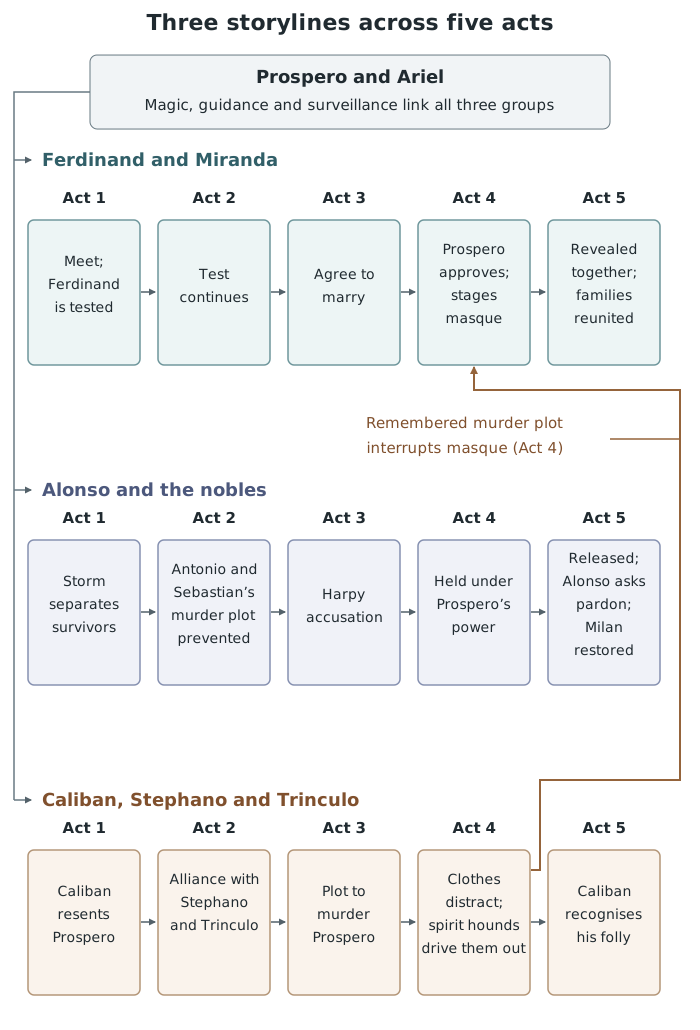
The three storylines unfold alongside one another and converge as Prospero's project reaches its conclusion.
In Act 4 Scene 1, Prospero accepts Ferdinand as Miranda's future husband and explains that the hardships were tests of love. He insists that they must wait until marriage before having sex. Spirits then perform a masque as Iris, Ceres and Juno, blessing the couple with hopes of prosperity and a fruitful marriage. The courtly entertainment turns their betrothal into a vision of future harmony.
Prospero suddenly remembers Caliban's murder plot and stops the performance. This interruption brings the lovers' story and the rebellion into the same scene: the promised peaceful future remains vulnerable to present conflict.
After dismissing the spirits, Prospero tells Ferdinand, “Our revels now are ended.” This is the setting for his famous speech comparing the vanished entertainment with the passing of human life: “We are such stuff / As dreams are made on, and our little life / Is rounded with a sleep.” The dream and sleep imagery shifts the mood from celebration to reflection on mortality. Structurally, the speech pauses the action between the interrupted masque and the defeat of the rebels. Prospero's reference to “actors” also connects his magical spectacle with the theatre in which the audience is watching him.
Ariel has led the conspirators through thorns and into a filthy pool. Prospero and Ariel now tempt them with glittering clothes. Stephano and Trinculo abandon their purpose to steal the garments, despite Caliban's warnings. Spirits shaped like dogs and hounds chase them away. Their rebellion fails through magical control and their own foolish distraction. By the act's end, Prospero has all his enemies at his mercy.
At the opening of Act 5 Scene 1, Ariel describes the nobles' suffering and suggests that witnessing it would move Prospero to compassion. Prospero chooses forgiveness over further revenge: “the rarer action is / In virtue than in vengeance”. He releases them from his spells and vows to give up his magic.
Prospero reveals his identity. Alonso asks pardon and restores his dukedom. Prospero also forgives Antonio, while demanding Milan back, and privately lets Antonio and Sebastian know that he knows about their conspiracy. Antonio offers no answering apology: political order is restored more clearly than every damaged relationship is healed.
Prospero then reveals Ferdinand and Miranda playing chess. Alonso discovers that his son is alive, and their planned marriage joins the families of Milan and Naples. The feared loss becomes a reunion. Seeing the assembled nobles, Miranda exclaims, “O brave new world / That has such people in ’t!” Here, “brave” means splendid or wonderful. Her delight looks towards a hopeful future, but there is dramatic irony: the audience knows that some of these impressive people have committed betrayal and planned murder. Prospero's reply, “’Tis new to thee.”, qualifies her wonder with his greater experience.
The sailors arrive with news that the ship is seaworthy, making the planned return possible. Caliban, Stephano and Trinculo are then brought in. Prospero identifies Caliban with the words “this thing of darkness I / Acknowledge mine.” The possessive “mine” can assert his authority over Caliban, but “Acknowledge” can also suggest acceptance of responsibility for someone he has governed. The moment brings the rebellion into the final gathering rather than leaving it as a separate storyline.
Caliban recognises his foolishness in worshipping Stephano and promises to seek grace. Prospero orders the three conspirators to tidy his cell as a condition of pardon. He invites the nobles to stay overnight, with departure for Naples planned for the morning, followed by the lovers' wedding and his return to Milan. Ariel is promised freedom after a final task of ensuring a safe voyage.
Apart from the opening aboard the ship, the action takes place in different parts of one island. The past is narrated rather than acted out: Prospero's exposition brings twelve years of history into a tightly concentrated present.
In Act 5 Scene 1, Alonso describes the wreck as occurring “three hours since”. At the beginning of that scene, Ariel announces “On the sixth hour”, the appointed time when Prospero said their work would cease. The Boatswain also recalls that they believed the ship broken only “three glasses since”. These repeated time references make the action feel close to the duration of a performance, rather than a story unfolding across weeks or years.
This concentration creates urgency and emphasises how rapidly magic brings about encounters, tests and discoveries. The play roughly follows the dramatic unities: a short span of time, a concentrated setting and connected action centred on Prospero's project. The three storylines are not three consecutive adventures; Shakespeare switches between groups experiencing overlapping events. The wedding and voyage remain future plans rather than events performed on stage.
The play moves from separation to reunion, threatened murder to survival, and punishment to forgiveness. Its subplots reinforce that movement: violent attempts to seize power fail, while the lovers' union offers a peaceful connection between previously hostile families.
After the main action, Prospero addresses the audience directly. In the Epilogue, he asks for release “With the help of your good hands.”, inviting applause. The magician who controlled other people now depends on the spectators to let him go.
The short rhyming couplets give this concluding appeal a distinct sound from the largely unrhymed verse of the serious scenes. The ending also extends the play's concern with mercy: Prospero has pardoned his enemies, and now asks the audience for its own forgiving acceptance.
Antonio's encouragement of Sebastian repeats his earlier betrayal of Prospero. Stephano's ambition offers a comic parallel to the nobles' pursuit of power. The remembered rebellion interrupts the lovers' masque.
Forgiveness is not universal repentance: Alonso apologises, but Antonio does not. The wedding, voyage and Prospero's promised destruction of his magical instruments are not staged. The ending moves towards harmony without making every relationship uncomplicated.
Use plot knowledge to explain why a moment matters, rather than retelling the whole story.
Distinguish what the audience knows from what a character believes: Alonso thinks Ferdinand is dead, but the audience knows he is alive.
Connect an extract to a relevant earlier or later event, explaining the similarity, contrast or change.
Keep outcomes precise: the marriage and departure are planned for after the stage action; Prospero's forgiveness does not mean every character openly repents.
It can see this note and what your specification asks for.
Answers are free with an account.
1 free note left this week
Get more free notesYour answer sets when this note comes back for review, or marks it complete.
Was this note helpful?
Log in to tell us whether it helped, or to report a problem.
Last updated
Usurpation
The removal of a rightful ruler and seizure of their position or authority.
Exposition
Information that establishes the background needed to understand a story, such as events that happened before its opening.
Subplot
A secondary storyline that develops alongside and connects with a play's main action.
Dramatic irony
A dramatic effect created when the audience knows something that a character does not.
Masque
An elaborate entertainment combining poetry, music, dance and spectacle, popular at the Jacobean court.
Epilogue
A concluding speech after a play's main action, often addressed directly to the audience.
Reconciliation
The restoration of a peaceful relationship after conflict or separation.
Put your knowledge into practice — try past paper questions for English Literature
Usurpation
The removal of a rightful ruler and seizure of their position or authority.
Exposition
Information that establishes the background needed to understand a story, such as events that happened before its opening.
Subplot
A secondary storyline that develops alongside and connects with a play's main action.
Dramatic irony
A dramatic effect created when the audience knows something that a character does not.
Masque
An elaborate entertainment combining poetry, music, dance and spectacle, popular at the Jacobean court.
Epilogue
A concluding speech after a play's main action, often addressed directly to the audience.
Reconciliation
The restoration of a peaceful relationship after conflict or separation.