

Loading…
Loading…
Loading…
AQA GCSE Combined Science: Synergy · 8465
AQA 8465 · 4.8.2.6 Check the specification (PDF) (opens in a new tab)
Whether an energy transfer is useful depends on what a system is meant to do. Heating food is useful when cooking, but transferring energy from hot food to the surrounding air is unwanted if we want the food to stay hot.
Unwanted transfers do not destroy energy. Instead, energy often spreads into the thermal stores of objects and their surroundings, where it is less useful. This is called energy dissipation. We can reduce these transfers by changing how a machine operates or by choosing suitable insulating materials.
Imagine pushing a supermarket trolley with stiff wheels. Friction in the moving parts opposes their movement, so you must do work against the frictional forces. Energy is transferred to the thermal stores of the parts, raising their temperature, and then spreads into the surroundings. That energy is not useful for moving the trolley.
Lubrication means applying a substance such as oil between moving surfaces. The lubricant reduces friction, so less work is done against friction as the parts move. Less energy is therefore dissipated by heating.
The same principle is used in bicycle chains and moving machine parts. Lubrication does not remove every unwanted transfer, but it reduces the energy needed to keep the parts moving.
Energy transfers by heating from a warmer object or region to a cooler one. Thermal insulation reduces the rate of this transfer; it does not supply energy or keep an object at the same temperature indefinitely.
One way energy is transferred is conduction: energy passes through a material from its hotter region to its colder region, without the material moving as a whole. A material’s thermal conductivity describes how readily this happens. Under the same conditions, a material with higher thermal conductivity transfers energy by conduction at a higher rate. Good insulating materials have low thermal conductivity.
Wool clothing provides an everyday example. Wool and the air trapped between its fibres are poor thermal conductors, so they slow energy transfer from your warm body to colder surroundings.
Insulation can also keep something cold. Wrapping slows energy transfer out of hot fish and chips, but it slows energy transfer into ice cream from warmer surroundings. The direction differs; the insulating material reduces the rate in both cases.
When a building is warmer than the outside, energy transfers through its walls to the colder surroundings. Two important factors affect this transfer:
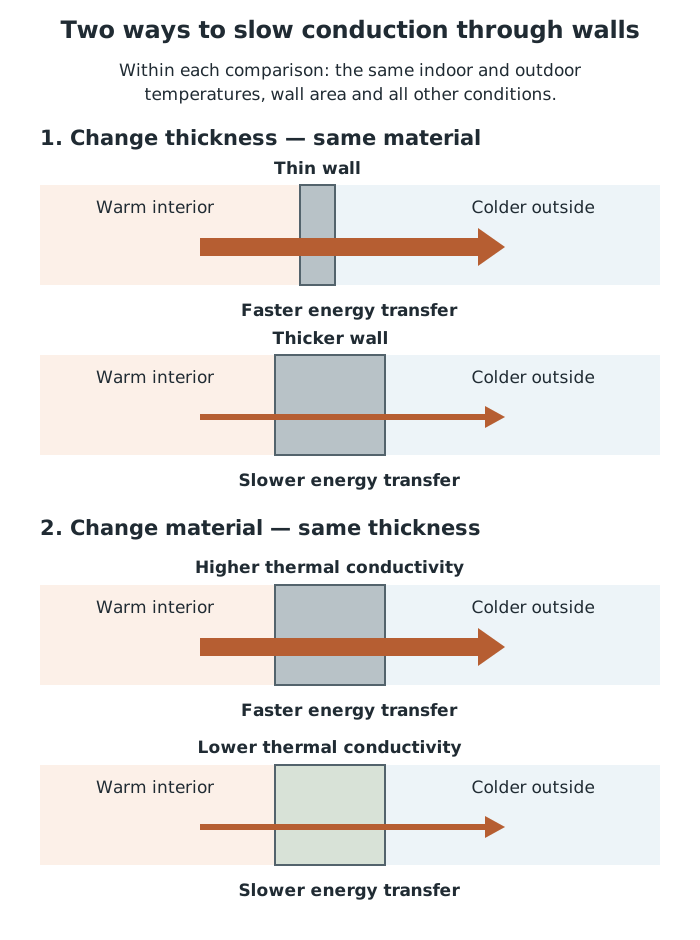
For otherwise identical conditions, greater wall thickness or lower thermal conductivity reduces energy transfer by conduction.
Thickness and material must be considered together. A thick wall and a thin wall cannot be compared using thickness alone if they are made from different materials.
Cavity wall insulation adds insulating material within the gap between wall layers. Loft insulation reduces energy transfer through the roof. Both use low-thermal-conductivity materials to slow unwanted transfer from the warm interior to the colder outside.
A well-insulated building needs less energy supplied by heating to maintain its indoor temperature. Choosing suitable insulation and an appropriate thickness therefore helps engineers reduce energy consumption and the resources needed to heat buildings.
For lubrication, link the steps: reduced friction → less work done against friction → less energy dissipated by heating.
Describe thermal conductivity in terms of the rate of energy transfer by conduction, not how well a material withstands high temperatures.
When comparing walls, state what is kept the same: thicker walls cool a building more slowly when the material and other conditions are unchanged.
The effects of wall thickness and thermal conductivity are qualitative here; no wall-conduction calculation is required.
It can see this note and what your specification asks for.
Answers are free with an account.
1 free note left this week
Get more free notesYour answer sets when this note comes back for review, or marks it complete.
Was this note helpful?
Log in to tell us whether it helped, or to report a problem.
Last updated
Friction
A force that opposes relative movement between surfaces in contact.
Lubrication
The use of a substance such as oil to reduce friction between moving surfaces.
Energy dissipation
The spreading of energy into the surroundings, where it becomes less useful.
Thermal insulation
The use of materials to reduce the rate of energy transfer by heating.
Conduction
Energy transfer through a material from a hotter region to a colder region, without the material moving as a whole.
Thermal conductivity
A property of a material that describes how readily it transfers energy by conduction. Higher thermal conductivity means a higher rate of transfer under the same conditions.
Put your knowledge into practice — try past paper questions for Combined Science: Synergy
Friction
A force that opposes relative movement between surfaces in contact.
Lubrication
The use of a substance such as oil to reduce friction between moving surfaces.
Energy dissipation
The spreading of energy into the surroundings, where it becomes less useful.
Thermal insulation
The use of materials to reduce the rate of energy transfer by heating.
Conduction
Energy transfer through a material from a hotter region to a colder region, without the material moving as a whole.
Thermal conductivity
A property of a material that describes how readily it transfers energy by conduction. Higher thermal conductivity means a higher rate of transfer under the same conditions.
With other conditions unchanged: