

Loading…
Loading…
Loading…
AQA GCSE Combined Science: Synergy · 8465
AQA 8465 · 4.7.4.4 Check the specification (PDF) (opens in a new tab)
Reactants are the starting substances in a chemical reaction; products are the substances formed. For a reaction to occur, reacting particles must collide. However, a collision alone is not enough: the particles must also have sufficient energy.
The activation energy, written , is the minimum energy that reacting particles must have for a collision to result in a reaction. If a collision has less than this energy, the particles do not react. Different reactions have different activation energies: a higher activation energy means a greater energy barrier must be overcome.
This barrier exists even in a reaction that releases energy overall. Energy being released by a reaction does not mean that the reaction can begin without the particles first having enough energy.
A reaction profile shows the energy changes as reactants become products. Its vertical axis is labelled Energy and its horizontal axis is labelled Progress of reaction. The horizontal axis shows the stages of the reaction, rather than how much time has passed.
Read the profile from left to right. It starts at the reactants’ energy level, rises to a peak and then falls to the products’ energy level. The peak represents the energy barrier that must be overcome.
Two vertical differences have different meanings:
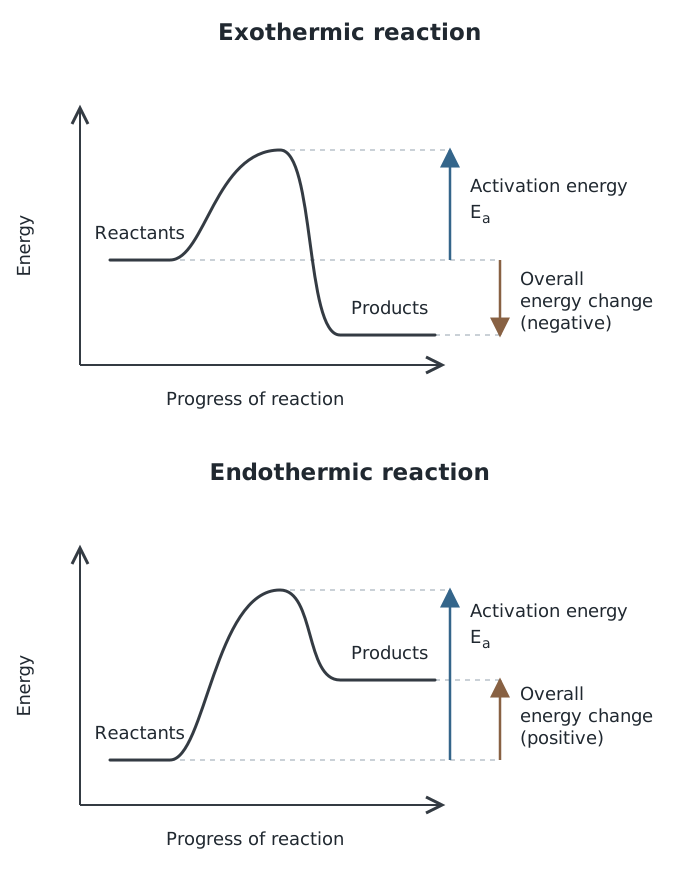
Activation energy is measured from the reactants’ level to the peak; overall energy change is measured between the reactants’ and products’ levels.
An exothermic reaction transfers energy to the surroundings. Its products have less energy than its reactants, so the profile finishes lower than it starts. The overall-energy-change arrow points downwards.
Energy is conserved: it is not destroyed when the products have less energy. The difference has been transferred to the surroundings.
The overall energy change is negative because the products’ energy is lower than the reactants’ energy. Notice that the curve still rises to a peak first: an exothermic reaction still has an activation energy.
An endothermic reaction takes in energy from the surroundings. Its products have more energy than its reactants, so the profile finishes higher than it starts. The overall-energy-change arrow points upwards.
The overall energy change is positive because the products’ energy is higher than the reactants’ energy. The activation-energy arrow still runs from the reactants’ level to the peak, not just to the products’ level.
For either type of reaction:
Start by drawing and labelling the axes. Add a short horizontal level on the left labelled Reactants, then another on the right labelled Products. Place the products lower for an exothermic reaction or higher for an endothermic reaction.
Join the levels with a smooth curve that rises to a peak above both levels before falling to the products. Add the activation-energy arrow from the reactants’ level to the peak. Finally, add a separate arrow between the reactants’ and products’ levels and label it Overall energy change.
When interpreting an unfamiliar profile, compare the starting and finishing levels first to identify the reaction type. Then find the vertical gap from the reactants to the peak to identify the activation energy. A larger gap between reactants and products means a larger overall energy change; it does not necessarily mean a larger activation energy.
Reacting particles must collide with sufficient energy. Activation energy, , is the minimum energy needed for a collision to result in reaction.
| Reaction | Products compared with reactants | Energy transfer | Overall change |
|---|---|---|---|
| Exothermic | Lower energy | To surroundings | Negative; downward arrow |
| Endothermic | Higher energy | From surroundings | Positive; upward arrow |
Both profiles rise to a peak: both reactions require activation energy.
Draw the activation-energy arrow from the reactants’ energy level to the top of the curve, not from the horizontal axis.
Identify exothermic and endothermic reactions by comparing the reactants’ and products’ levels, not by looking at the peak.
Label the horizontal axis ‘Progress of reaction’, not ‘Time’.
Keep the activation energy and overall energy change separate: they measure different vertical energy differences.
It can see this note and what your specification asks for.
Answers are free with an account.
1 free note left this week
Get more free notesYour answer sets when this note comes back for review, or marks it complete.
Was this note helpful?
Log in to tell us whether it helped, or to report a problem.
Last updated
Activation energy
The minimum energy that reacting particles must have for a collision to result in a chemical reaction.
Reaction profile
A diagram showing how energy changes as a reaction progresses, including the relative energies of reactants and products and the activation energy.
Exothermic reaction
A chemical reaction that transfers energy to the surroundings; its products have less energy than its reactants.
Endothermic reaction
A chemical reaction that takes in energy from the surroundings; its products have more energy than its reactants.
Overall energy change
The difference between the energy of the products and the energy of the reactants.
Put your knowledge into practice — try past paper questions for Combined Science: Synergy
Activation energy
The minimum energy that reacting particles must have for a collision to result in a chemical reaction.
Reaction profile
A diagram showing how energy changes as a reaction progresses, including the relative energies of reactants and products and the activation energy.
Exothermic reaction
A chemical reaction that transfers energy to the surroundings; its products have less energy than its reactants.
Endothermic reaction
A chemical reaction that takes in energy from the surroundings; its products have more energy than its reactants.
Overall energy change
The difference between the energy of the products and the energy of the reactants.