

Loading…
Loading…
Loading…
AQA GCSE Combined Science: Synergy · 8465
AQA 8465 · 4.7.4.3 Effect of Temperature, Concentration, and Pressure on Reaction Rates Check the specification (PDF) (opens in a new tab)
Concentration describes how much dissolved substance there is in a given volume of solution. A more concentrated solution contains more reactant particles in the same volume. These particles collide more frequently, so there are more successful collisions each second and the reaction is faster.
Required practical 19 tests this relationship using both gas production and a change in colour or turbidity. Here, the second method uses turbidity: a solution becomes cloudy.
A suitable hypothesis is: increasing reactant concentration will increase reaction rate because successful collisions will occur more frequently. Make this measurable before starting: predict that a fixed volume of gas will be produced sooner, or that a cross beneath a cloudy mixture will disappear sooner.
Magnesium reacts with hydrochloric acid to form magnesium chloride and hydrogen:
magnesium + hydrochloric acid → magnesium chloride + hydrogen
Collecting the hydrogen lets you track how much product forms as time passes. The independent variable is hydrochloric acid concentration; the dependent measurement is the volume of hydrogen collected at each recorded time.
Use a 100 cm³ conical flask, a single-holed rubber bung and delivery tube, a water trough, two 100 cm³ measuring cylinders, a clamp stand with boss and clamp, and a stop clock. You also need 3 cm lengths of magnesium ribbon and hydrochloric acid at 1.0 mol/dm³ and 1.5 mol/dm³.
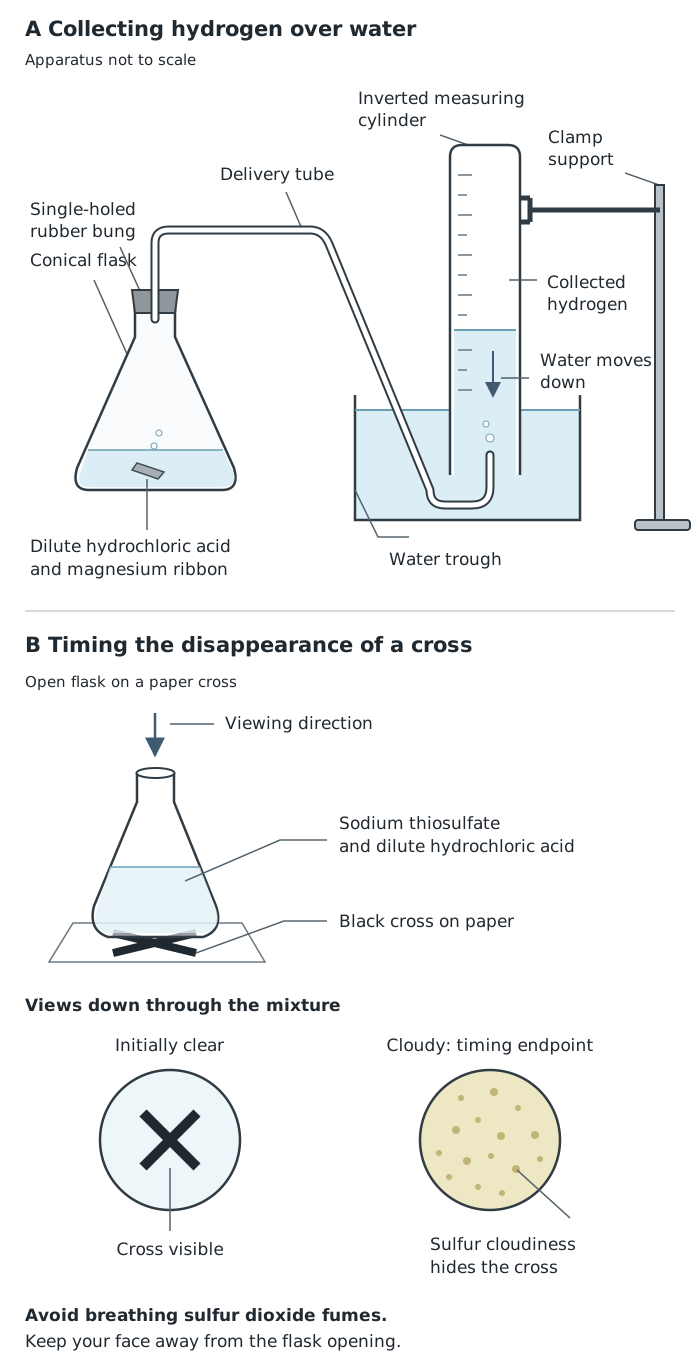
Collect hydrogen to follow product formation over time, or time how long sulfur cloudiness takes to hide a cross.
The collecting cylinder starts full of water, with its open end submerged. Hydrogen enters through the delivery tube and displaces water. The space occupied by the collected gas gives its volume.
Wear safety goggles because acid can splash. Keep hydrogen away from flames because it is flammable. Check that the connections are secure and the delivery tube is unobstructed.
Keep the acid volume and starting temperature the same. Use magnesium strips of the same length, width and thickness so that their amount and exposed surface area are comparable. Use the same apparatus and recording intervals. These controls help isolate the effect of acid concentration.
Record results with time in seconds in the first column and separate hydrogen volume in cm³ columns for the two acid concentrations. Plot time on the horizontal axis and gas volume on the vertical axis.
A faster reaction has a steeper rising curve and reaches a chosen gas volume sooner. When the curve becomes horizontal, no more gas is being produced. If acid is in excess and the same amount of magnesium reacts completely in each trial, the final gas volumes should be the same: changing concentration changes how quickly the gas forms, not how much that fixed amount of magnesium can produce.
Sodium thiosulfate reacts with dilute hydrochloric acid to produce solid sulfur. The sulfur is a precipitate: an insoluble solid formed in the solution. Its suspended particles make the mixture cloudy and eventually hide a black cross beneath the flask.
Here, sodium thiosulfate concentration is the independent variable. The dependent variable is the time taken for the cross to disappear.
Use 40 g/dm³ sodium thiosulfate solution, dilute hydrochloric acid, water, a 100 cm³ conical flask, 10 cm³ and 100 cm³ measuring cylinders, a black cross on paper and a stop clock.
Prepare the following mixtures. The concentrations shown are those of the 50 cm³ sodium thiosulfate–water mixture before acid is added.
| Sodium thiosulfate solution / cm³ | Water / cm³ | Concentration / g/dm³ |
|---|---|---|
| 10 | 40 | 8 |
| 20 | 30 | 16 |
| 30 | 20 | 24 |
| 40 | 10 | 32 |
| 50 | 0 | 40 |
Adding water dilutes the stock solution. For example, the first mixture contains the dissolved substance from 10 cm³ of stock solution spread through 50 cm³, so its concentration is one-fifth of the stock concentration.
Wear goggles and work in a well-ventilated area. This reaction releases sulfur dioxide: avoid breathing in its fumes and do not put your face close to the flask opening. The disappearance of the cross is the measurement endpoint, not necessarily the end of the reaction.
Keep the acid volume and concentration, starting temperature and total mixture volume constant. Use the same flask and cross, with consistent lighting, viewing position and endpoint judgement. Keeping the liquid depth the same matters because a deeper mixture can hide the cross with less cloudiness.
Use a results table with concentration in g/dm³ followed by first-trial, second-trial, third-trial and mean-time columns, all times in seconds. Plot concentration on the horizontal axis and mean disappearance time on the vertical axis. A shorter time means sulfur has formed more quickly, indicating a faster reaction.
Both methods should support the hypothesis if increasing concentration makes gas form sooner and reduces the cross-disappearance time. Explain the pattern using more frequent successful collisions, rather than simply stating that the reaction is faster.
Repeats show how consistent the measurements are. Gas can escape before the bung is fitted, while cross disappearance depends on human judgement. Prompt sealing, consistent observation and repeated measurements improve the comparison. Conclusions should follow the overall pattern of the results, including any uncertainty or unexplained anomalous readings.
Higher concentration → more reactant particles per unit volume → more frequent successful collisions → faster reaction.
Required practical 19 involves both gas-volume measurement and a colour-change or turbidity method, not a choice between them.
Identify exactly which concentration changes: hydrochloric acid in the magnesium investigation, sodium thiosulfate in the disappearing-cross investigation.
A shorter time to the same endpoint means a faster reaction. Do not confuse reaction time with reaction rate.
Fit the bung promptly after adding magnesium: escaping hydrogen makes the measured gas volume too low.
Only exclude an anomalous result with a reason; repeat the measurement to investigate it.
It can see this note and what your specification asks for.
Answers are free with an account.
1 free note left this week
Get more free notesYour answer sets when this note comes back for review, or marks it complete.
Was this note helpful?
Log in to tell us whether it helped, or to report a problem.
Last updated
Concentration
The amount of a substance dissolved in a given volume of solution.
Rate of reaction
The amount of reactant used up or product formed per unit time.
Hypothesis
A testable prediction, supported by a scientific explanation.
Turbidity
The cloudiness of a liquid caused by suspended particles.
Precipitate
An insoluble solid formed in a solution during a reaction.
Control variable
A factor kept constant so that its effect does not interfere with the investigation.
Put your knowledge into practice — try past paper questions for Combined Science: Synergy
Concentration
The amount of a substance dissolved in a given volume of solution.
Rate of reaction
The amount of reactant used up or product formed per unit time.
Hypothesis
A testable prediction, supported by a scientific explanation.
Turbidity
The cloudiness of a liquid caused by suspended particles.
Precipitate
An insoluble solid formed in a solution during a reaction.
Control variable
A factor kept constant so that its effect does not interfere with the investigation.
Compare the overall trend with the hypothesis. Consider gas loss, timing delays, subjective endpoint judgement and the consistency of repeats.