

Loading…
Loading…
Loading…
AQA GCSE Combined Science: Synergy · 8465
AQA 8465 · 4.7.1.6 Newton's Second Law Check the specification (PDF) (opens in a new tab)
Pushing an empty shopping trolley changes its motion more easily than pushing a heavily loaded one. Newton’s Second Law connects the three quantities involved: resultant force, mass and acceleration.
Acceleration means a change in velocity per unit time. An object accelerates when it speeds up, slows down or changes direction. Its acceleration is in the direction of the resultant force.
The resultant force is the overall effect of all the forces acting on an object, including their directions. If a trolley is pushed forwards with 10 N while resistance acts backwards with 4 N, the resultant force is 6 N forwards. It is this 6 N that determines the trolley’s acceleration.
Newton’s Second Law is expressed as:
Here, is the resultant force in newtons (N), is mass in kilograms (kg), and is acceleration in metres per second squared (m/s²).
Rearranging gives two other useful forms:
These allow you to calculate whichever quantity is unknown. For example, suppose a trolley has a mass of 3 kg and a resultant force of 6 N acts on it. Its acceleration is . This means its velocity changes by 2 m/s each second while that resultant force remains constant.
Alternatively, a 900 kg car accelerating at 2 m/s² needs a resultant force of . This is the overall forwards force after any opposing forces have been taken into account.
For a constant mass, acceleration is directly proportional to resultant force:
The symbol means ‘is proportional to’. Doubling the resultant force doubles the acceleration; tripling it triples the acceleration.
The graph below shows this relationship for a trolley of constant mass. The straight line through the origin represents direct proportionality: zero resultant force gives zero acceleration.
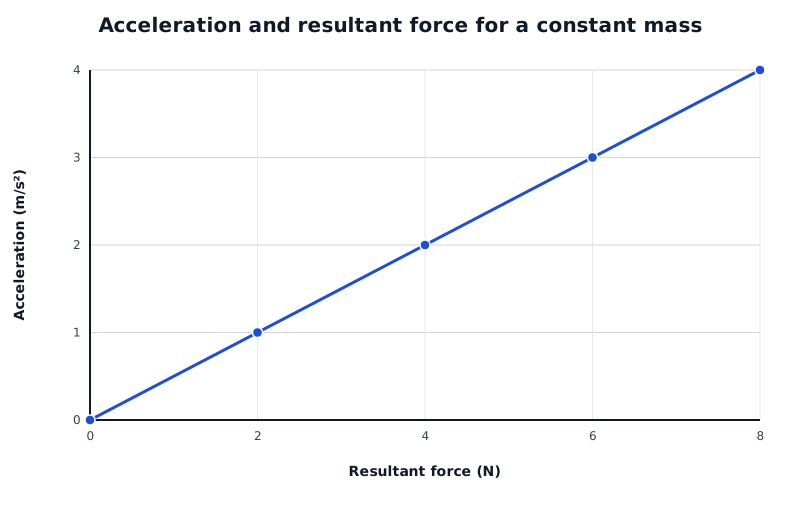
For a constant mass of 2 kg, doubling the resultant force doubles the acceleration.
Data for Acceleration and resultant force for a constant mass
| Series | Resultant force (N) | Acceleration (m/s²) |
|---|---|---|
| Constant mass: 2 kg | 0 | 0 |
| Constant mass: 2 kg | 2 | 1 |
| Constant mass: 2 kg | 4 | 2 |
| Constant mass: 2 kg | 6 | 3 |
| Constant mass: 2 kg | 8 | 4 |
For a constant resultant force, acceleration is inversely proportional to mass:
Doubling the mass halves the acceleration. For example, the same resultant force of 6 N produces an acceleration of 2 m/s² in a 3 kg trolley, but only 1 m/s² in a 6 kg trolley. This explains why a loaded trolley changes velocity less readily under the same resultant force.
The symbol indicates an approximate value or answer. It is different from : approximation means ‘about’, whereas proportionality describes a relationship between quantities.
Suppose a trolley’s mass is estimated as and its acceleration as . Using gives . Because the starting values are estimates, the calculated force is also approximate.
Inertia is the tendency of an object to continue in its state of rest or uniform motion. Uniform motion means constant velocity: the same speed in the same direction. A resultant force is needed to change that velocity, rather than simply to keep an object moving.
Inertial mass measures how difficult it is to change an object’s velocity. It is defined as the ratio of resultant force to acceleration:
For the same resultant force, an object with a larger inertial mass has a smaller acceleration. This resistance to a change in velocity applies to slowing down and changing direction as well as speeding up.
If the same resultant force acts on several objects, the one with the smallest acceleration has the largest inertial mass.
Use the resultant force in F = ma, not just one of the forces acting on the object.
Convert mass to kilograms before substituting into F = ma; for example, 500 g = 0.5 kg.
When explaining proportionality, state what stays constant: mass for a ∝ F, or resultant force for a ∝ 1/m.
A negative force or acceleration indicates a direction opposite to the direction chosen as positive; it does not automatically mean the object is slowing down.
For Higher Tier, define inertial mass as the ratio of resultant force to acceleration, as well as explaining what it measures.
It can see this note and what your specification asks for.
Answers are free with an account.
1 free note left this week
Get more free notesYour answer sets when this note comes back for review, or marks it complete.
Was this note helpful?
Log in to tell us whether it helped, or to report a problem.
Last updated
Resultant force
The single force that has the same effect as all the forces acting on an object combined, taking their directions into account.
Acceleration
The change in velocity per unit time, measured in metres per second squared (m/s²). It can involve a change in speed, direction or both.
Newton’s Second Law
The relationship in which an object's acceleration is proportional to its resultant force and inversely proportional to its mass: .
Direct proportionality
A relationship in which multiplying one quantity by a factor multiplies the other by the same factor, with other relevant quantities held constant.
Inverse proportionality
A relationship in which multiplying one quantity by a factor divides the other by that factor, with other relevant quantities held constant.
Inertia
(Higher Tier only) The tendency of an object to continue in its state of rest or uniform motion.
Inertial mass
(Higher Tier only) A measure of how difficult it is to change an object's velocity, defined as the ratio of resultant force to acceleration: .
Put your knowledge into practice — try past paper questions for Combined Science: Synergy
Resultant force
The single force that has the same effect as all the forces acting on an object combined, taking their directions into account.
Acceleration
The change in velocity per unit time, measured in metres per second squared (m/s²). It can involve a change in speed, direction or both.
Newton’s Second Law
The relationship in which an object's acceleration is proportional to its resultant force and inversely proportional to its mass: .
Direct proportionality
A relationship in which multiplying one quantity by a factor multiplies the other by the same factor, with other relevant quantities held constant.
Inverse proportionality
A relationship in which multiplying one quantity by a factor divides the other by that factor, with other relevant quantities held constant.
Inertia
(Higher Tier only) The tendency of an object to continue in its state of rest or uniform motion.
Inertial mass
(Higher Tier only) A measure of how difficult it is to change an object's velocity, defined as the ratio of resultant force to acceleration: .