

Loading…
Loading…
Loading…
AQA GCSE Combined Science: Synergy · 8465
AQA 8465 · 4.7.2.3 Series and Parallel Circuits Check the specification (PDF) (opens in a new tab)
A battery supplies a potential difference: it transfers energy to charge moving around a complete circuit. Current is the rate at which charge flows, while resistance describes how strongly a component opposes that flow.
Components connected in series lie end to end along one path. Charge passing through one component must also pass through the next. Components connected in parallel lie on separate branches between the same two junctions. Charge has a choice of paths. A circuit can contain both series and parallel parts, so follow the connections rather than judging by the shape of the drawing.
The diagram shows two resistors connected in series with a battery.
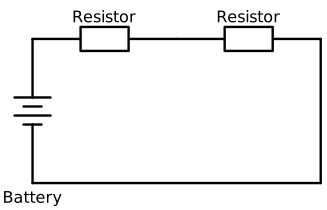
Both resistors lie on the same path: they carry the same current and share the battery's potential difference.
The current is the same through both resistors and through the battery:
Charge is not used up as it passes through a resistor. With no junction at which the current can divide, the same amount of charge passes every point each second.
The supply potential difference is shared between the components:
This means that the energy supplied to each unit of charge is transferred across the components as it travels around the circuit. Equal resistances receive equal shares of the potential difference. Unequal resistances do not: because the current is the same and , the larger resistance has the larger potential difference across it.
Adding a resistor in series puts another resistance into the only available path. All the charge must pass through both resistors, so their resistances add:
Resistance is measured in ohms, . For more than two series resistors, add all their resistances.
The total is also called the equivalent resistance. You can replace the combination with one resistor of this value when calculating the current supplied by the battery. At a fixed supply potential difference, increasing the total resistance decreases the current because .
In this circuit, each resistor is connected directly across the same battery terminals.
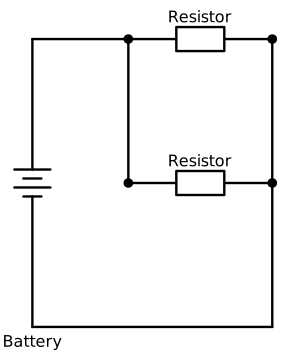
Each resistor is connected across the battery on its own branch. Branch currents add to give the total current.
Each branch therefore has the full supply potential difference:
The current splits at one junction and recombines at the other:
Charge is conserved: the charge arriving at a junction each second equals the charge leaving it each second. The current need not divide equally. At the same potential difference, a lower-resistance branch carries a larger current. Equal branch resistances carry equal currents.
For example, if two branches carry 0.2 A and 0.4 A, the current in the shared part of the circuit is 0.6 A.
Adding a resistor in parallel creates an additional path for charge. With the same supply potential difference, current can still flow through the original branch and can now also flow through the new one. The total current increases.
Since equivalent resistance is , a greater total current at the same potential difference means a smaller total resistance. For two resistors in parallel, the total resistance is . You need this qualitative explanation, not a formula for calculating parallel resistance.
Separate paths also allow independent operation. If one branch is opened by a switch, the other branch still forms a complete circuit. Opening the only path in a series circuit stops the current throughout it.
A direct current flows in one direction. To solve a series-resistor problem, first find the equivalent resistance, then use the supply potential difference to calculate the common current. Finally, use that current to find the potential difference across each resistor:
Suppose a 12 V battery supplies a 4 resistor and an 8 resistor in series. Their total resistance is , so the current is through both resistors. The potential differences are and . These add to 12 V, checking that the supply potential difference has been fully accounted for.
You can work backwards too. Suppose a 9 V supply is connected to two series components. One has a potential difference of 3 V, and the circuit current is 0.5 A. The other component has across it, so its resistance is .
For an unknown series resistance, subtract the known resistances from the total: .
An ammeter measures current and is connected in series with the path being measured. A voltmeter measures potential difference and is connected in parallel across the component being tested. To determine a component's resistance, measure its current and its potential difference, then calculate .
Series-circuit rules provide useful checks: current readings at different positions should agree, and the potential differences across the components should add to the supply potential difference. Measurements of a resistor combination can also be compared with the predicted equivalent resistance.
Use a low potential difference, especially when testing short lengths of resistance wire: their low resistance allows a large current, so the wire can become hot. Disconnect the supply between readings and before changing connections. Do not touch the wire or resistors while current flows, and allow hot components to cool before handling them. Take readings once they are steady; if a resistor's temperature changes, its resistance may change too.
Identify the junctions before deciding whether components are in series or parallel; their position on the page is not enough.
Potential difference is shared equally in series only when the components have equal resistance. Parallel branch currents are equal only when the branch resistances are equal.
Use the potential difference across the particular component in V = IR, not automatically the supply potential difference.
Explain lower parallel resistance using an extra path and a greater total current at the same supply potential difference—not by saying that resistance is shared.
Keep unrounded values during calculations and include units in your final answer. Calculating total resistance using a parallel-resistance formula is not required.
It can see this note and what your specification asks for.
Answers are free with an account.
1 free note left this week
Get more free notesYour answer sets when this note comes back for review, or marks it complete.
Was this note helpful?
Log in to tell us whether it helped, or to report a problem.
Last updated
Series circuit
An arrangement in which components are connected end to end along a single path, so the same current passes through each component.
Parallel circuit
An arrangement in which components are connected on separate branches between the same two junctions, so each branch has the same potential difference.
Current
The rate of flow of electric charge, measured in amperes (A).
Potential difference
The energy transferred per unit charge between two points, measured in volts (V).
Resistance
A measure of how strongly a component opposes current, calculated using and measured in ohms ().
Equivalent resistance
The resistance of a single resistor that would draw the same current as a combination of resistors at the same potential difference.
Junction
A point in a circuit where branches meet and current can split or recombine.
Direct current
An electric current that flows in one direction.
Put your knowledge into practice — try past paper questions for Combined Science: Synergy
Series circuit
An arrangement in which components are connected end to end along a single path, so the same current passes through each component.
Parallel circuit
An arrangement in which components are connected on separate branches between the same two junctions, so each branch has the same potential difference.
Current
The rate of flow of electric charge, measured in amperes (A).
Potential difference
The energy transferred per unit charge between two points, measured in volts (V).
Resistance
A measure of how strongly a component opposes current, calculated using and measured in ohms ().
Equivalent resistance
The resistance of a single resistor that would draw the same current as a combination of resistors at the same potential difference.
Junction
A point in a circuit where branches meet and current can split or recombine.
Direct current
An electric current that flows in one direction.
Rearrangements: and .
Ammeter: in series. Voltmeter: in parallel across the component. Use measured and to calculate resistance.