

Loading…
Loading…
Loading…
AQA GCSE Combined Science: Synergy · 8465
AQA 8465 · 4.6.2.1 Check the specification (PDF) (opens in a new tab)
Describe and systematically compare the specific nature and spatial arrangement of chemical bonds within ionic compounds, simple molecules, giant covalent structures, polymers, and metals.
Identify the three primary types of strong chemical bonds: ionic, covalent, and metallic.
Describe ionic bonding as the strong interaction involving oppositely charged ions.
Describe covalent bonding as the interaction occurring when atoms physically share pairs of electrons.
Describe metallic bonding as the interaction occurring when metal atoms share delocalized electrons.
Recognize that ionic bonding typically occurs in compounds formed from the combination of metals with non-metals.
Recognize that covalent bonding exclusively occurs within non-metallic elements and within compounds made entirely of non-metals.
Recognize that metallic bonding exclusively occurs within metallic elements and their derived alloys.
Chemical bonds hold atoms or ions together. There are three types of strong chemical bonding: ionic, covalent and metallic. They differ in the particles involved and in how electrons are involved in holding those particles together.
A substance’s structure describes how its particles and bonds are arranged. Knowing the bonding type is therefore only part of the description: covalent bonds, for example, can join atoms into small molecules, long polymer molecules or giant networks.
Bonding is not restricted to compounds. A compound contains two or more different elements chemically combined, but atoms of the same element can also bond together. Hydrogen molecules contain only hydrogen atoms; a metal can also be a single element.
Ionic bonding is the strong electrostatic attraction between oppositely charged ions. Electrostatic attraction means attraction between opposite electrical charges. An ion is an atom or group of atoms with an overall electrical charge because it has lost or gained electrons.
Ionic bonding happens when a metal combines with a non-metal. Sodium chloride is an example: it contains positive sodium ions, Na⁺, and negative chloride ions, Cl⁻.
These ions form a giant ionic lattice: a regular, repeating arrangement extending in three dimensions. Each ion is attracted to surrounding ions of the opposite charge, so the attractions act in all directions. The structure is not made of separate sodium chloride molecules.
A covalent bond forms when two atoms share a pair of electrons. Atoms can share one or more pairs. Covalent bonding is found in non-metal elements and in compounds made only of non-metals.
The same bonding type can produce three different arrangements.
Simple molecules are small, separate groups of covalently bonded atoms. In hydrogen, H₂, two hydrogen atoms share a pair of electrons. Methane, CH₄, contains a carbon atom covalently bonded to four hydrogen atoms. The strong covalent bonds are within each molecule, not between separate molecules. Forces between molecules are called intermolecular forces; in substances made of small molecules, these are much weaker than the covalent bonds.
Polymers have very large molecules built from repeating units. Their atoms are joined by strong covalent bonds along long chains. A polymer chain is still an individual molecule: neighbouring chains are not simply one continuous covalent network. Forces between the chains are distinct from the covalent bonds within them.
Giant covalent structures contain huge numbers of atoms linked by covalent bonds in an extended network. Diamond and silicon dioxide are examples. Unlike a simple molecular substance, there are no separate small molecules: the covalent bonding continues throughout the structure.
Metallic bonding occurs in metallic elements and alloys. Metal atoms share delocalised electrons: electrons that are not attached to one particular atom, but are shared throughout the metal and can move through its structure.
The metal contains a giant arrangement of positive metal ions surrounded by these delocalised electrons. The strong attraction between the positive ions and the negative electrons holds the structure together. In a pure metal, the ions form a regular arrangement, often represented as layers.
This differs from covalent bonding. A covalent bond involves a shared pair between particular atoms; metallic bonding involves electrons shared throughout the giant structure.
The diagram separates two questions: what holds the particles together, and how far does that bonding extend?
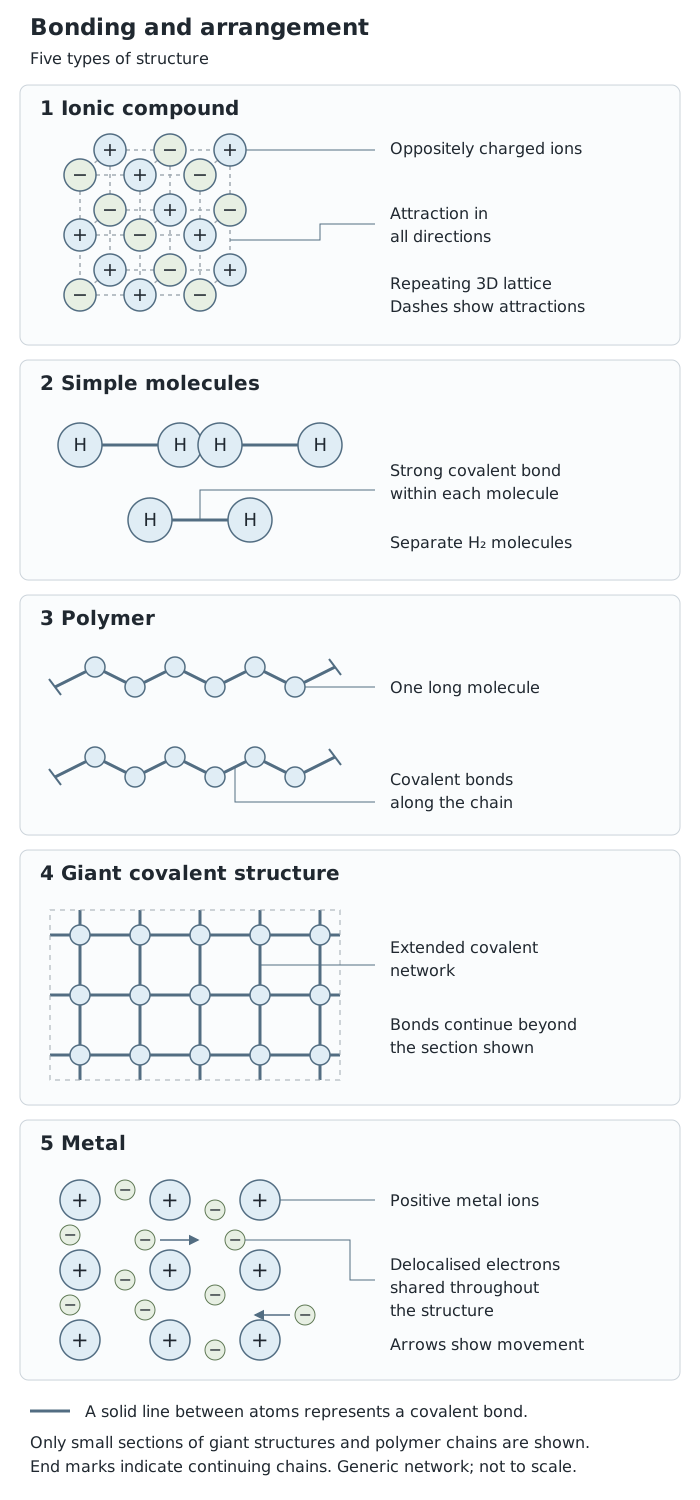
The same covalent bonding can form separate small molecules, long polymer molecules or a giant network. Ionic and metallic structures involve different charged particles.
For an ionic compound, look for opposite charges in a repeating lattice. For a simple molecular substance, look for separate small groups of bonded atoms. A polymer has separate, very long molecules, whereas a giant covalent structure has an extended bonded network. In a metal, look for positive and electrons shared throughout the structure, rather than electron pairs belonging to individual bonds.
| Structure | Arrangement and bonding |
|---|
Give both the bonding type and the arrangement when describing a structure: ‘covalent’ alone does not distinguish a simple molecule, a polymer and a giant covalent structure.
For ionic bonding, name oppositely charged ions, not neutral atoms.
Distinguish shared pairs of electrons in covalent bonds from delocalised electrons shared throughout a metal.
Do not describe the forces between separate molecules as covalent bonds.
It can see this note and what your specification asks for.
Answers are free with an account.
1 free note left this week
Get more free notesYour answer sets when this note comes back for review, or marks it complete.
Was this note helpful?
Log in to tell us whether it helped, or to report a problem.
Last updated
Compound
A substance containing two or more different elements chemically combined.
Ion
An atom or group of atoms with an overall electrical charge because it has lost or gained electrons.
Ionic bonding
The strong electrostatic attraction between oppositely charged ions.
Covalent bond
A bond in which two atoms share a pair of electrons.
Molecule
A group of atoms joined together by covalent bonds.
Polymer
A very large molecule built from repeating units, with atoms joined by covalent bonds.
Giant covalent structure
An extended network of atoms joined by strong covalent bonds, rather than separate small molecules.
Lattice
A regular, repeating arrangement of particles extending in three dimensions.
Delocalised electron
An electron that is not attached to one particular atom or confined to one bond, but is shared throughout a structure.
Metallic bonding
The strong attraction between positive metal ions and delocalised electrons shared throughout the metal.
Put your knowledge into practice — try past paper questions for Combined Science: Synergy
Compound
A substance containing two or more different elements chemically combined.
Ion
An atom or group of atoms with an overall electrical charge because it has lost or gained electrons.
Ionic bonding
The strong electrostatic attraction between oppositely charged ions.
Covalent bond
A bond in which two atoms share a pair of electrons.
Molecule
A group of atoms joined together by covalent bonds.
Polymer
A very large molecule built from repeating units, with atoms joined by covalent bonds.
Giant covalent structure
An extended network of atoms joined by strong covalent bonds, rather than separate small molecules.
Lattice
A regular, repeating arrangement of particles extending in three dimensions.
Delocalised electron
An electron that is not attached to one particular atom or confined to one bond, but is shared throughout a structure.
Metallic bonding
The strong attraction between positive metal ions and delocalised electrons shared throughout the metal.
| Ionic compound | Giant, repeating lattice of positive and negative ions; attractions in all directions. |
| Simple molecular substance | Separate small molecules; strong covalent bonds within each molecule. |
| Polymer | Very large molecules with repeating units; strong covalent bonds within each chain. |
| Giant covalent structure | Extended network of atoms linked by strong covalent bonds; no separate small molecules. |
| Metal | Giant arrangement of positive ions attracted to delocalised electrons shared throughout the structure. |
Examples: sodium chloride—ionic; hydrogen and methane—simple molecular; diamond and silicon dioxide—giant covalent.
Key distinction: covalent bonds within molecules are not the forces between molecules.