

Loading…
Loading…
Loading…
AQA GCSE Combined Science: Synergy · 8465
AQA 8465 · 4.6.1.7 Check the specification (PDF) (opens in a new tab)
Calculate the precise amount of elastic potential energy associated with a stretched spring.
Understand that physical elastic potential energy is directly stored within a stretched spring due to the work done on it.
Apply the standard equation to calculate stored energy, assuming the limit of proportionality has not been exceeded:
Identify the correct units for elastic potential energy in joules, spring constant in newtons per metre, and extension in metres.
Calculate the exact amount of physical work done in stretching the spring using this energy formula.
When you pull a spring to make it longer, you apply a force while its end moves. You therefore do work on the spring: energy is transferred into its elastic potential store. The stretched spring stores energy even when it is held still.
When released, the spring can transfer energy out of this store as it returns towards its original length. For example, a stretched spring can make an attached object move.
For a spring stretched within its limit of proportionality, the work done in stretching it equals the elastic potential energy stored. Calculating one therefore gives you the other.
The extension is how much longer the spring becomes, not its total length:
Both lengths must be measured in the same units before subtracting. The extension then needs to be expressed in metres for the energy calculation.
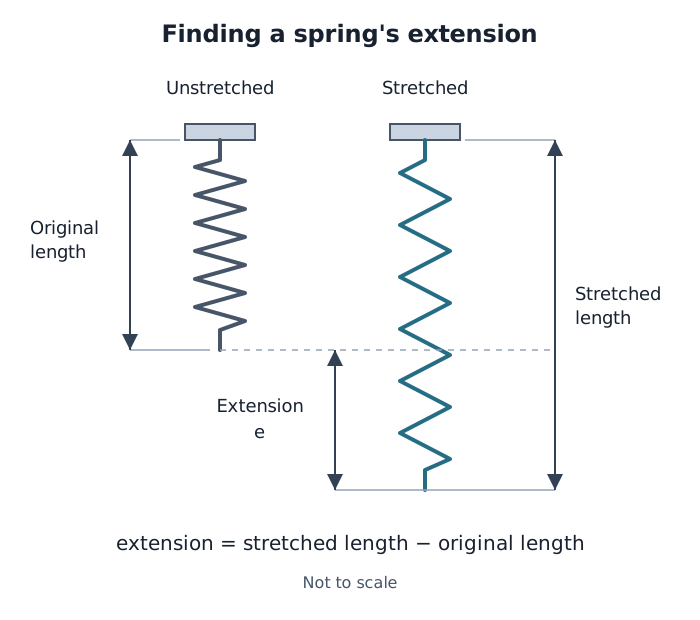
Extension is the extra length gained by the spring, not its total stretched length.
The elastic potential energy of a stretched spring is:
Here:
This equation is given on the Physics equations sheet. It applies provided the limit of proportionality has not been exceeded: the spring's extension must still be directly proportional to the applied force.
The spring constant describes how stiff the spring is. At the same extension, a spring with a larger spring constant stores more energy because more work is needed to stretch it.
The extension is squared, so its effect is especially important. For the same spring, doubling the extension stores four times as much energy, as long as both extensions remain within the proportional range.
Suppose a spring has a spring constant of and stretches from an original length of to . Assume its limit of proportionality has not been exceeded.
First find the extension:
Then substitute into the energy equation, squaring the extension:
The spring stores approximately of elastic potential energy, to two significant figures. The work done in stretching it from its original length is also approximately : this is the energy transferred into the spring's elastic potential store.
Stretching a spring transfers energy into its elastic potential store.
Within the limit of proportionality:
Use extension, not the total stretched length: subtract the original length first.
Convert extension into metres before substituting: divide centimetres by 100 or millimetres by 1000.
Square only the extension in Eₑ = ½ke², not the spring constant or the whole product.
Show the equation, substitution and answer with its unit. Work done in stretching the spring is also measured in joules.
Use this equation only when the limit of proportionality has not been exceeded.
It can see this note and what your specification asks for.
Answers are free with an account.
1 free note left this week
Get more free notesYour answer sets when this note comes back for review, or marks it complete.
Was this note helpful?
Log in to tell us whether it helped, or to report a problem.
Last updated
Elastic potential energy
Energy stored in an elastic object when work is done to change its shape, measured in joules (J).
Extension
The increase in an object's length: stretched length minus original length. In spring equations, extension is measured in metres (m).
Spring constant
The force needed per metre of extension of a spring within its proportional range, measured in newtons per metre (N/m). A larger spring constant means a stiffer spring.
Limit of proportionality
The point beyond which a spring's extension is no longer directly proportional to the applied force.
Work done
Energy transferred by a force moving an object through a distance, measured in joules (J).
Put your knowledge into practice — try past paper questions for Combined Science: Synergy
Elastic potential energy
Energy stored in an elastic object when work is done to change its shape, measured in joules (J).
Extension
The increase in an object's length: stretched length minus original length. In spring equations, extension is measured in metres (m).
Spring constant
The force needed per metre of extension of a spring within its proportional range, measured in newtons per metre (N/m). A larger spring constant means a stiffer spring.
Limit of proportionality
The point beyond which a spring's extension is no longer directly proportional to the applied force.
Work done
Energy transferred by a force moving an object through a distance, measured in joules (J).
Find extension → convert to metres → square extension → multiply by and .
For the same spring, doubling extension quadruples stored energy, provided the limit of proportionality is not exceeded.