

Loading…
Loading…
Loading…
AQA GCSE Combined Science: Synergy · 8465
AQA 8465 · 4.4.1.2 Check the specification (PDF) (opens in a new tab)
Recall that various materials cycle continuously through the abiotic and biotic components of an ecosystem.
Explain the importance of the carbon cycle to living organisms and its role in sustaining life on Earth.
Identify where carbon is found, including as atmospheric carbon dioxide, dissolved in oceans, as calcium carbonate in shells, in fossil fuels and limestone, and as carbohydrates in living organisms.
Describe the key processes involved in the environmental cycling of carbon, including photosynthesis, respiration, combustion of fuels, and industrial uses of limestone.
Describe how photosynthetic organisms act as the main producers of food and biomass by synthesizing carbohydrates from atmospheric carbon dioxide.
Understand how carbon compounds are passed along food chains as animals feed on plants and other animals.
Explain that plants and animals respire, releasing carbon dioxide back into the atmosphere.
Explain the role of microorganisms in the decay of dead plants and animals, returning carbon to the atmosphere as carbon dioxide and releasing mineral ions into the soil.
Draw and interpret scientific diagrams representing the main stores of carbon and the flows between them in the carbon cycle.
Living organisms need carbon to make carbohydrates and other large molecules that form their bodies. As organisms grow, they need a continuing supply of these materials. The carbon cycle makes carbon available for reuse by moving it between living organisms and the non-living environment.
An ecosystem includes biotic components, its living organisms, and abiotic components, such as air, water and soil. Many materials cycle between these components. Carbon, for example, can move from carbon dioxide in the air into a plant, then into an animal, and eventually back into the air. The carbon atoms are transferred between different substances rather than being used up.
A carbon store is a part of the environment in which carbon is held. Carbon occurs in several different chemical forms:
These stores are connected by processes that move carbon between them. Some carbon passes through living organisms relatively quickly, while carbon in rocks and fossil fuels can remain stored for very long periods.
Green plants and algae are photosynthetic producers: they make food using light energy. During photosynthesis, they use carbon dioxide and water to make glucose, a carbohydrate, and release oxygen. Chlorophyll absorbs the light needed for this process.
For a green plant on land, the carbon in the glucose comes from carbon dioxide in the air. The plant can use this glucose to make other substances needed for growth. Carbon that was in the atmosphere therefore becomes part of the plant's biomass, its living biological material.
Photosynthetic organisms are the main producers of food and biomass for life on Earth. They provide the carbon compounds on which food chains depend.
When an animal eats a plant, it takes in the plant's carbon compounds. Some of that carbon becomes part of the animal's body. If another animal eats it, carbon compounds pass to the next organism in the food chain.
For example, carbon can pass from grass to a rabbit and then to a fox. Each feeding step transfers carbon already present in food; it does not create new carbon. Producers introduce carbon into the food chain through photosynthesis, while consumers obtain it by feeding.
Plants, animals and microorganisms all respire. Respiration transfers energy from food for processes in their cells. In aerobic respiration, glucose reacts with oxygen, producing carbon dioxide and water:
The carbon in the glucose becomes carbon dioxide, which can return to the atmosphere. Plants therefore have two different roles in the cycle: photosynthesis takes in carbon dioxide, while respiration releases it. Respiration occurs in plants during both day and night.
When plants and animals die, their bodies still contain carbon compounds. Microorganisms, including bacteria and fungi, act as decomposers, breaking down dead material and waste products. This breakdown is called decay or decomposition.
Decomposers use some of these carbon compounds in respiration, releasing carbon dioxide back into the atmosphere. Decay also releases mineral ions into the soil, where plants can take them up again. Carbon dioxide and mineral ions have different destinations, but both become available for reuse. Without decomposition, many materials would remain locked in dead organisms rather than returning to the cycle.
Combustion is the burning of a fuel. Burning carbon-containing fuels such as wood, coal, oil or natural gas releases carbon dioxide into the atmosphere. Burning wood returns carbon held in plant material; burning fossil fuels releases carbon from long-term stores.
Industrial processing of limestone also releases carbon dioxide. Limestone contains calcium carbonate. When it is strongly heated, for example during cement manufacture, it breaks down into calcium oxide and carbon dioxide:
This moves carbon from a rock store into the atmosphere. Human activities can therefore change how much carbon is held in different stores.
In a carbon-cycle diagram, boxes represent stores and arrows represent transfers. Read each arrow from its starting store to its destination, using the process label to explain how the carbon moves.
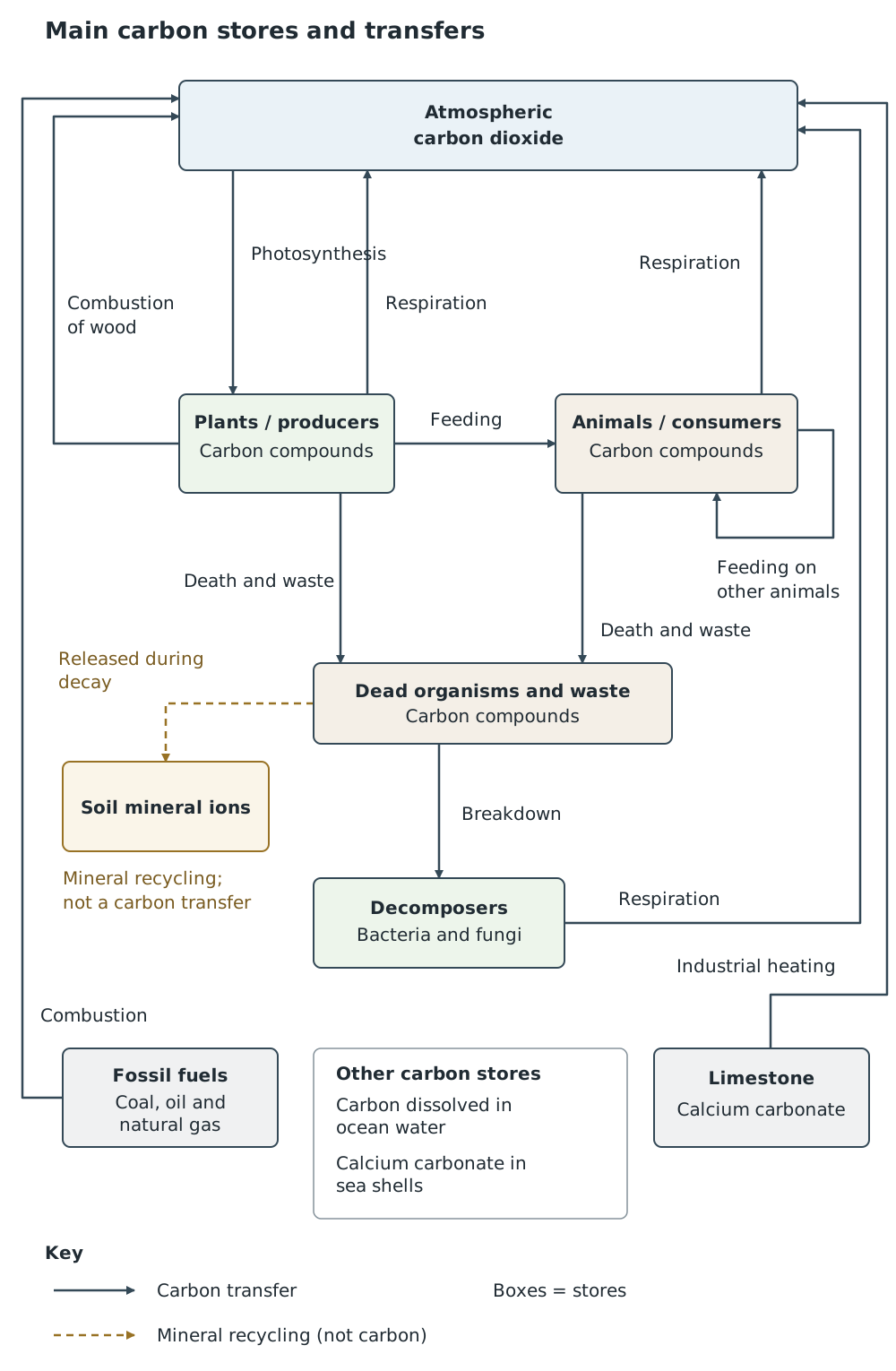
Carbon moves between stores through labelled processes. Decay also returns mineral ions to soil; that is a separate material transfer.
For example, an arrow from atmospheric carbon dioxide to plants labelled ‘photosynthesis’ means that carbon from the air is incorporated into plant carbohydrates. An arrow from plants back to atmospheric carbon dioxide labelled ‘respiration’ represents a different process, not the reversal of the photosynthesis arrow.
To draw the main biological cycle, place atmospheric carbon dioxide above boxes for plants and animals. Add photosynthesis from the atmosphere to plants, feeding from plants to animals, and respiration from both plants and animals back to the atmosphere. Add dead material receiving carbon from organisms, then decomposers that break it down and return carbon dioxide through respiration. Finally, add fuel and limestone stores with arrows showing how combustion and industrial heating release carbon dioxide.
Trace a complete route, such as atmosphere → plant → animal → atmosphere. This shows why the cycle matters: carbon returned to the air can be taken up again by producers and used to support new growth.
Carbon is found as:
Label boxes with carbon stores and arrows with processes. An arrow shows the direction in which carbon moves.
Include respiration by plants as well as animals and decomposers.
Explain that decomposers release carbon dioxide through respiration; decay also releases mineral ions into the soil.
Keep feeding and respiration distinct: feeding transfers carbon compounds between organisms, whereas respiration releases carbon dioxide.
Include both combustion of fuels and heating limestone in industry as processes that release carbon dioxide.
It can see this note and what your specification asks for.
Answers are free with an account.
1 free note left this week
Get more free notesYour answer sets when this note comes back for review, or marks it complete.
Was this note helpful?
Log in to tell us whether it helped, or to report a problem.
Last updated
Carbon cycle
The movement of carbon between living organisms and non-living parts of the environment through processes such as photosynthesis, feeding, respiration and combustion.
Abiotic component
A non-living part of an ecosystem, such as air, water or soil.
Biotic component
A living part of an ecosystem, such as a plant, animal or microorganism.
Carbon store
A part of the environment in which carbon is held, such as the atmosphere, living organisms or limestone.
Producer
An organism that makes its own food. Photosynthetic producers use light energy to make carbohydrates from carbon dioxide and water.
Biomass
The mass of living biological material.
Photosynthesis
The process by which plants and algae use light energy to make glucose from carbon dioxide and water, releasing oxygen.
Respiration
A chemical process in cells that transfers energy from food. Aerobic respiration uses oxygen and releases carbon dioxide and water.
Decomposer
An organism, such as a bacterium or fungus, that breaks down dead organisms and waste materials.
Decay
The breakdown of dead organisms and waste materials by decomposers.
Combustion
Burning a fuel, usually by reacting it with oxygen, transferring energy to the surroundings.
Put your knowledge into practice — try past paper questions for Combined Science: Synergy
Carbon cycle
The movement of carbon between living organisms and non-living parts of the environment through processes such as photosynthesis, feeding, respiration and combustion.
Abiotic component
A non-living part of an ecosystem, such as air, water or soil.
Biotic component
A living part of an ecosystem, such as a plant, animal or microorganism.
Carbon store
A part of the environment in which carbon is held, such as the atmosphere, living organisms or limestone.
Producer
An organism that makes its own food. Photosynthetic producers use light energy to make carbohydrates from carbon dioxide and water.
Biomass
The mass of living biological material.
Photosynthesis
The process by which plants and algae use light energy to make glucose from carbon dioxide and water, releasing oxygen.
Respiration
A chemical process in cells that transfers energy from food. Aerobic respiration uses oxygen and releases carbon dioxide and water.
Decomposer
An organism, such as a bacterium or fungus, that breaks down dead organisms and waste materials.
Decay
The breakdown of dead organisms and waste materials by decomposers.
Combustion
Burning a fuel, usually by reacting it with oxygen, transferring energy to the surroundings.
Materials move between biotic and abiotic components. Recycling makes carbon available for new organisms and growth.
Boxes = stores; labelled arrows = transfers. Follow arrow directions to trace carbon through a complete cycle.