

Loading…
Loading…
Loading…
AQA GCSE Combined Science: Synergy · 8465
AQA 8465 · 4.1.4.1 Transverse and Longitudinal Waves Check the specification (PDF) (opens in a new tab)
A wave transfers energy through a medium, such as water, air or a solid. To investigate its motion, distinguish the movement of the travelling disturbance from the movement of the material it passes through.
A small floating paper boat makes the movement of water easier to observe. As ripples pass, the boat bobs up and down rather than travelling across the water with the crests. Its movement shows that the water beneath it oscillates locally while the ripple and its energy move onwards. The water is not carried along with each crest.
For sound, a teacher can demonstrate the movement of air using a lit candle in front of a loudspeaker playing a steady note. The flame moves backwards and forwards rather than being blown steadily away from the speaker. This provides visible evidence of local back-and-forth air movement: the air oscillates while the compressions and rarefactions travel outwards, transferring energy. The oscillation is parallel to the direction of sound travel, as expected for a longitudinal wave. Stand the candle securely on a heatproof mat, keep flammable materials and hair clear, use a safe sound level and extinguish the candle after observing the movement.
These distinctions explain why measuring wave speed means tracking the disturbance, not measuring how fast an individual particle moves.
A ripple tank is a shallow transparent tank used to observe water waves. Use water about 5 mm deep. A motor vibrates a wooden rod which, when stationary, should just touch the water surface. The rod produces straight, parallel wavefronts.
Place a lamp above the tank and a large sheet of white card beneath it. Adjust the lamp until the projected wave pattern is clear. View the card directly from the side rather than looking down through the water. Darkening the room can make the pattern easier to see.
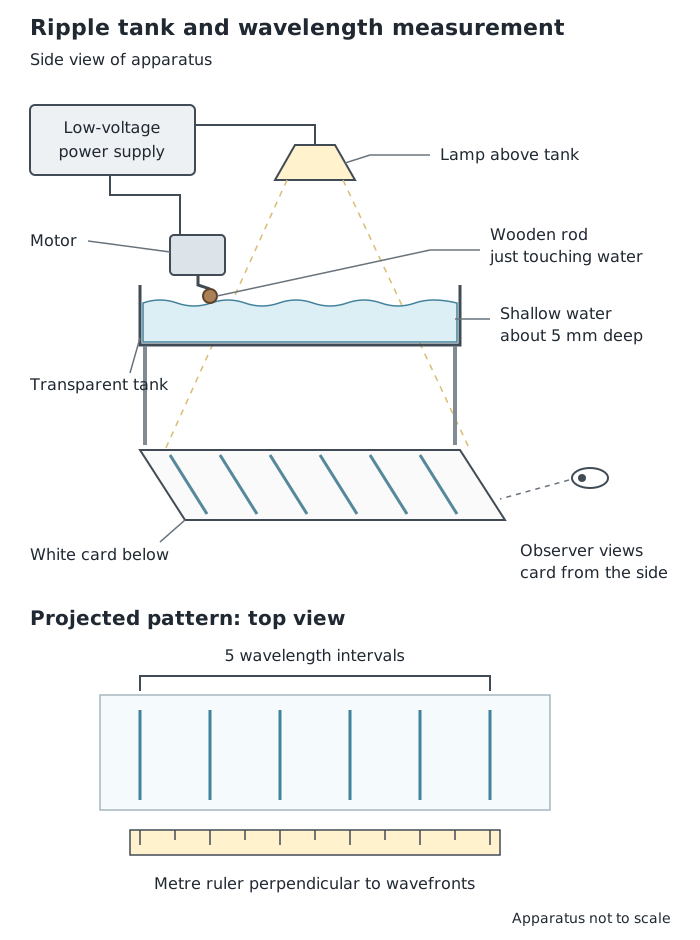
Measure across several wavelength intervals at right angles to the wavefronts.
Use a suitable low-voltage supply for the motor and lamp. Keep electrical connections dry, clear up spills promptly and keep walkways clear, especially if the room is darkened. A stroboscope should only be used after checking that flashing lights will not affect anyone taking part.
The apparatus is ready for measurement when the rod produces a regular pattern and successive wavefronts can be distinguished clearly.
Wavelength is the distance between equivalent points on adjacent waves. Position a metre ruler at right angles to the projected wavefronts. Measure a distance covering several complete wavelength intervals, then divide by the number of intervals:
Measuring several wavelengths reduces the effect of uncertainty in locating any one wavefront. The projected pattern must also have a suitable scale: an enlarged image cannot automatically be treated as the actual size of the ripples.
Frequency is the number of complete waves passing a fixed point each second. Run the motor slowly enough to count the wavefronts passing one point in, for example, 10 seconds. Divide the count by the time:
Repeat the count and calculate a mean. Several observers can count independently to check how consistent the observations are.
Direct counting is suitable for slow waves but becomes difficult when the wavefronts pass too quickly. Recording the pattern and using video playback can make counting easier. Alternatively, a suitably adjusted stroboscope can make the pattern appear stationary and provide a frequency reading.
Once frequency and wavelength are known, calculate wave speed using:
Frequency must be in hertz and wavelength in metres to obtain speed in metres per second.
For example, a ripple-tank result with frequency 4.545 Hz and wavelength 0.025 m gives . This is the speed of the travelling ripple pattern, not the speed at which the water surface rises and falls.
When comparing repeated results, look for agreement between calculated speeds. Large differences suggest checking the clarity of the pattern, wave counts, timing and wavelength measurements rather than immediately concluding that the wave speed has changed.
Sound travels too quickly for a hand-operated stopwatch to measure its travel time reliably across a laboratory. Two microphones and an oscilloscope can detect and time its arrival electronically.
Connect each microphone to a separate oscilloscope input. Place the microphones in a straight line, about 5 m apart, and measure the separation with a tape measure. Make a short, sharp sound using two wooden blocks just beyond the first microphone, in line with both microphones. The sound then travels past the first microphone towards the second, so the extra distance it travels between detections is the microphone separation.
Each microphone converts the sound into an electrical signal. Set the oscilloscope to trigger when the first microphone detects the sound, and adjust its time base until both signals can be seen clearly. The first trace changes before the second: this delay is evidence that the sound takes time to travel through the air.
Measure the horizontal separation between the starts of the two signals. Multiply the number of divisions by the time represented by each division:
Convert the delay to seconds if the time base is given in milliseconds. Calculate speed using the measured microphone separation and the delay :
Repeat the sound and timing measurements several times and calculate a mean delay. The result should be approximately 340 m/s for sound in air under ordinary room conditions. For the same separation, a longer measured delay gives a lower calculated speed. If the separation is increased, the delay should increase roughly in proportion, giving a similar calculated speed.
Electronic timing avoids the observer's reaction-time error. Increasing the microphone separation, where space and signal strength allow, makes the delay larger and easier to measure. A suitable time-base setting should spread the two detections clearly across the screen without losing either one. Repeats help identify inconsistent readings, but do not correct a wrongly interpreted time-base scale.
Keep the sound level no louder than needed for detection and do not make loud sounds close to anyone's ears. Keep leads out of walkways. The apparatus is ready when both microphones give clear signals and the arrival delay can be distinguished reliably.
A vibrating string provides a visible way to investigate waves in a solid. Connect the string to a vibration generator driven by a signal generator. Pass the other end over a pulley and use hanging masses to provide tension. A movable wooden bridge sets the length allowed to vibrate.
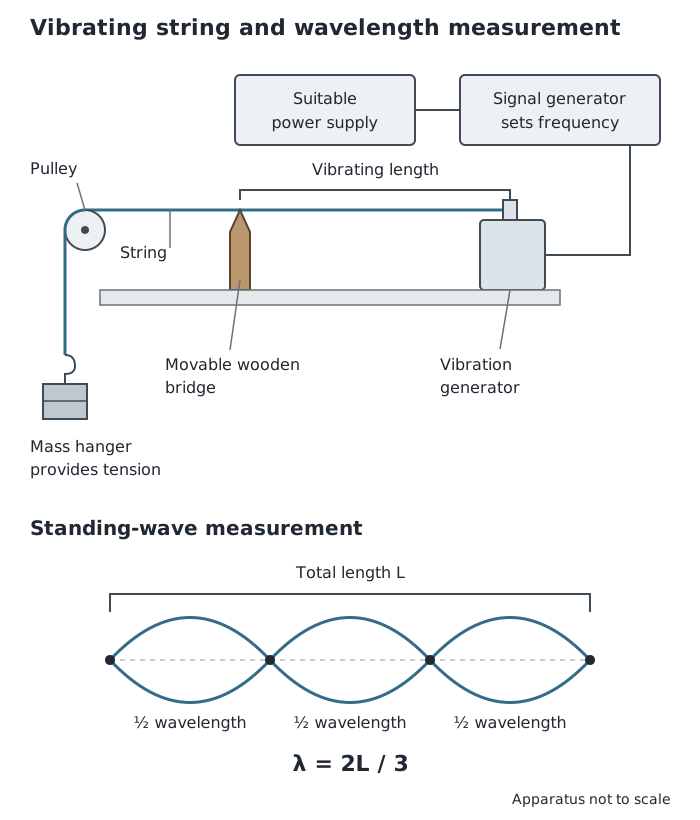
Each loop spans half a wavelength; measure several loops together.
Adjust the driving frequency, vibrating length or tension until a clear, steady pattern of loops appears. This is a standing-wave pattern: its loops remain in fixed positions while the string vibrates. A similar vibrating string produces sound in a stringed musical instrument; detailed standing-wave theory is not needed for these measurements.
Secure the apparatus and keep feet clear of the hanging masses. Stop the generator before repositioning the apparatus or changing masses, and do not overstretch an elastic cord.
Each complete loop represents half a wavelength. Measure the total length across several loops with a metre ruler, divide by the number of loops, then multiply by two:
Read the frequency from the signal generator and calculate speed using . The generator reading is more suitable than trying to count rapid string vibrations by eye.
With the same string and a 100 g mass hanger providing tension, example results give frequencies of 5.0, 10.0 and 15.0 Hz, with wavelengths of 3.38, 1.68 and 1.12 m respectively. The calculated speeds are 16.90, 16.80 and 16.80 m/s. As frequency increases, wavelength decreases, while the calculated speed remains approximately constant under these conditions.
A ruler is useful only when the wave pattern is clear enough to locate equivalent points. Measuring several intervals is preferable to measuring just one. A stopwatch and direct counting suit slow ripples, whereas video playback or a stroboscope can help with faster motion. A signal generator supplies a frequency reading for a vibrating string. For a short sound pulse, microphones and an oscilloscope are suitable for measuring a very brief travel time; this method does not require a wavelength measurement.
Suitability therefore depends on what can actually be observed and measured reliably. A clear pattern, repeatable readings and correctly interpreted distances and times matter more than simply having a particular item of equipment.
Count wavelength intervals, not wavefronts: six successive wavefronts span five wavelengths.
Measure perpendicular to the wavefronts, rather than along them.
For a vibrating string, each loop is half a wavelength, not a whole wavelength.
Convert lengths to metres before calculating speed in m/s.
Explain why an apparatus choice helps: for example, video playback makes fast ripples easier to count.
For the two-microphone sound method, use the delay between the two detections, not the time from making the sound.
Convert an oscilloscope delay from milliseconds to seconds before using it to calculate speed.
When describing evidence that waves do not transfer matter, name the observation and explain what it shows about the medium's movement.
It can see this note and what your specification asks for.
Answers are free with an account.
1 free note left this week
Get more free notesYour answer sets when this note comes back for review, or marks it complete.
Was this note helpful?
Log in to tell us whether it helped, or to report a problem.
Last updated
Medium
A substance through which a wave travels, such as water, air or a string.
Oscillation
A repeated movement about a resting position.
Wavelength
The distance between equivalent points on adjacent waves, measured in metres.
Frequency
The number of complete waves passing a point each second, measured in hertz (Hz).
Wave speed
The speed at which a wave transfers energy through a medium, measured in metres per second.
Wavefront
A line joining points at the same stage of a wave, such as the crest of a straight water ripple.
Stroboscope
A lamp that flashes repeatedly at an adjustable frequency and can make a repeating movement appear stationary.
Oscilloscope
An instrument that displays how an electrical signal changes with time; microphones can supply signals representing sound.
Time base
The oscilloscope setting that gives the time represented by each horizontal division on its screen.
Put your knowledge into practice — try past paper questions for Combined Science: Synergy
Medium
A substance through which a wave travels, such as water, air or a string.
Oscillation
A repeated movement about a resting position.
Wavelength
The distance between equivalent points on adjacent waves, measured in metres.
Frequency
The number of complete waves passing a point each second, measured in hertz (Hz).
Wave speed
The speed at which a wave transfers energy through a medium, measured in metres per second.
Wavefront
A line joining points at the same stage of a wave, such as the crest of a straight water ripple.
Stroboscope
A lamp that flashes repeatedly at an adjustable frequency and can make a repeating movement appear stationary.
Oscilloscope
An instrument that displays how an electrical signal changes with time; microphones can supply signals representing sound.
Time base
The oscilloscope setting that gives the time represented by each horizontal division on its screen.
Keep electrical connections dry, check suitability before using flashing lights, secure hanging masses and avoid excessive sound levels. For the candle demonstration, use a heatproof mat, keep flammable materials clear and extinguish the flame afterwards.