

Loading…
Loading…
Loading…
AQA GCSE Combined Science: Synergy · 8465
AQA 8465 · 4.1.4.3 Electromagnetic Waves Check the specification (PDF) (opens in a new tab)
Light from a lamp, the signal reaching a radio and the radiation warming you beside an electric heater are all electromagnetic waves. They transfer energy from a source to an absorber. The source emits the waves; the absorber takes in some of the energy they carry.
All electromagnetic waves are transverse: their oscillations are perpendicular to the direction in which the wave travels. Unlike sound, they do not need particles of a material to carry them, so they can travel through a vacuum. This is how sunlight crosses space to reach Earth.
Every electromagnetic wave travels at the same speed in a vacuum: approximately . Radio waves and gamma rays differ enormously in wavelength and frequency, but neither travels faster than the other in a vacuum.
The electromagnetic spectrum is the complete range of electromagnetic waves. It is continuous: wavelength and frequency change smoothly across it, rather than leaving gaps between separate types. The named regions are useful groupings within this continuous range.
From longest wavelength and lowest frequency to shortest wavelength and highest frequency, the order is:
Radio waves → microwaves → infrared → visible light → ultraviolet → X-rays → gamma rays.
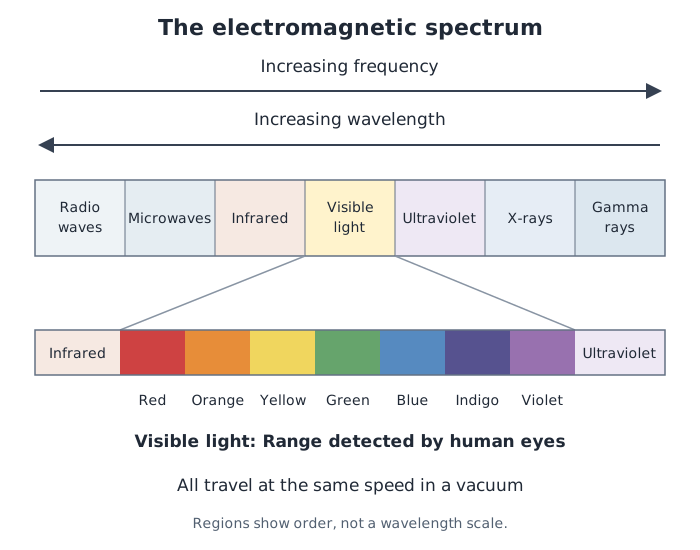
Towards gamma rays, frequency increases and wavelength decreases. Visible light is only a small part of the continuous spectrum.
Our eyes detect only the small region called visible light. Within this region, the order from longest to shortest wavelength is red, orange, yellow, green, blue, indigo, violet. Red therefore has a lower frequency than violet. Infrared lies beyond the red end, while ultraviolet lies beyond the violet end; neither is visible to human eyes.
The wave equation applies throughout the electromagnetic spectrum:
Here, is wave speed in metres per second, is frequency in hertz and is wavelength in metres.
Because all electromagnetic waves have the same speed in a vacuum, the product must stay constant. A higher frequency therefore means a shorter wavelength. For example, if the frequency doubles, the wavelength halves: twice as many waves pass each second, but each wave is half as long.
For calculations, rearrange the equation to find the required quantity:
This explains the spectrum's two opposite trends: moving from radio waves towards gamma rays increases frequency but decreases wavelength.
Electromagnetic waves can carry information as well as energy. A receiver absorbs energy from an incoming signal and uses it to recover the information being transmitted.
Radio waves are used for television and radio broadcasting. A transmitting aerial is the source, and a receiving aerial absorbs energy from the waves. Radio telescopes detect radio waves emitted by objects in space, allowing astronomers to study radiation that human eyes cannot see.
Microwaves are used for satellite communications. Signals travel between transmitters, satellites and receivers, including across the vacuum of space.
Visible light is used for fibre optic communications. Light signals travel along optical fibres and reach a detector, transferring information from the transmitter to the receiver.
Infrared cameras detect infrared radiation emitted by objects. They turn the detected radiation into an image, making it possible to identify warmer and cooler areas without relying on visible light.
When radiation is absorbed, its energy can increase the internal energy of the absorber and raise its temperature.
In a microwave oven, the oven generates microwaves and the food absorbs their energy, heating it. This is a clear source-to-absorber transfer: oven → microwaves → food.
Infrared radiation is used by electrical heaters and for cooking food. A hot heating element emits infrared radiation; nearby objects or food absorb it and become warmer. The radiation can transfer energy without the absorber touching the heating element.
Ultraviolet is used in fluorescent lamps and for sun tanning. In a fluorescent lamp, ultraviolet radiation is absorbed by a coating that emits visible light. In tanning, skin absorbs ultraviolet radiation and responds by producing a tan; tanning does not mean the exposure is harmless.
X-rays are used for medical imaging and treatments. In imaging, different tissues absorb different amounts of the radiation, allowing a detector to form an image of internal structures. In treatment, radiation transfers energy to the targeted tissue.
Gamma rays are used to sterilise surgical instruments and to treat cancer. For sterilisation, microorganisms absorb radiation that kills them. In cancer treatment, the aim is for cancer cells to absorb radiation that damages or kills them.
Across these very different uses, the same connection remains: a source emits electromagnetic waves, the waves carry energy, and an absorber takes that energy in. Absorption may produce heating, a detected signal, light emission or changes in living cells.
All electromagnetic waves are transverse, transfer energy from source to absorber, and travel through a vacuum at the same speed: approximately .
Check whether the question asks for increasing frequency or increasing wavelength: these give opposite orders.
Higher-frequency electromagnetic waves do not travel faster in a vacuum. All have the same speed there.
For energy-transfer explanations, name the source, the electromagnetic wave and the absorber, then state what absorption does.
Use wavelength in metres and frequency in hertz in v = fλ. Convert prefixes such as centimetres or megahertz before substituting.
It can see this note and what your specification asks for.
Answers are free with an account.
1 free note left this week
Get more free notesYour answer sets when this note comes back for review, or marks it complete.
Was this note helpful?
Log in to tell us whether it helped, or to report a problem.
Last updated
Electromagnetic wave
A transverse wave that transfers energy from a source to an absorber and can travel through a vacuum.
Electromagnetic spectrum
The complete, continuous range of electromagnetic waves, arranged by wavelength or frequency.
Transverse wave
A wave whose oscillations are perpendicular to its direction of travel.
Visible light
The limited range of electromagnetic wavelengths that the human eye can detect.
Vacuum
A region containing no matter. Electromagnetic waves can travel through a vacuum.
Absorber
An object or material that takes in energy carried by radiation.
Wavelength
The distance between equivalent points on consecutive waves, measured in metres.
Frequency
The number of complete waves passing a point each second, measured in hertz (Hz).
Put your knowledge into practice — try past paper questions for Combined Science: Synergy
Electromagnetic wave
A transverse wave that transfers energy from a source to an absorber and can travel through a vacuum.
Electromagnetic spectrum
The complete, continuous range of electromagnetic waves, arranged by wavelength or frequency.
Transverse wave
A wave whose oscillations are perpendicular to its direction of travel.
Visible light
The limited range of electromagnetic wavelengths that the human eye can detect.
Vacuum
A region containing no matter. Electromagnetic waves can travel through a vacuum.
Absorber
An object or material that takes in energy carried by radiation.
Wavelength
The distance between equivalent points on consecutive waves, measured in metres.
Frequency
The number of complete waves passing a point each second, measured in hertz (Hz).
Long wavelength / low frequency → short wavelength / high frequency:
Radio → microwave → infrared → visible → ultraviolet → X-ray → gamma.
Only visible light is detected by human eyes. Within visible light, red → violet means decreasing wavelength and increasing frequency.
: m/s; : Hz; : m. At constant speed, increasing frequency decreases wavelength.
| Region | Uses |
|---|---|
| Radio | Television, radio, radio telescopes |
| Microwave | Satellite communications, cooking food |
| Infrared | Electrical heaters, cooking food, infrared cameras |
| Visible | Fibre optic communications |
| Ultraviolet | Fluorescent lamps, sun tanning |
| X-ray | Medical imaging and treatments |
| Gamma | Sterilising surgical instruments, treating cancer |