

Loading…
Loading…
Loading…
AQA GCSE Combined Science: Synergy · 8465
AQA 8465 · 4.1.4.3 Electromagnetic Waves Check the specification (PDF) (opens in a new tab)
Infrared radiation transfers energy from a source to an absorber. An object can emit infrared, transferring energy away from itself, and absorb infrared arriving from elsewhere, transferring energy to itself. Absorbing radiation can raise an object's temperature.
Warm objects emit infrared radiation. Hotter objects emit more, so a comparison of surfaces is only fair if their temperatures are the same. The nature of the surface also matters: a matt black surface is a good absorber and emitter of infrared, whereas a shiny silver surface is a poor absorber and emitter and a good reflector.
Colour and shininess are different properties. Matt black and shiny black surfaces have the same colour but different finishes. Comparing them helps investigate the effect of finish rather than treating colour as the only factor. Visible colour alone is not always a reliable guide to infrared behaviour: a white painted surface need not behave like shiny metal.
A Leslie cube is a hollow metal cube with differently finished faces. The surfaces used here are shiny black, matt black, shiny silver and matt white. Filling the cube with hot water heats all four faces, allowing their infrared emission to be compared at approximately the same temperature.
The apparatus consists of a Leslie cube, a kettle, an infrared detector and a heatproof mat. A ruler is useful for setting a consistent detector distance.
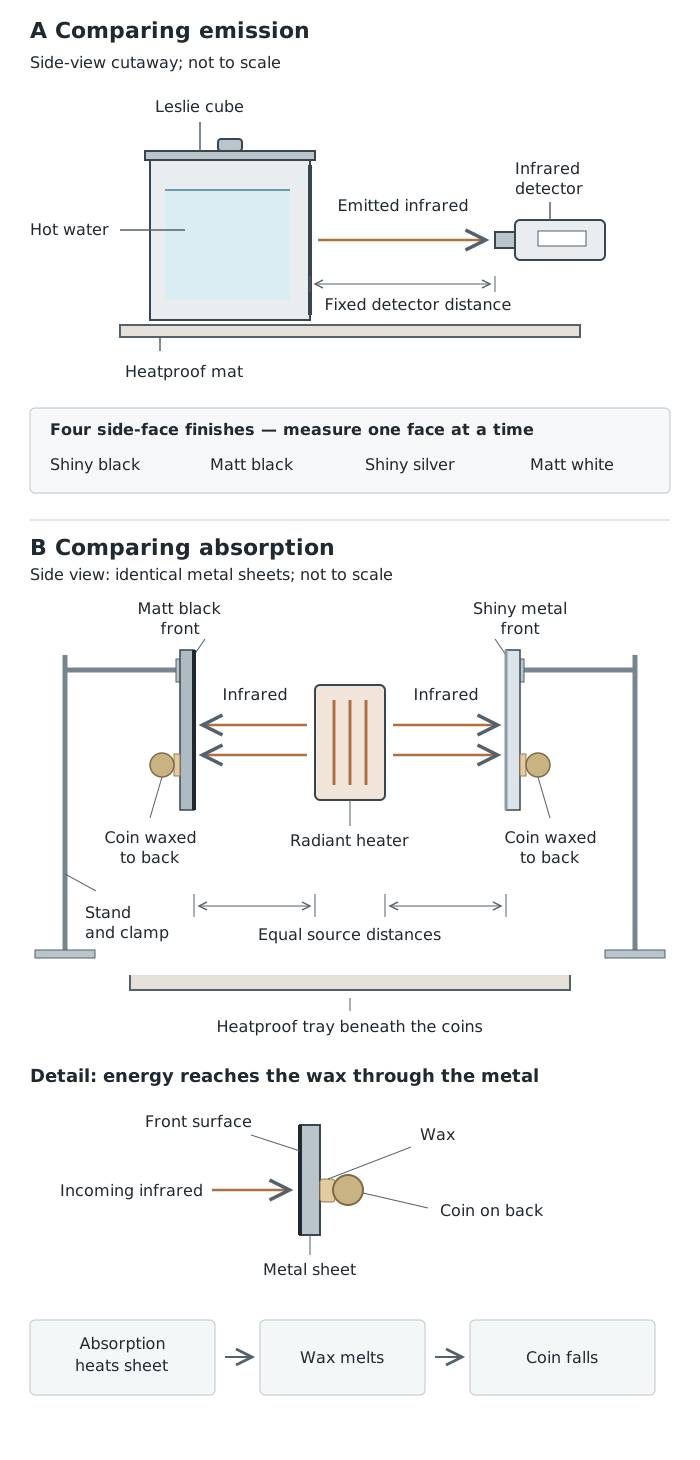
Emission is measured with a detector; absorption is compared through the heating of metal sheets. Equal distances are essential in both investigations.
The independent variable is the surface type or finish. The dependent variable is the infrared detector reading, which indicates the radiation reaching the detector. Keep the detector distance, angle and settings unchanged. The equal-sized faces also allow equal surface areas to be compared.
Very hot water can scald, and the cube becomes hot. Filling should be supervised, the cube should remain on its mat, and students should not carry containers of hot water across the laboratory. Avoid touching the hot faces and keep water away from electrical equipment. Leave the apparatus to cool before handling or emptying it.
Record the readings in a table with one row for each surface. Draw a bar chart, with surface type on the horizontal axis and mean detector reading, with its unit, on the vertical axis. Surface types are separate categories, so they should have separate bars.
A higher reading means that more infrared reached the detector. With distance and temperature controlled, this indicates greater emission from that surface. The expected contrast is strong emission from matt black and weak emission from shiny silver.
For example, a set of Leslie-cube results gives infrared intensities of 19.5 W/m² for matt black, 14.2 W/m² for shiny black, 5.1 W/m² for matt white and 3.8 W/m² for shiny silver. In this example, matt black is the best emitter and shiny silver is the worst; shiny black emits more than matt white. Use your measured readings to order the surfaces rather than assuming that every material must follow a complete order based on its visible colour.
The cube cools during the investigation. If one face is always measured last, its lower reading might partly reflect cooling rather than its finish. Take the readings promptly and repeat them in a different order. For repeated sets, check that the water temperature is comparable.
An inconsistent detector position can also change the reading. Use a fixed distance measured with a ruler and aim at the centre of each face. Repeated readings help reveal random variation; however, repeating measurements does not correct a distance that is consistently wrong.
Absorption can be investigated by directing infrared at two similar metal sheets: one with a matt black surface facing the source and the other with a shiny metal surface facing it.
Use an infrared source such as a radiant heater, two stands and clamps, two small coins, candle wax and a stopwatch. Secure the sheets so that they face the source at equal distances. Attach a coin to the back of each sheet using a similar small amount of wax. The coins should be on the sides facing away from the source, so the source heats the sheets rather than directly heating the wax.
Start with both sheets at the same temperature. Switch on the source and time how long it takes for each coin to fall. Infrared absorbed at the front heats the metal; energy is transferred through the sheet to the wax. When the wax melts sufficiently, it can no longer hold the coin.
The coin on the matt black sheet is expected to fall first. Its shorter falling time indicates faster heating and supports the conclusion that matt black is the better absorber. The shiny surface reflects more of the incoming infrared and absorbs less.
For a fair comparison, use sheets of the same metal, size and thickness, identical coins, similar amounts of wax and equal source distances and angles. Here, surface finish is the independent variable and time until the coin falls is the dependent variable. Repeat only after the sheets have cooled and the coins have been reattached consistently.
The source and sheets become hot. Secure the clamps, keep combustible materials away from the heater, place a heatproof tray beneath the coins and do not touch the sheets or fallen coins until they have cooled. Switch off the source once the observations are complete.
Temperature rise provides another way to compare absorption. In an investigation using four same-sized hollow metal cubes containing cold water, each cube was placed the same distance from an infrared heater. After 10 minutes, the temperature increases were 3.0°C for matt white, 2.0°C for shiny white, 6.5°C for matt black and 4.0°C for shiny black.
Compare like with like to draw two distinct conclusions. Matt black warmed more than matt white, and shiny black warmed more than shiny white: black surfaces absorbed more infrared than white surfaces in this investigation. Matt black warmed more than shiny black, and matt white warmed more than shiny white: matt surfaces absorbed more than shiny surfaces of the same colour. Matt black produced the greatest temperature rise and shiny white the smallest.
Here the dependent variable is the temperature increase after a fixed time, rather than a detector reading or a falling time. Equal water volumes, starting temperatures, cube dimensions, heater distances and heating times are needed for a fair comparison.
The Leslie cube compares energy travelling from a surface to a detector. The absorption investigations compare energy travelling from a source into a surface. Together they demonstrate that surface finish affects both emission and absorption: good infrared absorbers are also good infrared emitters, while shiny metallic surfaces are poor at both.
Hot water, the cube, heater and sheets can burn or scald. Use heatproof protection, secure apparatus, avoid carrying hot water and allow equipment to cool before handling.
Identify the surface type or finish as the independent variable. In the Leslie cube experiment, the dependent variable is the infrared detector reading, not the water temperature.
Explain control variables: keep the detector distance and surface temperature the same so that differences in readings can be attributed to the surfaces.
Use a bar chart for separate surface categories, rather than joining them with a line.
Distinguish emission from absorption: the Leslie cube emits infrared towards a detector; the metal sheets absorb infrared from a heater.
Do not assume that a surface which looks white must behave like shiny metal. Surface finish matters as well as colour.
When comparing colour, compare surfaces with the same finish; when comparing finish, compare surfaces of the same colour.
It can see this note and what your specification asks for.
Answers are free with an account.
1 free note left this week
Get more free notesYour answer sets when this note comes back for review, or marks it complete.
Was this note helpful?
Log in to tell us whether it helped, or to report a problem.
Last updated
Infrared radiation
Electromagnetic radiation that transfers energy and has wavelengths longer than those of visible red light.
Emission
The release of radiation from an object, transferring energy away from it.
Absorption
The taking in of radiation by a material, transferring energy to it.
Reflection
The return of radiation from a surface without it being absorbed.
Leslie cube
A hollow metal cube with differently finished faces, filled with hot water to compare infrared emission from those surfaces.
Matt surface
A dull, non-shiny surface finish.
Put your knowledge into practice — try past paper questions for Combined Science: Synergy
Infrared radiation
Electromagnetic radiation that transfers energy and has wavelengths longer than those of visible red light.
Emission
The release of radiation from an object, transferring energy away from it.
Absorption
The taking in of radiation by a material, transferring energy to it.
Reflection
The return of radiation from a surface without it being absorbed.
Leslie cube
A hollow metal cube with differently finished faces, filled with hot water to compare infrared emission from those surfaces.
Matt surface
A dull, non-shiny surface finish.