Loading…


Loading…
Loading…
Loading…
AQA GCSE Combined Science Trilogy · 8464
AQA 8464 · 6.6.1.2 Properties of Waves Check the specification (PDF) (opens in a new tab)
A wave transfers energy from one place to another. In a mechanical wave, such as a ripple or sound wave, points in the medium oscillate about their undisturbed positions rather than travelling along with the wave. An oscillation is one complete back-and-forth movement.
Four properties describe this motion: amplitude tells us how far a point moves, wavelength describes the spacing of the repeating pattern, and frequency and period describe its timing.
The amplitude is the maximum displacement of a point on a wave from its undisturbed position. On a transverse-wave diagram, the undisturbed position is the centre line. A crest is the highest point and a trough is the lowest. Measure amplitude from the centre line to either a crest or a trough. Amplitude is measured in metres (m).
The wavelength, symbol (lambda), is the distance from a point on one wave to the equivalent point on the adjacent wave. For a transverse wave, this can be measured from one crest to the next crest, or one trough to the next trough. For a longitudinal wave, it can be measured from the centre of one compression to the centre of the next. Wavelength is also measured in metres (m).
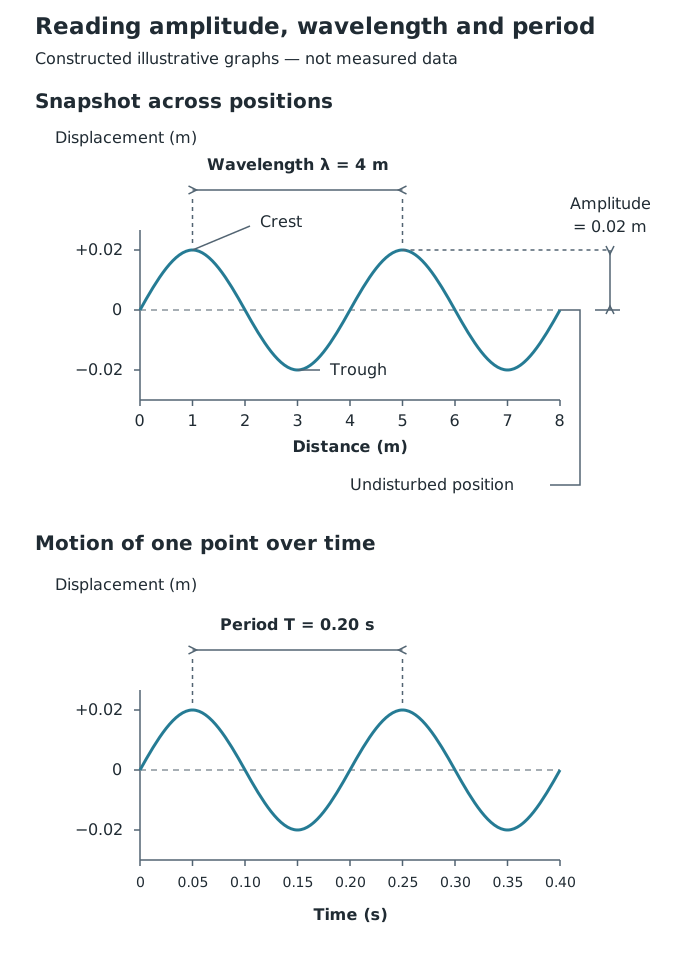
Horizontal spacing gives wavelength on a distance axis, but period on a time axis.
The upper graph is a snapshot of a wave at one instant. Its horizontal axis shows distance, so it describes the shape of the wave across different positions. The crests are 0.02 m above the undisturbed position: the amplitude is therefore 0.02 m. Adjacent crests are at 1 m and 5 m, so the wavelength is .
The frequency, , is the number of waves passing a point each second. It is measured in hertz (Hz). A frequency of 5 Hz means five complete waves pass a fixed point every second; a point in the medium makes five complete oscillations each second.
The period, , is the time taken for one complete wave to pass a point, or for one complete oscillation. It is measured in seconds (s).
The lower graph follows the displacement of one point over time. Adjacent peaks occur at 0.05 s and 0.25 s, giving a period of . Unlike the upper graph, its horizontal spacing represents time, not wavelength.
Frequency and period are reciprocals:
For the wave with frequency 5 Hz:
Five cycles fit into one second because each takes one-fifth of a second. A higher frequency therefore means a shorter period. To calculate frequency from period, use .
Wave speed, , is the speed at which energy is transferred, or the wave moves, through the medium. It is not the speed of an individual particle oscillating about its undisturbed position.
During one period, the wave pattern advances by one wavelength. If waves pass a point each second and each wave occupies a distance , the wave travels metres each second. All waves obey:
Use in metres per second (m/s), in hertz (Hz) and in metres (m).
For the wave, the frequency is 5 Hz and the wavelength is 4 m:
This means the wave pattern, carrying energy, advances 20 metres each second.
Rearrange the same equation according to the quantity needed:
As another example, suppose a wave has speed 12 m/s and wavelength 3 m. Its frequency is : four waves pass a point each second.
If instead a wave has speed 12 m/s and frequency 8 Hz, its wavelength is . These calculations connect the distance travelled by the wave with the number of cycles passing each second.
Get unlimited access to all revision notes, key terms, and exam tips.
Higher frequency means shorter period.
Get unlimited access to all revision notes, key terms, and exam tips.
Measure amplitude from the undisturbed position to a crest or trough, not from crest to trough.
Check the horizontal axis: a distance axis gives wavelength; a time axis gives period.
For wavelength, choose adjacent equivalent points, such as crest to crest. Crest to trough is only half a wavelength.
Before using the wave equation with speed in m/s, convert wavelength to metres and frequency to hertz: 100 cm = 1 m and 1 kHz = 1000 Hz.
Show the equation, rearrangement and substitution, and include the unit in your answer.
Amplitude
The maximum displacement of a point on a wave from its undisturbed position. Amplitude is measured in metres (m).
Wavelength
The distance from a point on one wave to the equivalent point on the adjacent wave. Its symbol is and its unit is the metre (m).
Frequency
The number of waves passing a point each second. Its symbol is and its unit is the hertz (Hz).
Period
The time taken for one complete wave to pass a point, or for one complete oscillation. Its symbol is and its unit is the second (s).
Wave speed
The speed at which a wave moves, transferring energy through a medium. Its symbol is and its unit is metres per second (m/s).
Displacement
The distance and direction of a point from its undisturbed position.
Put your knowledge into practice — try past paper questions for Combined Science Trilogy
Amplitude
The maximum displacement of a point on a wave from its undisturbed position. Amplitude is measured in metres (m).
Wavelength
The distance from a point on one wave to the equivalent point on the adjacent wave. Its symbol is and its unit is the metre (m).
Frequency
The number of waves passing a point each second. Its symbol is and its unit is the hertz (Hz).
Period
The time taken for one complete wave to pass a point, or for one complete oscillation. Its symbol is and its unit is the second (s).
Wave speed
The speed at which a wave moves, transferring energy through a medium. Its symbol is and its unit is metres per second (m/s).
Displacement
The distance and direction of a point from its undisturbed position.