Loading…


Loading…
Loading…
Loading…
AQA GCSE Combined Science Trilogy · 8464
AQA 8464 · 6.6.2.2 Refraction and Wave Properties Check the specification (PDF) (opens in a new tab)
A warm object transfers energy to its surroundings by emitting infrared radiation. Infrared is an electromagnetic wave: it carries energy without needing a material medium. You cannot see it, but an infrared detector can respond to it.
A surface can also absorb infrared arriving from elsewhere. Absorption transfers energy to the object and can increase its temperature. Emission means giving radiation out; absorption means taking it in.
The nature of a surface affects both processes. A matt black surface is a good absorber and emitter of infrared. A shiny silver surface is a poor absorber and emitter, and reflects much of the infrared that reaches it. ‘Matt’ means dull rather than shiny, so the finish matters as well as the colour.
Required practical activity 21 investigates how infrared absorption or emission depends on the nature of a surface. The Leslie cube method investigates emission directly.
A Leslie cube is a hollow metal container whose four sides have different surfaces: shiny black, matt black, shiny silver and matt white. Filling it with hot water heats all four sides together. This lets you compare different surfaces at approximately the same temperature, rather than comparing separate objects that might be at different temperatures.
The apparatus is a Leslie cube, a kettle, an infrared detector and a heatproof mat. A ruler is useful for checking the distance between the detector and each face.
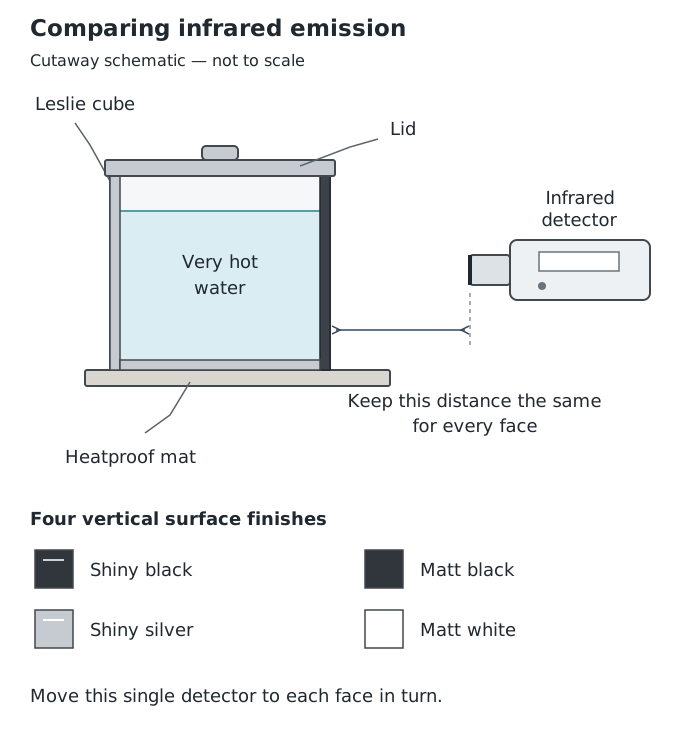
Compare radiation from each face using the same detector at the same distance.
Record readings with the units shown by the instrument. The readings allow you to compare the infrared detected from each surface; a larger reading indicates more infrared reaching the detector under the same measurement conditions.
Very hot water and the heated cube can cause burns or scalds. Keep the apparatus stable, handle the hot water carefully and keep water away from electrical equipment.
The independent variable is the nature of the surface. The dependent variable is the infrared detector reading.
Distance must stay constant: moving the detector further away can reduce the radiation it receives. Keep the detector's position and angle consistent, and use the same detector throughout. The cube's faces have the same area, so surface area is not deliberately changed either.
Temperature is particularly important because hotter objects emit more infrared. The shared hot water helps keep the faces at approximately the same temperature, but the cube gradually cools. Take the readings promptly. Changing the order of the surfaces between repeated sets helps reveal whether cooling is affecting the comparison: a surface should not always be measured last.
Use a results table with a row for each surface and columns for repeated detector readings and their mean. A bar chart is appropriate because the surface types are separate categories. Put surface type on the horizontal axis and mean detector reading, with its units, on the vertical axis. Do not join the bars with a line as though surface type were a continuous numerical variable.
Compare the heights of the bars. Under the same conditions, a higher bar means that the surface emitted more infrared towards the detector. Matt black is expected to be a strong emitter and shiny silver a weak emitter. Compare shiny black and matt white using your actual readings rather than assuming an exact order.
Your conclusion should connect the evidence to the aim: surfaces at approximately the same temperature can give different detector readings, showing that infrared emission depends on surface nature. This experiment measures emission, not absorption. The related pattern is that good infrared emitters are also good absorbers, but demonstrating absorption directly would require measuring the response to incoming radiation.
Get unlimited access to all revision notes, key terms, and exam tips.
Place the cube on a heatproof mat, fill it with very hot water and fit the lid. Compare detector readings from shiny black, matt black, shiny silver and matt white faces.
Use a bar chart: surface type against mean detector reading, including units. A higher reading under the same conditions indicates greater emission towards the detector.
The Leslie cube method tests emission, not absorption.
Get unlimited access to all revision notes, key terms, and exam tips.
For Combined Science: Trilogy, this is required practical activity 21. Describe the apparatus and measurements, rather than relying on the practical number.
Name the independent variable as the nature of the surface: both colour and finish matter.
Explain controls: keeping the detector at the same distance prevents distance, rather than surface type, from causing a difference in readings.
A Leslie cube investigation measures emission. Do not describe its detector readings as measurements of absorption.
Infrared radiation
Electromagnetic radiation that transfers energy and is emitted by warm objects; it is invisible to the human eye.
Emission
The giving out of radiation by an object, transferring energy away from it.
Absorption
The taking in of radiation by a material, transferring energy to it.
Leslie cube
A hollow metal container with different surface finishes on its four sides, used to compare infrared emission when filled with hot water.
Matt surface
A dull, non-shiny surface finish.
Infrared detector
An instrument that responds to infrared radiation, allowing radiation from different surfaces to be compared.
Put your knowledge into practice — try past paper questions for Combined Science Trilogy
Infrared radiation
Electromagnetic radiation that transfers energy and is emitted by warm objects; it is invisible to the human eye.
Emission
The giving out of radiation by an object, transferring energy away from it.
Absorption
The taking in of radiation by a material, transferring energy to it.
Leslie cube
A hollow metal container with different surface finishes on its four sides, used to compare infrared emission when filled with hot water.
Matt surface
A dull, non-shiny surface finish.
Infrared detector
An instrument that responds to infrared radiation, allowing radiation from different surfaces to be compared.