Loading…


Loading…
Loading…
Loading…
AQA GCSE Combined Science Trilogy · 8464
AQA 8464 · 6.6.2.3 Radiation Origins and Hazards Check the specification (PDF) (opens in a new tab)
Electromagnetic waves transfer energy. When a wave is emitted, energy is transferred away from its source. When it is absorbed, energy is transferred from the wave to the material receiving it. Changes within atoms and their nuclei can cause both processes, across a wide range of frequencies.
An atom has a small central nucleus, with electrons around it. The electrons can have different energy levels. Absorbing energy from an electromagnetic wave can move an electron to a higher energy level. When an electron moves down to a lower energy level, it releases energy by emitting an electromagnetic wave.
These are opposite energy transfers: absorption increases the atom’s energy, while emission decreases it. Different changes involve different amounts of energy, allowing atoms to absorb and emit waves at different frequencies. Visible light and ultraviolet radiation are examples associated with changes in electron energy levels.
Changes can also occur within an atom’s nucleus. Gamma rays originate from changes in the nucleus, rather than from electrons moving between energy levels around it. When the nucleus releases energy in this way, that energy is carried away by a gamma ray.
The important distinction is the location of the change: changes involving electrons occur outside the nucleus; gamma emission involves the nucleus itself.
Radio waves can be generated by oscillations in an electrical circuit. An oscillation is a repeated change or back-and-forth movement. In an alternating-current circuit, the current repeatedly reverses direction, so electric charge moves back and forth rather than continuously in one direction.
A transmitting aerial, also called an antenna, can be connected to a high-frequency alternating-current source. Charge oscillates up and down the aerial, producing radio waves that travel away from it. The radio waves have the same frequency as the oscillations in the transmitting circuit.
Frequency means the number of complete oscillations each second. Faster oscillations in the circuit therefore produce higher-frequency radio waves. Energy supplied to the transmitting circuit is transferred outwards by the waves.
A receiving aerial can absorb energy from incoming radio waves. This can cause charge in the aerial to oscillate, creating an alternating current with the same frequency as the absorbed radio wave. Radio waves can therefore induce oscillations in an electrical circuit.
Transmission and reception form a linked sequence: electrical oscillations produce a radio wave, and absorption of that wave can produce electrical oscillations elsewhere. Energy travels between the aerials in the electromagnetic wave; the charge in the transmitting aerial does not travel across the gap to the receiver.
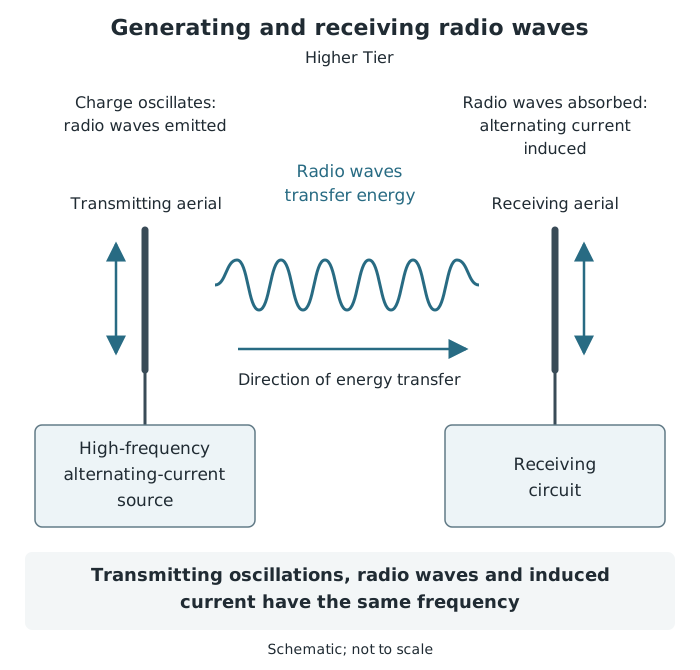
Electrical oscillations produce radio waves; absorption can induce electrical oscillations at the same frequency in a receiving circuit.
This connection between circuits and electromagnetic waves makes radio communication possible: a transmitting circuit sends energy out as waves, and a receiving circuit responds when those waves are absorbed.
Get unlimited access to all revision notes, key terms, and exam tips.
Get unlimited access to all revision notes, key terms, and exam tips.
For radio-wave questions, link oscillating charge in the transmitting circuit to the radio wave, then to an alternating current in the receiving circuit.
State that the induced alternating current has the same frequency as the absorbed radio wave—not necessarily the same size.
Identify changes in the nucleus as the origin of gamma rays. Do not describe gamma emission as an electron moving between energy levels.
Electromagnetic wave
A wave that transfers energy through electromagnetic oscillations and can travel through a vacuum.
Emission
The release of electromagnetic waves, transferring energy away from their source.
Absorption
The transfer of energy from an electromagnetic wave to the material receiving it.
Oscillation
A repeated change or back-and-forth movement about a central position.
Alternating current
An electric current that repeatedly reverses direction.
Frequency
The number of complete oscillations each second, measured in hertz (Hz).
Gamma ray
An electromagnetic wave originating from a change in an atomic nucleus.
Put your knowledge into practice — try past paper questions for Combined Science Trilogy
Electromagnetic wave
A wave that transfers energy through electromagnetic oscillations and can travel through a vacuum.
Emission
The release of electromagnetic waves, transferring energy away from their source.
Absorption
The transfer of energy from an electromagnetic wave to the material receiving it.
Oscillation
A repeated change or back-and-forth movement about a central position.
Alternating current
An electric current that repeatedly reverses direction.
Frequency
The number of complete oscillations each second, measured in hertz (Hz).
Gamma ray
An electromagnetic wave originating from a change in an atomic nucleus.