Loading…


Loading…
Loading…
Loading…
AQA GCSE Combined Science Trilogy · 8464
AQA 8464 · 5.5.1.1 Energy Transfer in Reactions Check the specification (PDF) (opens in a new tab)
When chemicals react in solution, the mixture may become warmer or colder. A thermometer measures this change in the surroundings of the reacting particles. A temperature rise indicates an exothermic reaction; a fall indicates an endothermic reaction.
Required practical 10 investigates variables that affect the recorded temperature change. Suitable reactions include acids with metals, acids with carbonates, neutralisation reactions and displacement of metals. The central skill is to change one factor, measure its effect and make a fair comparison. This practical is limited to temperature measurements: calculations of energy changes or are not required.
One investigation compares different concentrations of hydrochloric acid reacting with sodium hydroxide solution. These substances undergo neutralisation, producing sodium chloride and water.
Use 25 cm³ of hydrochloric acid at each of four concentrations: 0.2, 0.4, 0.6 and 0.8 mol/dm³. Mix each with 25 cm³ of 1.0 mol/dm³ sodium hydroxide. The sodium hydroxide is in excess throughout this range, meaning that enough is available to react with all the acid.
The independent variable is acid concentration. The dependent variable is temperature rise. Keep both solution volumes, the sodium hydroxide concentration, the starting temperature, the cup and lid, and the mixing and temperature-reading method constant. These are the control variables. For example, changing the solution volume as well as concentration would make it harder to decide which change caused the result.
Use measuring cylinders to measure the solutions, a thermometer to measure temperature, and a polystyrene cup supported inside a beaker. A lid with a thermometer hole helps reduce energy transfer between the mixture and the room. Polystyrene is a thermal insulator, so less energy escapes through the sides than it would through a poorly insulated container.
Keep the thermometer bulb fully immersed in the liquid. Stirring gently distributes thermal energy through the mixture, making the reading more representative of the whole solution.
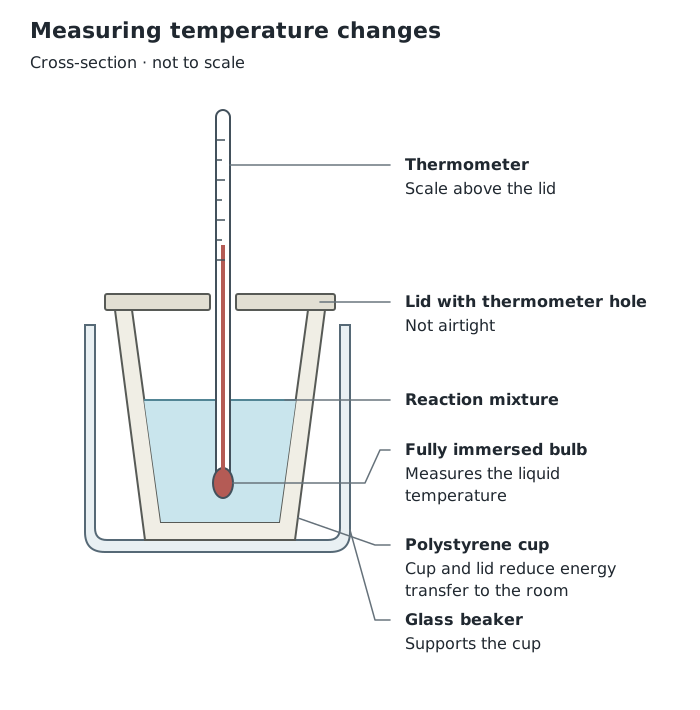
An insulated cup reduces unwanted energy transfer while the thermometer measures the reaction mixture's temperature.
Using the same starting temperature matters because otherwise part of the measured change could result from mixing a warmer solution with a colder one, rather than from the reaction.
Calculate the temperature change using:
For one trial, a starting temperature of 20.0 °C and a maximum of 24.5 °C give a change of °C. The positive change shows that the mixture warmed. If a mixture instead fell from 20.0 °C to 17.0 °C, its change would be °C: a temperature decrease of 3.0 °C.
Record the concentration, starting temperature, maximum temperature and temperature rise for every trial. Plot mean temperature rise in °C on the vertical axis against acid concentration in mol/dm³ on the horizontal axis. Use the pattern of results to describe how concentration affects the rise.
In this investigation, a more concentrated acid contains more acid in the same volume. With the alkali in excess, more acid can be neutralised, so a larger temperature rise is expected. This prediction applies to the chosen conditions, not to every possible mixture of acid and alkali.
For a solid reacting with a solution, measure the solution volume and starting temperature, then use a balance to measure the solid's mass before adding it. Mix gently and record the highest or lowest temperature reached.
For example, compare equal masses of magnesium, zinc, iron and copper added separately to dilute hydrochloric acid. Change the type of metal, while keeping the acid volume, concentration, starting temperature and measurement method the same. Because metal type is a category, a bar chart is more suitable than a continuous concentration graph.
The same basic temperature-measurement approach can be adapted to acid–carbonate reactions or metal displacement reactions. Choose suitable reactants under teacher supervision and keep all factors except the selected variable constant.
Energy can still escape through the cup, lid and thermometer. An exothermic reaction's measured maximum may therefore be lower than it would be with perfect insulation. Using a lid, mixing consistently and taking frequent readings helps reduce this problem and the chance of missing the maximum or minimum.
Repeats reveal how consistent the measurements are, but averaging does not remove a repeated heat-loss error. Compare temperature changes under controlled conditions rather than treating them as direct measurements of the energy transferred.
Measure fixed quantities → record a common starting temperature → mix in a supported polystyrene cup → replace lid and stir → record the maximum or minimum → calculate temperature change → repeat and find a mean.
Positive change: exothermic. Negative change: endothermic.
Suitable reactions include acid–metal, acid–carbonate, neutralisation and metal displacement. Energy-change and calculations are not required.
Describe how to find the maximum or minimum temperature, not just a reading taken immediately after mixing.
Calculate temperature change by subtracting the starting temperature from the highest or lowest temperature reached.
Name specific control variables and explain how to keep them constant; ‘keep everything the same’ is too vague.
Explain that a polystyrene cup and lid reduce energy transfer to the surroundings; they do not prevent it completely.
Do not assume that a larger recorded temperature rise always means a more reactive substance. Amounts, heat loss and measurement timing also affect the result.
Temperature change
The difference between the temperature reached during a reaction and the starting temperature, measured in °C.
Independent variable
The factor deliberately changed in an investigation, such as acid concentration or the type of metal.
Dependent variable
The quantity measured to find the effect of changing the independent variable; here, the temperature change.
Control variable
A factor kept constant so that its effect does not interfere with the comparison being investigated.
Neutralisation
A reaction in which an acid reacts with a base; an acid reacting with an alkali produces a salt and water.
Concentration
The amount of a dissolved substance in a given volume of solution.
Put your knowledge into practice — try past paper questions for Combined Science Trilogy
Temperature change
The difference between the temperature reached during a reaction and the starting temperature, measured in °C.
Independent variable
The factor deliberately changed in an investigation, such as acid concentration or the type of metal.
Dependent variable
The quantity measured to find the effect of changing the independent variable; here, the temperature change.
Control variable
A factor kept constant so that its effect does not interfere with the comparison being investigated.
Neutralisation
A reaction in which an acid reacts with a base; an acid reacting with an alkali produces a salt and water.
Concentration
The amount of a dissolved substance in a given volume of solution.