Loading…


Loading…
Loading…
Loading…
AQA GCSE Combined Science Trilogy · 8464
AQA 8464 · 4.1.3.1 Diffusion Check the specification (PDF) (opens in a new tab)
Every living cell needs to take in useful substances and remove waste products. Its surface provides a route for exchange, while its volume represents the amount of living material that must be supplied.
The surface area to volume ratio tells us how much surface is available relative to that volume. A high ratio means there is plenty of exchange surface for a relatively small amount of living material. A low ratio means each unit of surface must supply a larger volume.
A single-celled organism, such as a bacterium, has a relatively large surface area to volume ratio. Its cell membrane is in direct contact with its surroundings, and distances within the cell are short. Sufficient molecules can therefore move into and out of the cell to meet its needs without a specialised exchange organ or a transport system.
Simple cubes can model the effect of increasing size. They are models, not the actual shapes of organisms. For a cube with side length :
There are six square faces, each with area . To calculate the surface area to volume ratio, divide surface area by volume and express the comparison with volume as 1.
| Cube side length | Surface area | Volume | Surface area : volume |
|---|---|---|---|
| 1 cm | 6 cm² | 1 cm³ | 6 : 1 |
| 2 cm | 24 cm² | 8 cm³ | 3 : 1 |
| 3 cm | 54 cm² | 27 cm³ | 2 : 1 |
For the 2 cm cube, simplifies to by dividing both numbers by 8. It has three square centimetres of surface for each cubic centimetre of volume, compared with six for the 1 cm cube.
As these cubes get larger, their total surface area increases, but their volume increases faster. Their surface area to volume ratio decreases. The same pattern applies when organisms of similar shape increase in size. Shape also matters: folding a surface or forming projections can increase the area available for exchange.
Large multicellular organisms have a comparatively small external surface area to volume ratio. They contain many cells needing supplies, and cells deep inside the organism are far from the outside surface. Exchange across the external surface followed by diffusion over these long distances would be too slow to meet their needs.
Two adaptations solve different parts of this problem. Specialised exchange surfaces allow substances to enter or leave rapidly. Transport systems carry substances between those surfaces and cells elsewhere in the organism. In mammals, for example, oxygen enters the blood at the lungs, and the circulation carries it to tissues. Diffusion then occurs over the short distance between nearby blood vessels and cells.
A large surface area allows more particles to cross at the same time. Folds, projections and many small structures can provide a large area within a compact organ.
A thin barrier provides a short diffusion path, so particles can cross quickly.
In animals, an efficient blood supply brings substances to an exchange surface or carries them away. This prevents concentrations on the two sides from becoming similar and maintains a steep concentration gradient, supporting rapid net diffusion.
Animal gas exchange surfaces are also ventilated. Replacing the air or water next to the surface maintains concentration gradients. Ventilation moves the surrounding fluid; diffusion moves gases across the exchange barrier.
The lungs exchange oxygen and carbon dioxide between air and blood. Millions of tiny air sacs called alveoli provide a large total surface area. Their walls are one cell thick, and they have an excellent blood supply, giving gases a short diffusion path to or from the blood.
Breathing refreshes the air in the alveoli, while blood flow brings in blood with less oxygen and carries oxygenated blood away. Together, ventilation and blood flow maintain the gradients for oxygen to diffuse into the blood and carbon dioxide to diffuse into the alveoli.
The small intestine absorbs digested food molecules. Its folded lining has many finger-like villi, increasing the surface area for absorption. Each villus is covered by a single layer of epithelial cells, providing a short path into the blood. Its good blood supply carries absorbed molecules away, maintaining a concentration gradient for molecules absorbed by diffusion.
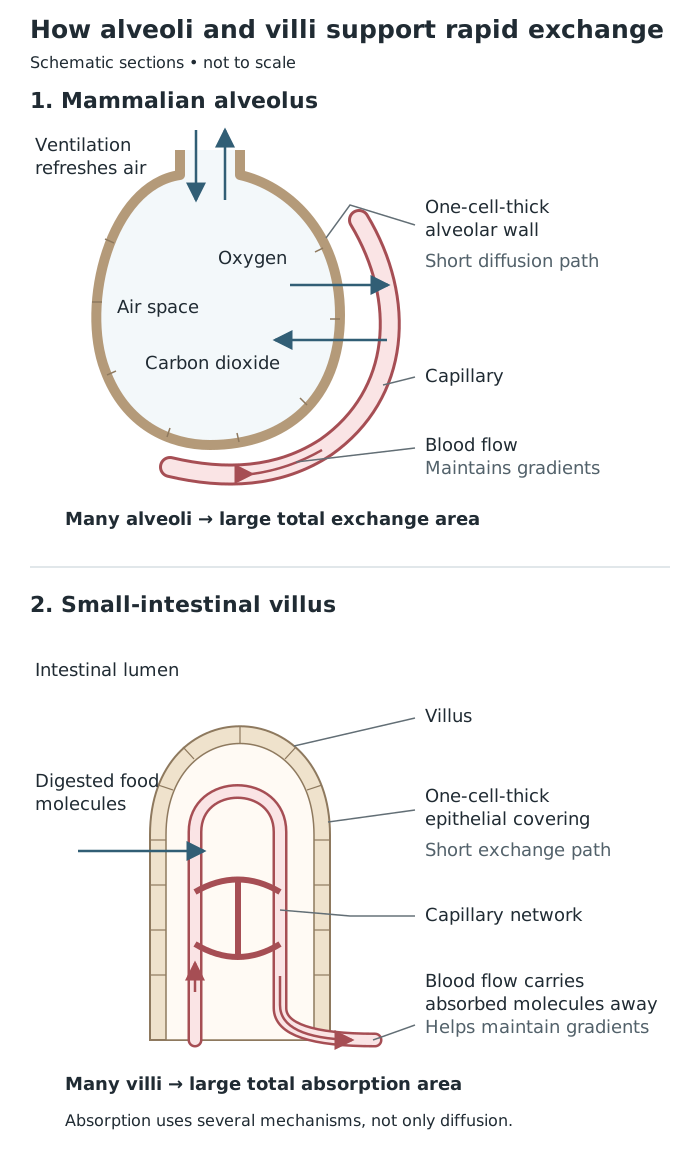
Alveoli and villi combine a large exchange area, a thin barrier and a good blood supply. Alveoli also receive fresh air through ventilation.
Fish exchange gases between the water and their blood at the gills. The gills' complex, folded structure provides a large surface area, and thin exchange barriers give gases a short diffusion path. A dense network of capillaries provides a good blood supply.
Water flowing over the gills refreshes the water at the exchange surface. Water flow and blood flow maintain concentration gradients, allowing oxygen to diffuse from the water into the blood and carbon dioxide to diffuse out.
Roots absorb water and mineral ions from the soil. A highly branched root network reaches through the soil and provides a large surface area. Root hair cells have long projections that further increase the area in contact with the soil, allowing more absorption. These are adaptations for uptake, but not all uptake happens by diffusion.
Leaves exchange gases needed for photosynthesis. Carbon dioxide must reach the photosynthetic cells, while oxygen can leave. Leaves are thin, so gases have a short distance to diffuse.
Pores called stomata allow gases to move between the outside air and air spaces inside the leaf. Loosely packed spongy mesophyll cells provide these air spaces and a large internal surface area for gas exchange. Guard cells control the opening and closing of stomata, allowing gas exchange while helping to reduce water loss in dry conditions.
These examples share a principle: increasing the area available for exchange and shortening transport distances helps an organism supply its cells efficiently.
Get unlimited access to all revision notes, key terms, and exam tips.
Divide both quantities by volume to express the ratio as .
For a cube, include all six faces when calculating surface area. Use consistent length units before calculating surface area and volume.
Compare surface area relative to volume, not surface area alone: a larger organism can have a larger total surface area but a smaller surface area to volume ratio.
Link each adaptation to its effect: a thin barrier shortens the diffusion path; blood flow and ventilation maintain concentration gradients.
The walls of alveoli and villi are made of animal cells. They are not cell walls.
Do not assume that all absorption by roots or the small intestine occurs by diffusion.
Surface area to volume ratio
The amount of surface area available relative to an object's volume, calculated by dividing surface area by volume.
Exchange surface
A specialised surface across which substances move between an organism and its environment, or between body compartments.
Transport system
A system that carries substances between exchange surfaces and cells elsewhere in an organism.
Concentration gradient
The difference in concentration of a substance between two regions.
Diffusion path
The distance a substance travels by diffusion between two regions.
Ventilation
The movement of air or water over a gas exchange surface, helping maintain concentration gradients.
Alveolus
A tiny air sac in a mammalian lung where gases are exchanged between air and blood.
Villus
A finger-like projection of the small intestine's lining that increases the surface area for absorption.
Root hair cell
A plant root cell with a long projection that increases its surface area for absorbing water and mineral ions.
Stoma
A pore in a leaf through which gases move, with its opening controlled by guard cells.
Put your knowledge into practice — try past paper questions for Combined Science Trilogy
Surface area to volume ratio
The amount of surface area available relative to an object's volume, calculated by dividing surface area by volume.
Exchange surface
A specialised surface across which substances move between an organism and its environment, or between body compartments.
Transport system
A system that carries substances between exchange surfaces and cells elsewhere in an organism.
Concentration gradient
The difference in concentration of a substance between two regions.
Diffusion path
The distance a substance travels by diffusion between two regions.
Ventilation
The movement of air or water over a gas exchange surface, helping maintain concentration gradients.
Alveolus
A tiny air sac in a mammalian lung where gases are exchanged between air and blood.
Villus
A finger-like projection of the small intestine's lining that increases the surface area for absorption.
Root hair cell
A plant root cell with a long projection that increases its surface area for absorbing water and mineral ions.
Stoma
A pore in a leaf through which gases move, with its opening controlled by guard cells.
For a cube: and .
| Structure | Essential adaptations |
|---|---|
| Mammalian lungs | Many alveoli; one-cell-thick walls; good blood supply; ventilation |
| Small intestine | Folded lining and villi; one-cell-thick covering; good blood supply |
| Fish gills | Large, folded surface; thin exchange barriers; dense capillary network; water flow |
| Roots | Branched root network and root hair projections increase absorption area |
| Leaves | Thin; stomata; internal air spaces and large mesophyll surface area; guard cells control stomata |
Get unlimited access to all revision notes, key terms, and exam tips.