Loading…


Loading…
Loading…
Loading…
AQA GCSE Combined Science Trilogy · 8464
AQA 8464 · 4.1.3.1 Diffusion Check the specification (PDF) (opens in a new tab)
Particles in gases and solutions are constantly moving randomly. If a substance is more concentrated in one region than another, its particles gradually spread out. This process is diffusion: the spreading out of particles of a substance in solution, or particles of a gas, resulting in a net movement from an area of higher concentration to an area of lower concentration.
Concentration means the amount of a substance in a given volume. A drop of dye added to water initially creates a region with a high concentration of dye particles. As those particles move randomly, they spread into the surrounding water, where the dye concentration is lower.
Particles do not all travel in the same direction. Some move towards the higher-concentration region, but more move away from it because there are more particles there to begin with. The overall result is called net movement. The difference in concentration between two regions is the concentration gradient, and diffusion produces net movement down this gradient.
Eventually, in a closed system, the particles become evenly spread. They still move randomly, but equal numbers move in opposite directions, so there is no net movement.
The cell membrane separates the inside of a cell from its surroundings. Some substances can diffuse across it, allowing materials to enter or leave the cell. The membrane is partially permeable: it allows some substances through but not others.
For a substance that can cross the membrane, the concentration gradient determines the direction of net movement. If its concentration is higher outside the cell, it diffuses into the cell. If its concentration is higher inside, it diffuses out. A change in the gradient can therefore reverse the direction of net movement.
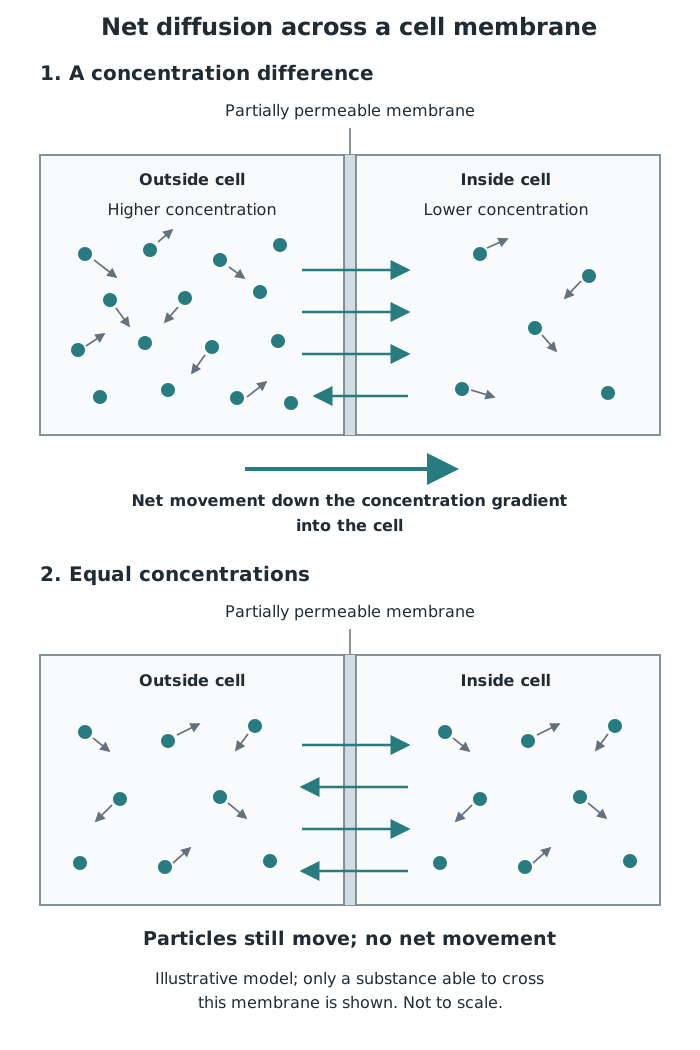
Particles move randomly in both directions. A concentration difference produces net movement towards the lower concentration.
Diffusion is a passive process, so the cell does not have to supply energy for it. The moving particles already have kinetic energy—the energy of movement.
Cells need oxygen for aerobic respiration. When oxygen concentration is higher outside a cell than inside, oxygen diffuses into it. Using oxygen in respiration helps maintain this concentration difference. Carbon dioxide produced by respiration can build up inside the cell and diffuse out into surroundings with a lower carbon dioxide concentration.
Diffusion also allows gas exchange in the lungs. Oxygen diffuses from the air in the alveoli—the small air sacs in the lungs—into the blood. Carbon dioxide diffuses in the opposite direction, from the blood into the alveoli, and is then breathed out. Each gas follows its own concentration gradient: oxygen and carbon dioxide do not have to move in the same direction.
Urea is a waste product made in liver cells when excess amino acids are broken down. It diffuses from these cells into the blood plasma, the liquid part of the blood. The blood carries it to the kidneys for excretion. Diffusion gets urea out of the cells; transport in the bloodstream takes it to the organs that remove it from the body.
The rate of diffusion describes how quickly particles spread out or cross a surface. To understand the effect of one factor, compare situations in which the other factors remain the same.
| Factor increased | Effect on diffusion rate | Explanation |
|---|---|---|
| Difference in concentration | Faster net diffusion | A steeper concentration gradient produces a greater difference between the numbers of particles moving in opposite directions. |
| Temperature | Faster diffusion | Particles have more kinetic energy and move faster, so they spread out more quickly. |
| Surface area of the membrane | Faster diffusion across the membrane | More membrane is available for particles to cross, allowing more particles through in a given time. |
A steeper concentration gradient does not make particles deliberately move towards the less concentrated region: their movement remains random. It increases the overall imbalance between movement in the two directions.
Temperature changes how quickly the particles move. Membrane surface area has a different effect: a larger area provides more space for particles to cross at the same time. Both can increase diffusion rate, but for different reasons.
Get unlimited access to all revision notes, key terms, and exam tips.
These comparisons assume other factors remain the same.
Get unlimited access to all revision notes, key terms, and exam tips.
Include ‘net movement’ and ‘higher to lower concentration’ when defining diffusion.
Particles move randomly in both directions; the concentration gradient determines the direction of net movement.
When explaining a factor, link it to the mechanism: higher temperature gives particles more kinetic energy, whereas greater membrane surface area allows more particles to cross at once.
Diffusion is passive: it does not require energy supplied by the cell. This does not mean the particles have no energy.
Diffusion
The spreading out of particles of a substance in solution, or particles of a gas, resulting in a net movement from an area of higher concentration to an area of lower concentration.
Concentration
The amount of a substance in a given volume.
Concentration gradient
A difference in the concentration of a substance between two regions.
Net movement
The overall movement of particles in one direction after taking movement in both directions into account.
Passive process
A process that does not require energy to be supplied by the cell.
Gas exchange
The exchange of oxygen and carbon dioxide between an organism and its surroundings.
Urea
A waste product made in the liver from the breakdown of excess amino acids and removed from the body by the kidneys.
Blood plasma
The liquid component of blood in which blood cells and dissolved substances are carried.
Put your knowledge into practice — try past paper questions for Combined Science Trilogy
Diffusion
The spreading out of particles of a substance in solution, or particles of a gas, resulting in a net movement from an area of higher concentration to an area of lower concentration.
Concentration
The amount of a substance in a given volume.
Concentration gradient
A difference in the concentration of a substance between two regions.
Net movement
The overall movement of particles in one direction after taking movement in both directions into account.
Passive process
A process that does not require energy to be supplied by the cell.
Gas exchange
The exchange of oxygen and carbon dioxide between an organism and its surroundings.
Urea
A waste product made in the liver from the breakdown of excess amino acids and removed from the body by the kidneys.
Blood plasma
The liquid component of blood in which blood cells and dissolved substances are carried.