Loading…


Loading…
Loading…
Loading…
AQA GCSE Combined Science Trilogy · 8464
AQA 8464 · 4.1.3.2 Check the specification (PDF) (opens in a new tab)
Water can move into and out of cells by osmosis. Osmosis is the diffusion of water from a dilute solution to a concentrated solution through a partially permeable membrane. It does not require energy released by respiration.
A solution contains a dissolved substance, called a solute. A dilute sugar solution contains relatively little sugar and a high concentration of water. A concentrated sugar solution contains more sugar and a lower concentration of water. Here, ‘dilute’ and ‘concentrated’ describe the amount of dissolved solute, not the amount of water.
A partially permeable membrane allows some substances through but not others. Imagine dilute sugar solution on one side of a membrane and concentrated sugar solution on the other. If water can cross but sugar cannot, water molecules move in both directions, but more move towards the concentrated solution. This overall movement is the net movement of water.
When the solutions balance, water continues to cross in both directions, but there is no net movement.
Plant cells have partially permeable cell membranes. If potato tissue is placed in a solution more dilute than its cell contents, water enters the cells by osmosis. The tissue gains mass, and its cells become firm as their vacuoles fill with water.
If the surrounding solution is more concentrated than the cell contents, water leaves the cells by osmosis. The tissue loses mass and becomes less firm. Measuring the change in tissue mass therefore provides evidence of net water uptake or loss.
The required practical investigates the effect of a range of salt or sugar solution concentrations on the mass of plant tissue. Potato cylinders provide a useful method.
You need potato tissue, a cork borer, a cutting tool and ruler, a balance, labelled test tubes or beakers, a measuring cylinder, a timer, paper towel and a range of salt or sugar solutions.
The independent variable is solution concentration. The measured outcome is the change in tissue mass, usually expressed as a percentage. Cylinder dimensions, potato source, solution volume, temperature, immersion time and blotting method are controlled so that differences in mass change can be attributed to concentration.
First calculate the change in mass:
Then express that change relative to the starting mass:
For a cylinder with an initial mass of 5.0 g and a final mass of 5.5 g, the change is +0.5 g. Its percentage change is . The positive result means a gain: water entered the tissue.
If another cylinder starts at 5.0 g and finishes at 4.5 g, its percentage change is . The negative result means a loss: water left the tissue.
Percentages make comparisons fairer when initial masses differ. A 0.5 g gain represents a much larger relative change for a small cylinder than for a large one.
Put solution concentration on the x-axis and mean percentage change in mass on the y-axis. Label both axes with units, choose even scales and plot the points accurately. Draw a suitable line or curve of best fit to show the trend rather than forcing the line through every point.
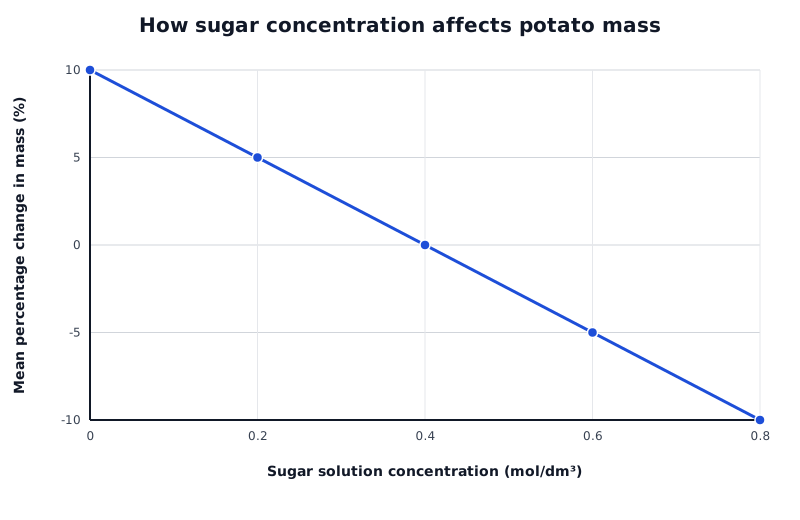
The zero crossing estimates the solution concentration at which the tissue has no net mass change.
Data for How sugar concentration affects potato mass
| Series | Sugar solution concentration (mol/dm³) | Mean percentage change in mass (%) |
|---|---|---|
| Illustrative mean percentage mass change | 0 | 10 |
| Illustrative mean percentage mass change | 0.2 | 5 |
| Illustrative mean percentage mass change | 0.4 | 0 |
| Illustrative mean percentage mass change | 0.6 | -5 |
| Illustrative mean percentage mass change | 0.8 | -10 |
This example shows percentage mass change falling as sugar concentration increases. Points above zero represent water entering the tissue; points below zero represent water leaving it.
The line crosses zero percentage change at 0.4 mol/dm³. This estimates the external concentration that balances the tissue’s cell contents, so there is no net movement of water. It does not mean water molecules have stopped moving. Actual tissue may give a different crossing point; use the experimental graph rather than memorising this value.
Mass gain over a known time can estimate the average rate of net water uptake:
For example, if a cylinder gains 0.6 g during 30 minutes of immersion, its average rate is . This means an average net gain of 0.02 g per minute over that period, not necessarily the same gain in every minute. A larger mass gain does not automatically mean a faster rate if the immersion times differ.
Get unlimited access to all revision notes, key terms, and exam tips.
Water diffuses from a dilute solution to a concentrated solution through a partially permeable membrane. No energy from respiration is required.
Measure initial masses of equal-sized potato cylinders. Immerse them in a range of salt or sugar concentrations for the same time. Remove, blot consistently and measure final masses.
Control potato source, cylinder dimensions, solute type, solution volume, temperature and immersion time. Repeat each concentration and calculate mean percentage changes.
Positive = gain; negative = loss.
Use a compound unit such as g/min.
Get unlimited access to all revision notes, key terms, and exam tips.
A complete definition of osmosis must mention water, movement from a dilute to a concentrated solution, and a partially permeable membrane.
Divide the change in mass by the initial mass, not the final mass, when calculating percentage change.
Explain why cylinders are blotted: surface solution would otherwise contribute to the measured mass.
At zero percentage mass change, there is no net movement of water; water molecules still move in both directions.
Read the concentration at the graph’s zero crossing from the x-axis, and include its unit.
Osmosis
The diffusion of water from a dilute solution to a concentrated solution through a partially permeable membrane.
Partially permeable membrane
A membrane that allows some substances, such as water, to pass through but prevents other substances from passing through.
Solute
A substance dissolved in a solvent to form a solution, such as sugar dissolved in water.
Dilute solution
A solution containing relatively little dissolved solute and a relatively high concentration of water.
Concentrated solution
A solution containing relatively much dissolved solute and a relatively low concentration of water.
Net movement
The overall movement in one direction after movement in the opposite direction has been taken into account.
Percentage change in mass
The change in mass expressed as a percentage of the initial mass: .
Put your knowledge into practice — try past paper questions for Combined Science Trilogy
Osmosis
The diffusion of water from a dilute solution to a concentrated solution through a partially permeable membrane.
Partially permeable membrane
A membrane that allows some substances, such as water, to pass through but prevents other substances from passing through.
Solute
A substance dissolved in a solvent to form a solution, such as sugar dissolved in water.
Dilute solution
A solution containing relatively little dissolved solute and a relatively high concentration of water.
Concentrated solution
A solution containing relatively much dissolved solute and a relatively low concentration of water.
Net movement
The overall movement in one direction after movement in the opposite direction has been taken into account.
Percentage change in mass
The change in mass expressed as a percentage of the initial mass: .