Loading…


Loading…
Loading…
Loading…
AQA GCSE Business · 8132
AQA 8132 · Methods and Impacts of Expansion Check the specification (PDF) (opens in a new tab)
Business expansion means increasing the scale of a business’s activities. A retailer might sell more products or open more shops; a manufacturer might increase output. Businesses often expand to reach more customers and increase sales and profits, but growth brings costs and risks as well as opportunities.
There are two main routes. Organic growth, also called internal growth, develops the business’s existing activities. External growth combines it with another business through a merger or takeover. A business can use both routes at different times.
Organic growth does not mean that every task must be done by the business’s own employees, or that it must use only its own money. It can involve franchisees, outsourced production and borrowed finance. The distinction is whether the business expands its activities or grows by combining with another business.
Organic growth builds on resources the business already understands: its products, brand, customers and experience. It can be financed using retained profits, although borrowing may also be needed. Expansion can often take place at a steady pace, giving managers time to develop operations rather than immediately having to integrate an acquired business.
However, building sales and opening locations can be slow. Limited finance or a small market may restrict growth. A business that already serves a large proportion of its market may find it particularly difficult to gain many more customers.
The main organic methods here are opening new stores, expanding through e-commerce, franchising and outsourcing.
A business can open additional stores in locations where it expects customer demand. This gives more people access to its products and increases the visibility of its brand, potentially raising sales.
The same principle applies beyond shops. Premier Inn’s expansion through new hotels illustrates how adding locations can increase a service business’s capacity and reach.
New premises require investment before they can operate: they need to be equipped, stocked and staffed. Researching suitable locations also takes time and resources. The business must judge whether additional sales will justify these costs. Opening a store is therefore more attractive when there is evidence of demand in a location the business does not already serve well.
E-commerce allows a business to sell online, either instead of operating physical stores or alongside them. Customers can browse and place orders around the clock, and the business can reach customers beyond the area surrounding its existing shops. This can increase sales without the expense of opening a store in every new market.
Online ordering through Just Eat illustrates how e-commerce can connect local takeaway businesses with customers. The growth opportunity comes from making it easier for customers to find and order their products.
An online sales channel still requires investment. The website and ordering system must work reliably, and the business needs arrangements for delivery and returns. Poor distribution can disappoint customers even when the product itself is good.
A retailer may also offer click and collect: customers buy online and collect their purchases from a store. This links online selling with existing premises. However, some online orders may simply replace purchases customers would otherwise have made in the shop, rather than creating additional sales.
In franchising, the franchisor grants a franchisee the right to trade using its brand and business format. The franchisee pays an initial fee and ongoing payments, often royalties based on sales revenue. In return, it usually receives support such as training and marketing assistance.
The franchisee runs its own outlet but must follow the franchise agreement. This can restrict its products, suppliers and other decisions so that customers receive a recognisable experience across the brand. Domino’s Pizza, KFC and Burger King are examples of businesses that use franchising.
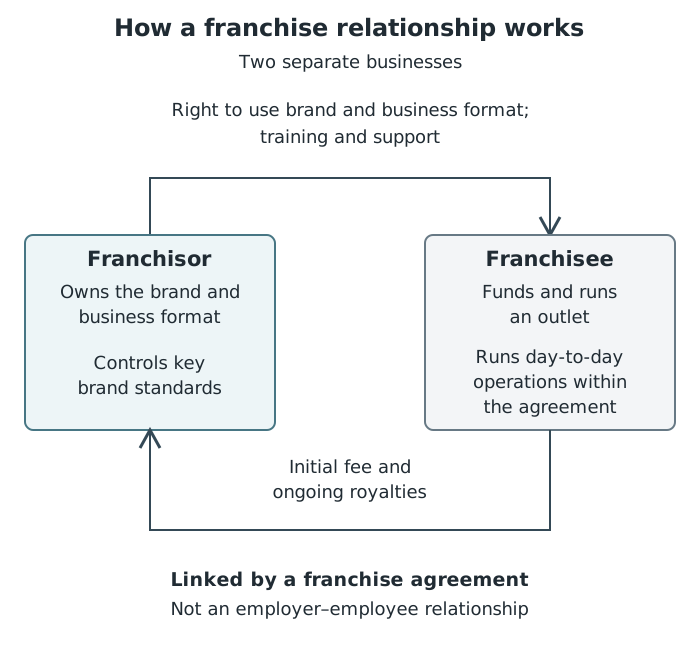
Franchising links two separate businesses: the franchisor supplies the brand and format, while the franchisee operates an outlet and makes payments.
For the franchisor, the main advantage is faster expansion with less finance required from its own resources: franchisees fund and operate new outlets. Franchisees also have a personal interest in making their businesses successful. The franchisor receives fees and royalties while retaining control over key aspects of the brand.
The trade-off is reduced control over everyday operations. Poor service at one outlet can damage the reputation of the whole brand. The franchisor must choose franchisees carefully and maintain standards, and it does not keep all the profits generated by each outlet.
For the franchisee, an established brand and tested business format can reduce the uncertainty of starting a business. Training and support can also help. Nevertheless, success is not guaranteed. Fees and royalties reduce the profit available to the franchisee, its freedom is restricted, and poor performance by another outlet can affect customers’ views of its business.
Outsourcing means paying another business to carry out an activity on the business’s behalf. It can support organic growth when an outside producer supplies additional goods that the business can sell. The supplier remains a separate business: it has not been taken over.
Cadbury’s outsourcing of some seasonal Easter egg production illustrates this approach. Seasonal demand can require more production and storage capacity than the business has available itself. Using another producer allows it to meet demand without undertaking all the investment needed to expand its own facilities.
The advantage is access to extra capacity without the full cost and risk of building and equipping new production facilities. The drawback is less direct control over production. If the supplier delivers late or produces goods of poorer quality, the business may disappoint customers and damage its reputation. Choosing and monitoring a reliable supplier is therefore important.
A merger occurs when businesses agree to combine into one business. A takeover occurs when one business buys another and gains control of it. Takeovers can be agreed by the businesses involved; they are not always opposed by the business being bought.
Both are forms of external growth. Instead of gradually building every resource itself, a business gains access to another business’s existing customers, staff, products, premises or technology. This can make expansion much faster than developing those resources from the beginning.
For example, Kraft Foods bought Cadbury in 2010, adding Cadbury’s products and expanding its business in the UK. This was a takeover, unlike Cadbury paying a separate supplier to manufacture Easter eggs.
A merger can pool the resources and expertise of the businesses involved. A takeover gives the buyer control of the acquired business. Either method may provide entry into new markets; combining with a rival can also increase market share and reduce competition.
However, purchasing a business can require substantial finance, and the price paid may take a long time to recover through additional profits. Combining businesses also creates practical difficulties. Their employees may be used to different working practices and management styles, creating a culture clash. There may be duplicated jobs or premises, and managers must decide how to bring operations together. Rapid expansion is not automatically successful expansion.
The best route depends on the business’s circumstances. A retailer with evidence of demand in another town might favour a new store. A business with limited funds for premises might consider e-commerce, but it still needs reliable delivery arrangements. A strong, repeatable service format may suit franchising, while a temporary production shortage may be addressed through outsourcing.
A business seeking rapid access to an established market might prefer a merger or takeover, provided the benefits justify the finance and integration risks. The decision connects finance, marketing, operations and human resources: funding growth is only useful if the business can attract customers, supply them reliably and provide the staff needed to deliver its plans.
Get unlimited access to all revision notes, key terms, and exam tips.
| Method | Main advantage | Main drawback |
|---|---|---|
| New stores | Reach customers in new locations; increase brand awareness | Investment and location research required |
| E-commerce | Reach more customers; orders available 24/7 | Systems, delivery and returns cost money |
| Franchising | Franchisees fund and operate new outlets | Less day-to-day control; brand reputation at risk |
| Outsourcing | Extra capacity without building own facilities | Quality and delivery depend on the supplier |
Organic growth builds on existing strengths and can be manageable, but may be slow or limited by finance and market demand.
Choose using finance, speed, demand, operational capability and control.
Get unlimited access to all revision notes, key terms, and exam tips.
Classify outsourcing as organic growth: paying another business to produce goods is not the same as buying or merging with that business.
For franchising, identify whose interests you are discussing. A benefit to the franchisor is not necessarily a benefit to the franchisee.
Develop each point into a consequence: for example, poor outsourced quality could cause complaints, damage reputation and reduce repeat sales.
When recommending a growth method, use the business’s available finance, desired speed of growth, customer demand and need for control. Explain why these make your choice preferable to an alternative.
Do not assume that higher sales guarantee higher profits: expansion also creates costs.
Business expansion
An increase in the scale of a business’s activities, such as its sales, output or number of locations.
Organic growth
Expansion by developing a business’s existing activities rather than merging with or taking over another business. Also called internal growth.
External growth
Expansion by combining with another business through a merger or takeover.
Franchising
An arrangement in which a business grants another person or business the right to use its brand and business format in return for payments.
Franchisor
A business that grants others the right to trade using its brand and business format.
Franchisee
A person or business that pays for the right to operate using a franchisor’s brand and business format.
Royalties
Ongoing payments by a franchisee to a franchisor, often calculated as a percentage of sales revenue.
E-commerce
Buying and selling goods or services online.
Outsourcing
Paying another business to carry out an activity, such as manufacturing products, on the business’s behalf.
Merger
An agreement between businesses to combine into one business.
Takeover
The purchase of one business by another, giving the buyer control of the acquired business.
Retained profit
Profit kept in a business to finance its activities rather than distributed to its owners.
Put your knowledge into practice — try past paper questions for Business
Business expansion
An increase in the scale of a business’s activities, such as its sales, output or number of locations.
Organic growth
Expansion by developing a business’s existing activities rather than merging with or taking over another business. Also called internal growth.
External growth
Expansion by combining with another business through a merger or takeover.
Franchising
An arrangement in which a business grants another person or business the right to use its brand and business format in return for payments.
Franchisor
A business that grants others the right to trade using its brand and business format.
Franchisee
A person or business that pays for the right to operate using a franchisor’s brand and business format.
Royalties
Ongoing payments by a franchisee to a franchisor, often calculated as a percentage of sales revenue.
E-commerce
Buying and selling goods or services online.
Outsourcing
Paying another business to carry out an activity, such as manufacturing products, on the business’s behalf.
Merger
An agreement between businesses to combine into one business.
Takeover
The purchase of one business by another, giving the buyer control of the acquired business.
Retained profit
Profit kept in a business to finance its activities rather than distributed to its owners.