

Loading…
Loading…
Loading…
OCR GCSE Psychology · J203
OCR J203 · Multi-store Model of Memory Check the specification (PDF) (opens in a new tab)
Remembering involves more than receiving information. We must represent it in a form the mind can use, retain it and access it when needed. These processes are called encoding, storage and retrieval.
Atkinson and Shiffrin proposed the Multi-store Model of memory in 1968. It is a cognitive explanation: it describes how the mind processes information. The model distinguishes three separate stores — the sensory store, short-term memory (STM) and long-term memory (LTM). Information passes through these stores in sequence before becoming a long-term memory.
A memory store is not simply a labelled box in the brain. It represents a system with particular properties. The stores differ in their duration — how long information lasts; capacity — how much they hold; and encoding — the form in which information is represented.
The sensory store briefly holds information arriving through sight, hearing, smell, taste and touch. For example, as you enter a classroom, you receive information about voices, colours and the feel of your bag strap. The sensory store has a very large capacity, but information remains for only a few seconds: it holds a great deal of sensory input very briefly.
Its encoding depends on the sense receiving the information: a sight is represented visually, while a sound is represented through hearing. Attention selects information for transfer into STM. Much of the information you do not attend to quickly fades.
Suppose someone tells you a phone number. Paying attention allows it to enter short-term memory, the temporary store for information currently being held in mind. STM holds approximately seven items, and information lasts about 30 seconds without rehearsal.
Encoding in STM is mainly acoustic, meaning based on sound. You might repeat the number in your head using an inner voice. This is maintenance rehearsal: repetition keeps the information active in STM for longer. It does not make STM larger.
Without rehearsal, information can be forgotten through decay, as it fades over time. It can also be lost through displacement, when new information pushes out existing information from the limited-capacity store. Hearing another number could therefore interfere with holding the first one in mind.
Elaborative rehearsal goes beyond repetition by attaching meaning to information. When learning a new word, for instance, connecting it to a familiar idea and using it in a sentence gives you more to remember than its sound alone. In this account of the model, elaborative rehearsal helps information transfer from STM into LTM.
Encoding in long-term memory is mainly semantic, meaning based on meaning. LTM has unlimited capacity and a potentially permanent duration. You may retain the meaning of a word or a childhood memory for many years.
However, storing a memory and accessing it are different processes. A long-term memory may be difficult to retrieve even though it has been retained. During retrieval, information from LTM becomes available in STM so that you can use it — for example, recalling a definition while answering a question.
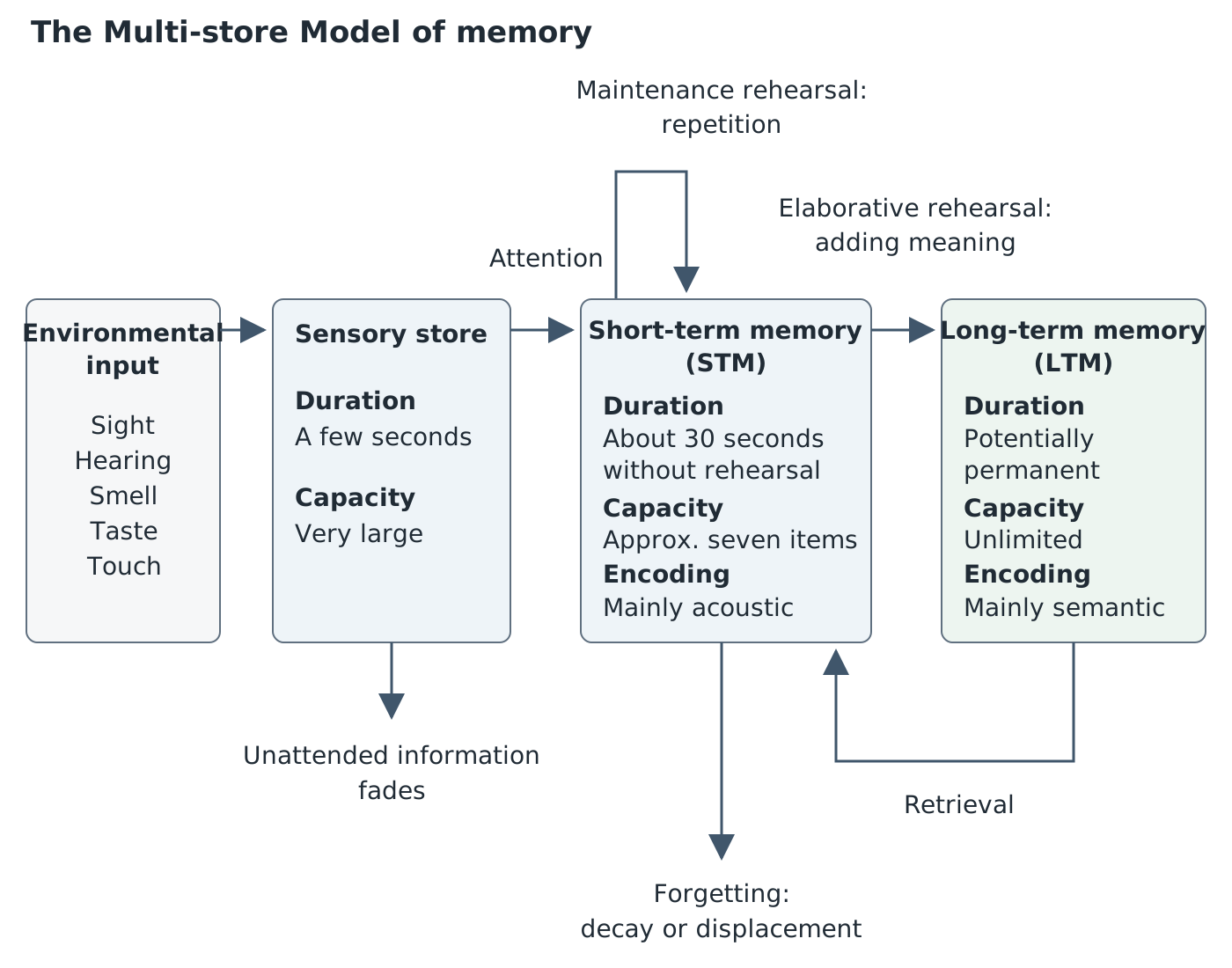
Attention and rehearsal connect the stores; retrieval makes long-term information available for current use.
| Feature | Sensory store | Short-term memory | Long-term memory |
|---|---|---|---|
| Duration | A few seconds | About 30 seconds without rehearsal | Potentially permanent |
| Capacity | Very large | Approximately seven items | Unlimited |
| Encoding | Depends on the sense, such as visual or auditory | Mainly acoustic: by sound | Mainly semantic: by meaning |
The model connects these differences to everyday remembering: attention selects a small amount of sensory information, repetition keeps it temporarily available, and meaningful processing helps establish a lasting memory.
A strength of the model is that it offers a clear explanation of why attending to information and processing it matter. It also distinguishes temporary retention from long-term storage. Wilson, Kopelman and Kapur’s research on Clive Wearing, published in 2008, showed his profound difficulty forming new long-term memories following neurological damage. This supports the importance of distinguishing memory functions, although it does not establish every detail of the model.
A central criticism is that the model overemphasises rehearsal. Some information is remembered for a long time without deliberate repetition. Receiving your GCSE results or hearing news of a bereavement can create a lasting memory because the event is personally significant.
These examples challenge the claim that rehearsal is always necessary for information to enter LTM. They suggest that meaning and significance, rather than repetition alone, are important. Maintenance rehearsal can keep information available briefly, but that is not the same as creating a durable memory.
The strongest conclusion is therefore balanced: the model provides a useful framework for understanding separate stores and the movement of information between them, but rehearsal alone cannot fully explain long-term remembering.
| Store | Duration | Capacity | Encoding |
|---|---|---|---|
| Sensory | A few seconds | Very large | Sense-specific |
| STM | About 30 seconds without rehearsal | Approximately seven items | Mainly acoustic |
| LTM | Potentially permanent | Unlimited | Mainly semantic |
Atkinson and Shiffrin, 1968: sensory store → attention → STM → elaborative rehearsal → LTM.
Compare the stores using the same feature: duration with duration, capacity with capacity, and encoding with encoding.
Distinguish maintenance rehearsal, which keeps information active in STM, from elaborative rehearsal, which adds meaning and helps transfer it to LTM.
For an evaluation point, explain why the example challenges the model. Remembering your GCSE results without repeated rehearsal challenges the claim that rehearsal is necessary for long-term storage.
Potentially permanent storage does not mean that every long-term memory can always be retrieved.
It can see this note and what your specification asks for.
Answers are free with an account.
1 free note left this week
Get more free notesYour answer sets when this note comes back for review, or marks it complete.
Was this note helpful?
Log in to tell us whether it helped, or to report a problem.
Last updated
Multi-store model
An explanation of memory proposed by Atkinson and Shiffrin in which information passes through three separate stores: sensory memory, short-term memory and long-term memory.
Sensory store
The memory store that briefly holds information detected by the senses before attention selects some of it for short-term memory.
Short-term memory
A temporary memory store with a capacity of approximately seven items and a duration of about 30 seconds without rehearsal.
Long-term memory
A memory store with potentially permanent duration and unlimited capacity, in which information is mainly encoded by meaning.
Encoding
The form in which information is represented in memory, such as by its sound or meaning.
Acoustic encoding
Representing information in memory according to its sound.
Semantic encoding
Representing information in memory according to its meaning.
Maintenance rehearsal
Repeating information to keep it active in short-term memory.
Elaborative rehearsal
Processing information by connecting it to meaning rather than simply repeating it, helping it enter long-term memory.
Retrieval
Accessing stored information so that it can be used or recalled.
Decay
The fading of information from memory over time.
Displacement
The loss of information from a limited-capacity memory store when new information pushes it out.
Put your knowledge into practice — try past paper questions for Psychology
Multi-store model
An explanation of memory proposed by Atkinson and Shiffrin in which information passes through three separate stores: sensory memory, short-term memory and long-term memory.
Sensory store
The memory store that briefly holds information detected by the senses before attention selects some of it for short-term memory.
Short-term memory
A temporary memory store with a capacity of approximately seven items and a duration of about 30 seconds without rehearsal.
Long-term memory
A memory store with potentially permanent duration and unlimited capacity, in which information is mainly encoded by meaning.
Encoding
The form in which information is represented in memory, such as by its sound or meaning.
Acoustic encoding
Representing information in memory according to its sound.
Semantic encoding
Representing information in memory according to its meaning.
Maintenance rehearsal
Repeating information to keep it active in short-term memory.
Elaborative rehearsal
Processing information by connecting it to meaning rather than simply repeating it, helping it enter long-term memory.
Retrieval
Accessing stored information so that it can be used or recalled.
Decay
The fading of information from memory over time.
Displacement
The loss of information from a limited-capacity memory store when new information pushes it out.