

Loading…
Loading…
Loading…
OCR GCSE Geography A · J383
OCR J383 · 2.3.6 Check the specification (PDF) (opens in a new tab)
A drought is a prolonged period of unusually low rainfall that causes a shortage of water. Its effects build up: soil dries out, river flows decline and stored water is used faster than it is replaced. Even when rain returns, reservoirs and soils may take much longer to recover.
Australia lies between the Indian and Pacific oceans. Much of the country is vulnerable to drought because subtropical sinking air produces clear skies and little rainfall. Farming and settlements therefore depend on water supplies that can become unreliable during extended dry periods.
This case study focuses on 2002–2009, a severe phase of the Big Dry, also known as the Millennium Drought. The wider drought developed from 1996, varied between regions and was not finally declared over nationally until April 2012. El Niño contributed to the drought, including during 2006–2007, but the whole prolonged event was not caused by a single El Niño episode.
The Murray–Darling Basin, in south-eastern Australia, is especially important. A river basin is the area drained by a river and its tributaries. This basin was home to about 2 million people, with strong demand for water from both residents and agriculture. Reduced rainfall therefore affected households, farms and river environments together.
Under normal conditions, trade winds blow westwards across the tropical Pacific. They push warm surface water towards the western Pacific, near Australia. Warm, moist air rises over this water, cools and condenses, bringing rainfall. Near Peru, on the eastern side of the Pacific, colder deep water rises to replace surface water moving westwards. This is upwelling.
During El Niño, the trade winds weaken and may stop or reverse. Warm surface water spreads eastwards towards South America, reducing cold-water upwelling there. The main area of rising moist air and rainfall also shifts eastwards.
Over Australia, descending air and higher pressure become more likely. Sinking air discourages cloud formation, so rainfall decreases, particularly in eastern Australia. If this continues, rivers, soils and reservoirs receive too little replacement water and drought develops or intensifies.
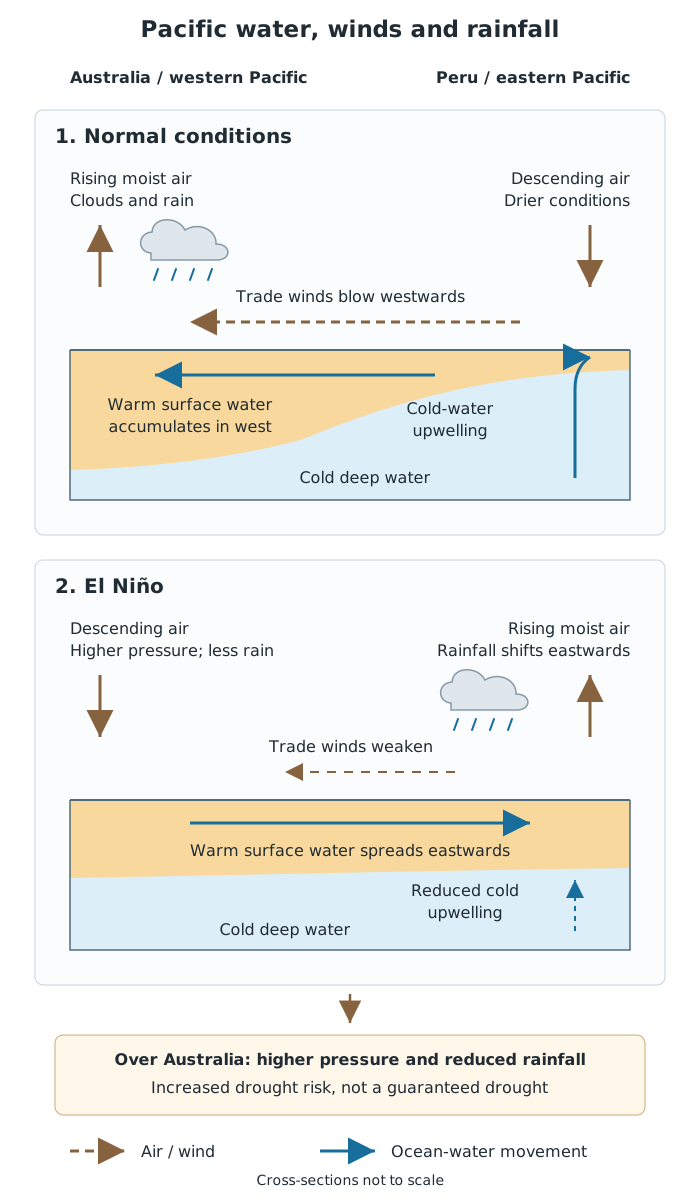
El Niño shifts warm water and the main rainfall zone eastwards, increasing the risk of drought in Australia.
La Niña is the contrasting pattern: stronger trade winds push more warm water westwards. This can increase rainfall and flood risk in Australia rather than producing the same drought pattern there.
During 2006, rainfall was 40–60% below normal over most of Australia south of the Tropic of Capricorn. The 2006–2007 El Niño worsened an already serious shortage, with a near-total failure of late-winter and spring rains in south-eastern Australia in 2006. Water demand did not cause this rainfall failure, but it increased pressure on the remaining supplies.
Water shortages damaged farming and spread costs beyond the farms themselves. Farmers had to sell cattle, while the number of dairy farms fell by 50%. Selling livestock could bring in money immediately, but also reduced the animals available for future production. About 10,000 people directly employed in cotton growing were affected, showing how drought threatened employment as well as crops.
As agricultural production suffered, Australia became more dependent on food imports and food prices increased. Households also faced higher water costs: water bills rose by 20% in 2008. These effects reached people who did not work in agriculture.
Some people left drought-stricken rural areas for cities, increasing urban populations. This movement shows that a prolonged drought can change where people live, not just the amount of water they use.
Water storage in the Murray–Darling Basin fell to 17% of capacity in 2003. Storage levels remained below their pre-drought levels until late 2011. This long recovery helps explain why a few periods of rain did not immediately restore reliable supplies.
Drought caused loss of vegetation and soil erosion. With less plant cover to protect and hold soil in place, exposed ground became more vulnerable to erosion. This damaged the environment and also reduced the quality of land used for farming.
Depleted rivers and lakes experienced toxic algal outbreaks, damaging water quality. These problems connected environmental harm with the availability of usable water for people.
Reduced water supplies also meant less hydroelectric power, which generates electricity using moving water. Fossil fuel use increased to replace some of that lost generation. The consequences therefore extended from river systems to energy use.
The effects cannot be separated neatly into independent categories. Vegetation loss and damaged water quality harmed ecosystems, but also made farming and water supply more difficult. Rural livelihoods were particularly exposed, while food and water prices spread the effects more widely.
Individuals reused grey water from showers, baths and wash basins for suitable purposes. Reusing water reduced demand for fresh supplies rather than relying entirely on new sources.
Local governments subsidised household rainwater tanks, helping homes store rainfall when it occurred. Restrictions included bans on car washing and four-minute shower limits, reducing avoidable consumption. Tanks could improve resilience, but could not supply water indefinitely without rain; conservation remained important during a prolonged drought.
Farmers could claim A$400–600 per fortnight in financial assistance. This helped them cope with reduced income, although it did not replace rainfall or restore river flows.
A multimillion-dollar desalination plant was built in Sydney to produce fresh water from seawater. Unlike rainwater storage, desalination provides a source that does not depend directly on rainfall. It expanded supply, whereas restrictions and reuse reduced demand.
Scientists and environmentalists promoted efficient irrigation systems to reduce the water needed for agriculture. They also worked on calculating sustainable water-use limits for states, with allowances that could be traded across state boundaries. Such limits aimed to balance human demand with the amount of water available rather than allowing unrestricted use.
National drought relief payments reached A$1.7 million a day for farmers. By mid-2010, approximately A$4.4 billion had been paid in direct drought assistance. This supported affected livelihoods, but financial relief was different from adapting water use itself.
Together, these responses addressed three needs: using less water, finding alternative supplies and supporting people whose incomes had suffered. No single response could meet all three. Long-term resilience required water-saving measures and supply management alongside help for the people most severely affected.
Normal: trade winds push warm water westwards → rising moist air brings rain near Australia.
El Niño: trade winds weaken → warm water and rainfall shift eastwards → descending air over Australia → reduced rainfall and greater drought risk.
Distinction: financial relief reduces hardship; adaptation changes how water is supplied, managed or used.
Anchor your case study in Australia’s Big Dry, focusing on 2002–2009 and the El Niño event of 2006–2007. Do not imply that one El Niño episode caused the entire prolonged drought.
Explain the causal chain: weaker trade winds → warm water moves eastwards → less rising moist air over Australia → reduced rainfall.
Link each named effect to its significance. For example, selling cattle reduced farmers’ productive assets and their ability to earn income.
Distinguish adapting to water shortages from relieving their effects: efficient irrigation saves water, whereas financial assistance supports farmers’ incomes.
Use this course’s requirements, not the different case-study selection rules for OCR Geography B.
It can see this note and what your specification asks for.
Answers are free with an account.
1 free note left this week
Get more free notesYour answer sets when this note comes back for review, or marks it complete.
Was this note helpful?
Log in to tell us whether it helped, or to report a problem.
Last updated
Drought
A prolonged period of unusually low rainfall that causes a shortage of water.
El Niño
A periodic warming of the central and eastern tropical Pacific associated with weaker trade winds and changes in rainfall patterns, which can increase drought risk in Australia.
Trade wind
Prevailing tropical surface winds that blow from east to west across the Pacific under normal conditions.
Upwelling
The movement of colder, deeper ocean water towards the surface.
Adaptation
A change in behaviour, technology or management that helps people cope with conditions such as drought.
Grey water
Waste water from showers, baths and wash basins that can be reused for suitable purposes rather than using fresh water.
Desalination
The removal of salt from seawater to produce fresh water.
Irrigation
The artificial supply of water to crops.
Put your knowledge into practice — try past paper questions for Geography A
Drought
A prolonged period of unusually low rainfall that causes a shortage of water.
El Niño
A periodic warming of the central and eastern tropical Pacific associated with weaker trade winds and changes in rainfall patterns, which can increase drought risk in Australia.
Trade wind
Prevailing tropical surface winds that blow from east to west across the Pacific under normal conditions.
Upwelling
The movement of colder, deeper ocean water towards the surface.
Adaptation
A change in behaviour, technology or management that helps people cope with conditions such as drought.
Grey water
Waste water from showers, baths and wash basins that can be reused for suitable purposes rather than using fresh water.
Desalination
The removal of salt from seawater to produce fresh water.
Irrigation
The artificial supply of water to crops.