

Loading…
Loading…
Loading…
OCR GCSE Geography A · J383
OCR J383 · 2.2.2 Check the specification (PDF) (opens in a new tab)
Uneven development means that places differ in their economic prosperity and quality of life. These differences have built up over time through a combination of physical conditions, historical relationships and decisions made by governments and businesses. No single factor explains every country's position, and development can slow down or go backwards as well as improve.
Factors also reinforce one another. More employment can increase household incomes and government tax revenue. This allows greater investment in education, healthcare and infrastructure, such as roads and electricity supplies. Better services then help people and businesses become more productive. Where incomes are low, there may be too little money to begin this positive cycle.
A country's geographical location affects its access to markets. Landlocked countries have no coastline, so goods travelling by sea must pass through another country to reach a port. This can increase transport costs and make exports less competitive.
Climate and landscape influence farming and construction. Flat, fertile land can support productive agriculture and make building transport routes easier. Drought can reduce harvests, leaving households with less food and farmers with less income. Natural hazards can destroy homes, businesses and infrastructure; money spent rebuilding is then unavailable for other development projects.
Natural resources, such as minerals and timber, can provide export income and employment. However, possessing valuable resources does not guarantee development. What matters is who controls their extraction, where the profits go and whether the income is invested in the wider population.
Colonialism is the control of one country or territory by another. European powers ruled many territories overseas, particularly during the eighteenth and nineteenth centuries. They took or bought resources from colonies and used or sold them to increase their own wealth. Enslaved African people were also transported to colonies to work on plantations producing crops such as sugar and cotton.
Colonial investment often served extraction rather than balanced local development. Transport links could connect resource-producing areas to export ports, making it easier to send materials overseas rather than linking communities to one another. Colonised people had limited control over decisions about their resources and how income was spent.
This helped establish unequal trading relationships: colonies supplied primary products, while wealthier countries processed materials and sold manufactured goods. Processing adds value, so a larger share of the final product's value could remain outside the producing country. For example, cocoa beans exported from Ghana become more valuable when they are processed into chocolate and sold to consumers.
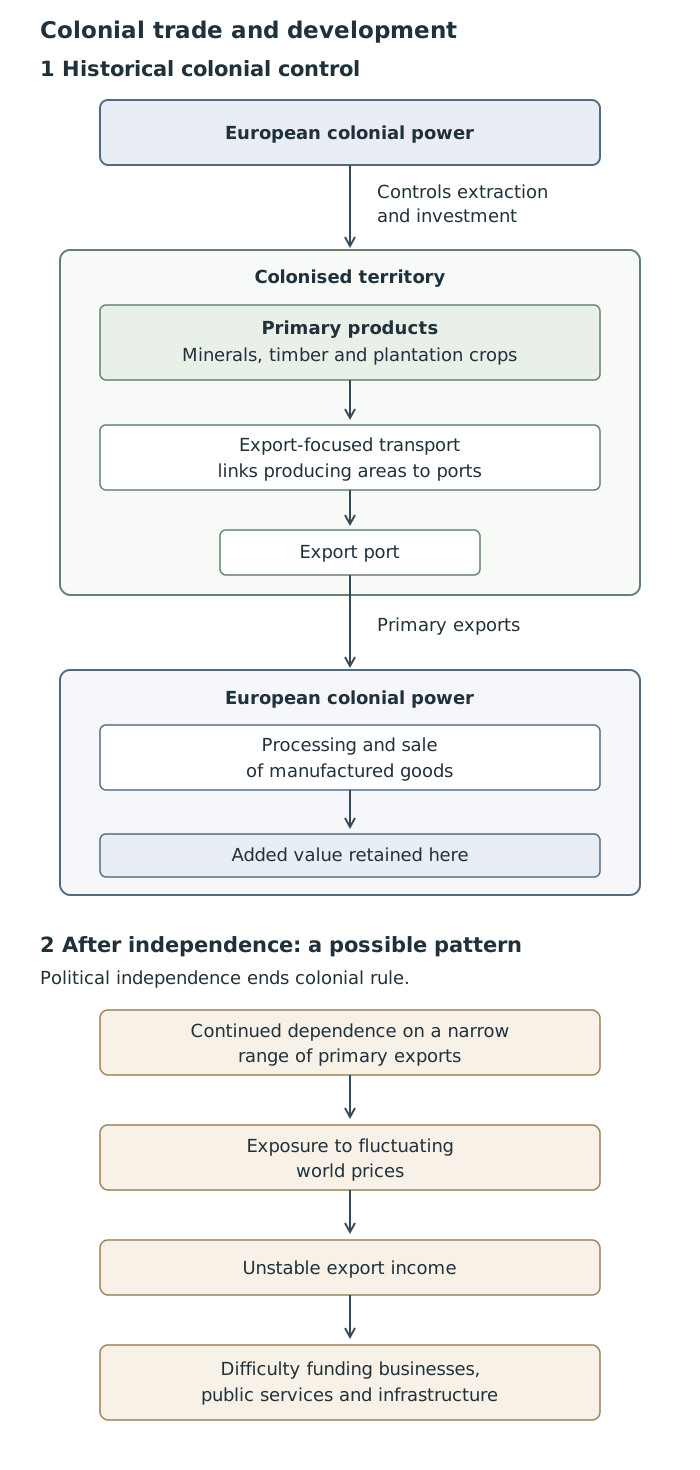
Colonial control shaped resource extraction and trade. Dependence on primary exports can continue after political independence.
Political independence did not automatically remove these economic patterns. A country still dependent on a narrow range of primary exports remains vulnerable to changes in world prices. If export prices fall, income falls too, making investment in businesses and public services harder. Historical disadvantage can therefore continue to influence present-day development, although it does not determine every country's future.
Limited access to education can restrict the skills available to employers and make it harder to develop manufacturing and service industries. Poor health can reduce people's ability to work and earn income. Low national income then limits investment in schools, healthcare and clean water, reinforcing these problems.
Conflict destroys buildings and livelihoods, disrupts trade and diverts money towards military spending. Corruption can redirect public funds into private hands rather than services for the population. Unstable government can also make businesses less willing to invest.
Borrowing can finance useful development, but debt repayments and interest reduce the money available for other spending. A country with low income may struggle to repay loans while maintaining education, healthcare and infrastructure. These barriers are connected: a fall in export earnings, for example, can make debt repayments harder to afford.
Aid is assistance provided to people or countries. It can include money, food, equipment, medical care and training. Aid can be classified by who provides it, its purpose and any conditions attached to it.
| Classification | Type | Meaning and example |
|---|---|---|
| Provider | Bilateral | One government gives assistance directly to another country, such as drought relief from the UK to Ethiopia. |
| Provider | Multilateral | Several countries contribute through an international organisation, such as World Bank funding for education in Pakistan. |
| Provider | Voluntary or NGO | A charity or non-governmental organisation provides assistance, such as WaterAid supporting water supplies in Mali. |
| Purpose | Emergency | Immediate help during a crisis, such as food, shelter and medical supplies after Typhoon Haiyan. |
| Purpose | Development | Longer-term support, such as training teachers, building roads or installing irrigation. |
| Conditions | Tied | Assistance must be used in specified ways, often to buy the donor country's goods or services. |
These are not separate, mutually exclusive boxes. Government-funded emergency relief can be bilateral, while a charity can provide both emergency assistance and long-term development support. Financial assistance may be a grant, which does not need repayment, or a loan, which does.
Emergency aid saves lives by meeting immediate needs for food, water, shelter and medicine. It can also prevent a disaster from causing even greater losses of health and livelihoods. However, surviving the emergency is not the same as achieving lasting development.
Long-term aid can fund services and infrastructure that a country cannot yet afford alone. Teacher training improves skills; healthcare helps people stay well enough to work; and roads make it easier to reach markets. Training and suitable equipment can help communities continue benefiting after outside support ends.
Projects are more likely to last when local people help identify needs and can maintain what is provided. A water pump, for example, is more useful over time if local people have the skills and resources to repair it.
Aid can fail to reach those who need it if officials divert funds or conflict prevents delivery. A project designed without local involvement may not meet local needs, or may be too expensive to maintain.
Tied aid can favour the donor's businesses rather than giving the recipient the best-value equipment. Aid loans create repayment obligations, which may reduce future spending on development. Grants avoid that debt burden, but poorly planned assistance can still create dependence on continuing outside support.
Aid can also damage local livelihoods. Free imported food is essential when people face hunger, but continued distribution when local farmers have produce to sell can undercut their prices. Farmers may lose income, weakening local food production.
Aid is therefore neither automatically helpful nor automatically harmful. Emergency assistance is vital during crises; lasting development depends more on well-targeted support, local involvement, accountable management and affordable maintenance. The strongest aid programmes build the recipient's capacity to meet future needs rather than simply supplying repeated short-term help.
These causes interact and can reinforce one another.
A single programme can belong to several categories.
Promotes development: saves lives, funds infrastructure and services, improves health and skills, and supports future self-sufficiency.
Can hinder development: corruption, unsuitable projects, dependency, tied purchases, loan repayments and competition with local producers.
Judgement: effectiveness depends on local needs, delivery, accountability and whether benefits can continue after outside support ends.
Explain a chain of effects: for example, falling export prices reduce income, which leaves less money for investment in schools and healthcare.
Link colonialism to both trade patterns and resource exploitation, rather than simply saying that countries were once colonies.
Aid categories overlap: a project can be bilateral, long-term and tied at the same time.
When evaluating aid, weigh benefits against limitations and judge the conditions under which it is most likely to support lasting development.
Distinguish grants from loans: not all aid creates debt.
It can see this note and what your specification asks for.
Answers are free with an account.
1 free note left this week
Get more free notesYour answer sets when this note comes back for review, or marks it complete.
Was this note helpful?
Log in to tell us whether it helped, or to report a problem.
Last updated
Uneven development
Differences in economic prosperity and quality of life between places.
Colonialism
The control of one country or territory by another, often involving the exploitation of its people and resources.
Natural resource
A material found in nature that people can use, such as timber, minerals or oil.
Trade
The exchange of goods and services; international trade takes place between countries.
Primary product
A product obtained directly from farming, fishing, forestry or mining, rather than through manufacturing.
Aid
Assistance provided to people or countries, including money, goods, skills and services.
Bilateral aid
Assistance given directly by the government of one country to another country.
Multilateral aid
Assistance provided through an international organisation, using contributions from several countries.
Voluntary aid
Assistance provided by charities and non-governmental organisations, often funded by public donations.
Emergency aid
Short-term assistance intended to meet immediate needs during or after a crisis.
Development aid
Long-term assistance intended to improve a country's ability to meet people's needs and support economic progress.
Tied aid
Assistance given on conditions that restrict how it can be used, commonly requiring purchases from the donor country.
Debt
Money owed to a lender, which must be repaid, usually with interest.
Put your knowledge into practice — try past paper questions for Geography A
Uneven development
Differences in economic prosperity and quality of life between places.
Colonialism
The control of one country or territory by another, often involving the exploitation of its people and resources.
Natural resource
A material found in nature that people can use, such as timber, minerals or oil.
Trade
The exchange of goods and services; international trade takes place between countries.
Primary product
A product obtained directly from farming, fishing, forestry or mining, rather than through manufacturing.
Aid
Assistance provided to people or countries, including money, goods, skills and services.
Bilateral aid
Assistance given directly by the government of one country to another country.
Multilateral aid
Assistance provided through an international organisation, using contributions from several countries.
Voluntary aid
Assistance provided by charities and non-governmental organisations, often funded by public donations.
Emergency aid
Short-term assistance intended to meet immediate needs during or after a crisis.
Development aid
Long-term assistance intended to improve a country's ability to meet people's needs and support economic progress.
Tied aid
Assistance given on conditions that restrict how it can be used, commonly requiring purchases from the donor country.
Debt
Money owed to a lender, which must be repaid, usually with interest.