

Loading…
Loading…
Loading…
OCR GCSE Geography A · J383
OCR J383 · 1.3.4 Check the specification (PDF) (opens in a new tab)
The UK needs energy to heat buildings, move people and goods, and generate electricity. Its is the combination of sources used to meet these needs. Natural gas can heat a home directly or fuel a power station; oil provides fuels such as petrol and diesel for transport. Electricity is produced using energy sources rather than being a renewable or non-renewable source itself.
This distinction matters when comparing contributions. A figure showing the sources of UK electricity generation does not describe the whole energy supply: it leaves out fuels used directly for heating and transport.
Renewable energy sources are naturally replenished fast enough to replace what is used. They include:
Renewable does not mean continuously available. Wind and solar output depend on wind conditions and daylight. Nor does it mean impact-free: burning biological material still releases emissions.
Non-renewable energy sources have finite stocks that are not replaced on a human timescale. Coal, oil and natural gas are fossil fuels, formed over millions of years and used much faster than new supplies form. Coal and gas can fuel electricity generation, while oil is particularly important for transport.
Nuclear fuel is also non-renewable. Nuclear power stations use energy released from a finite fuel supply to produce heat and generate electricity. Nuclear power is not a fossil fuel, and its low-carbon electricity generation does not make the fuel renewable.
In 2024, renewables accounted for 16.2% of UK gross final energy consumption. This measure brings together energy used for electricity, heating and transport. Around 84% was therefore supplied by sources other than renewables, showing that non-renewable energy still dominated overall energy use.
The renewable contribution differed sharply between uses: 49.5% for electricity, 9.4% for heat and 6.2% for transport on this consumption measure.
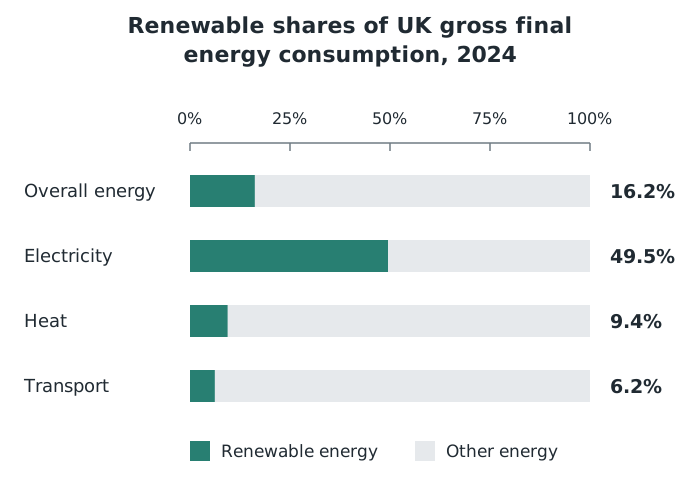
Renewables supplied nearly half of electricity consumption, but much smaller shares of heat and transport energy in 2024.
Electricity had by far the highest renewable share. Gas remained important for heating, while oil-derived fuels remained important for transport. Consequently, a large renewable contribution to electricity did not mean that half of all UK energy use was renewable. The overall percentage is not a simple average of the three sector percentages, because the sectors use different amounts of energy.
Looking specifically at electricity generated in the UK in 2024, renewables supplied 50.4%. This is a generation measure, distinct from the electricity consumption percentage above.
The main contributions were:
| Source or statistical category | Share of UK electricity generation, 2024 |
|---|---|
| Wind and solar combined | 34.3% |
| Gas | 30.4% |
| Nuclear | 14.2% |
| Other renewables | 14.1% |
| Oil and other fuels | 4.2% |
| Hydro | 2.0% |
| Coal | 0.7% |
Wind and solar together contributed more than gas, but gas remained a major individual source. Nuclear provided a substantial non-renewable contribution alongside fossil fuels. Coal’s contribution was small; the UK’s last coal-fired power station closed in September 2024.
The categories need careful reading. ‘Oil and other fuels’ is a mixed statistical category that includes pumped-storage generation, so its entire share cannot be labelled fossil fuel. The separately reported fossil-fuel share was 31.8%. Small differences in totals can also result from rounding.
Renewables are not limited to wind turbines and solar panels. Bioenergy accounted for about half of the renewable energy sources used in the UK in 2024, including energy used for heating and transport as well as electricity generation. Wind and marine energy accounted for roughly a quarter.
This explains why the leading renewable sources depend on what is being measured. Wind and solar were especially prominent in electricity generation, while bioenergy made the largest contribution across renewable energy use more broadly.
Electricity generation is only part of the energy mix. Heating and transport help explain why renewables’ overall contribution was much lower than their electricity contribution.
State whether a figure refers to all energy use or electricity generation, and give its year. These are different measures.
Nuclear energy is non-renewable because its fuel is finite; low-carbon does not mean renewable.
Use figures to support a comparison, rather than listing percentages without explaining what they show.
Do not treat the whole ‘oil and other fuels’ category as fossil fuels: it also includes generation from pumped storage.
It can see this note and what your specification asks for.
Answers are free with an account.
1 free note left this week
Get more free notesYour answer sets when this note comes back for review, or marks it complete.
Was this note helpful?
Log in to tell us whether it helped, or to report a problem.
Last updated
Renewable energy
An energy source that is naturally replenished fast enough to replace what is used.
Non-renewable energy
An energy source with a finite stock that is not replaced on a human timescale.
Fossil fuel
Coal, oil or natural gas: fuels formed from ancient organic material over millions of years.
Energy mix
The combination of energy sources used by a country, often expressed as each source’s percentage contribution.
Bioenergy
Energy obtained from biological material, including solid biomass, biogas and liquid biofuels.
Put your knowledge into practice — try past paper questions for Geography A
Renewable energy
An energy source that is naturally replenished fast enough to replace what is used.
Non-renewable energy
An energy source with a finite stock that is not replaced on a human timescale.
Fossil fuel
Coal, oil or natural gas: fuels formed from ancient organic material over millions of years.
Energy mix
The combination of energy sources used by a country, often expressed as each source’s percentage contribution.
Bioenergy
Energy obtained from biological material, including solid biomass, biogas and liquid biofuels.