Loading…


Loading…
Loading…
Loading…
OCR GCSE Computer Science · J277
OCR J277 Check the specification (PDF) (opens in a new tab)
A school network connects devices within the school, while a home network connects devices in a house. These networks can connect to other networks, which connect to still more networks. The Internet is this worldwide collection of interconnected computer networks. It allows devices on different networks to communicate rather than remaining isolated within their own local network.
The Internet and the World Wide Web are not the same thing. The Internet provides the connections over which data travels. The Web is the collection of websites and web pages accessed using a browser. Accessing a website uses the Internet, but the Internet also supports other services, such as email.
A server provides services over a network. A client is a device or program that requests and uses those services. These names describe their roles in the communication: the client makes a request, and the server responds.
A web server stores website resources, including web page files. When you visit a website, your browser acts as a client: it requests the resources from the web server, receives them and displays the page. One server can respond to requests from many clients.
A file server provides a different service: storing files and allowing clients to retrieve them. For example, a school file server can let a pupil access their saved work from different school computers, provided they have permission. The work is stored on the server, not only on the particular computer they used to create it.
Hosting means storing websites, files or other content on a server so that clients can access them. Hosting a website therefore involves making its resources available through a web server. Reliable, secure servers matter because many users may depend on access to the hosted content.
People find names easier to remember than numbers. A browser, however, needs the web server's IP address to contact it. A Domain Name Service (DNS) connects these two forms of address by looking up a domain name and returning its corresponding IP address.
DNS is not one computer containing the whole Internet's address book. It is made up of multiple Domain Name Servers, which together provide the lookup service.
A URL is the address of a resource. In the URL https://example.org/news, example.org is the domain name and /news identifies the requested resource. When describing DNS as converting a URL to an IP address, it is the domain-name part that is looked up, not the page's path.
A simplified sequence for opening a web page is:
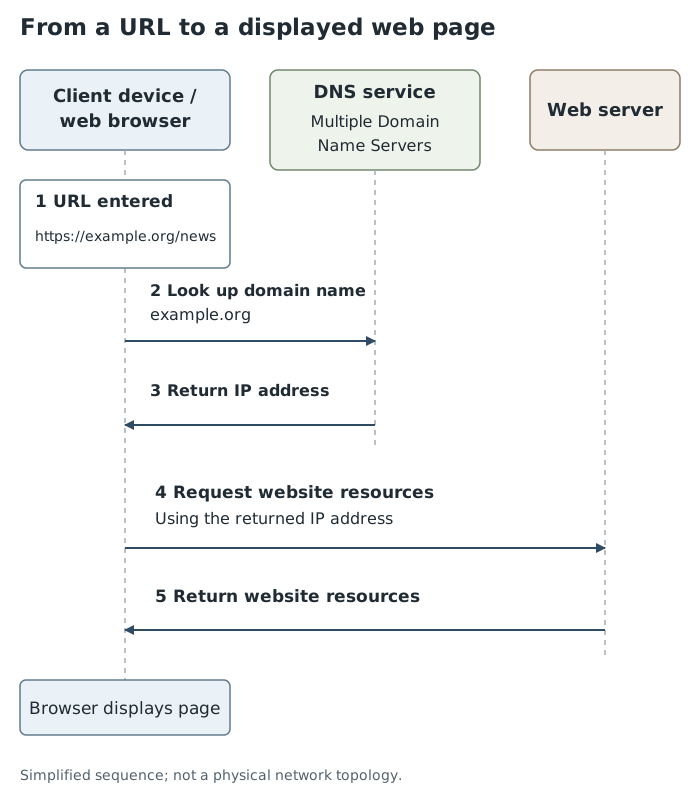
DNS returns the server's IP address. The client then requests the website resources from the web server.
DNS provides the address; the web server provides the website resources. Keeping those jobs separate explains why knowing a website's name is enough to begin a request without memorising its IP address.
The Cloud is remote service provision using servers accessed over the Internet. The storage or processing takes place on the provider's servers rather than only on the user's own device. The word does not describe a place in the sky: cloud services depend on physical computers somewhere in the world.
Cloud services include:
The client–server idea therefore connects directly to the Cloud: the user's device requests a service, and the provider's remote servers supply it.
Cloud services can make work more flexible. Users can access their files from different devices and locations, provided they have Internet access. They can also share content and collaborate, rather than keeping separate copies on individual machines.
The provider maintains the service's server hardware and typically manages security and backups. This reduces the equipment and maintenance work required by the user or organisation. Cloud storage can also offer substantial capacity without the user buying their own storage server.
These benefits have trade-offs. Access to remote services depends on an Internet connection: without one, users may be unable to retrieve files or use the software they need. Subscription charges create ongoing costs, and paying for more capacity can become expensive across a business.
Storing data with another organisation also raises security and privacy concerns. A data leak could expose confidential information, and users need to consider where their data is stored and how the provider is allowed to use it. Moving responsibility for security to a provider does not remove the risk.
For a team working from several locations, shared access and collaboration may make a cloud service attractive. For an organisation with unreliable Internet access, dependence on that connection may be a serious disadvantage. A useful judgement weighs the benefits against the needs of the particular users, rather than treating the Cloud as always better or always worse.
Get unlimited access to all revision notes, key terms, and exam tips.
DNS is made up of multiple Domain Name Servers.
URL entered → domain name looked up → IP address returned → client contacts web server → resources returned and displayed.
DNS supplies the address, not the web page.
Remote services accessed over the Internet: storage, software and processing.
Benefits: access across devices and locations; collaboration; provider-managed hardware, backups and security; storage capacity without buying a server.
Drawbacks: Internet dependence; ongoing subscription and expansion costs; security and privacy risks.
Choose according to the scenario: explain how each relevant benefit or drawback affects the users.
Get unlimited access to all revision notes, key terms, and exam tips.
Distinguish the Internet, which is the network infrastructure, from the World Wide Web, which consists of websites and web pages accessed using it.
For DNS, state that the domain name in the URL is looked up and the corresponding IP address is returned. DNS does not send the web page itself.
A client is a device or program requesting a service, not simply the person using it.
When evaluating cloud services, link each advantage or disadvantage to the scenario and explain its consequence. Provider-managed security and backups do not guarantee that data can never be lost or stolen.
Internet
A worldwide collection of interconnected computer networks.
World Wide Web
The collection of websites and web pages accessed over the Internet using a web browser.
Server
A computer or program that provides services to clients over a network.
Client
A device or program that requests and uses services provided by a server.
Web server
A server that stores website resources and supplies them to clients when requested.
File server
A server that provides file storage and retrieval services to clients.
Hosting
Storing websites, files or other content on a server so that clients can access them over a network.
DNS
A Domain Name Service, made up of multiple Domain Name Servers, that looks up domain names and returns their corresponding IP addresses.
Domain name
A human-readable name, such as example.org, used to identify a website rather than remembering its server's numeric IP address.
URL
A Uniform Resource Locator: an address identifying a resource, such as a web page, and how to access it.
IP address
A numerical address used to identify a device on an IP network and direct communications to it.
Cloud
Remote provision of services, such as storage, software and processing, using servers accessed over the Internet.
Put your knowledge into practice — try past paper questions for Computer Science
Internet
A worldwide collection of interconnected computer networks.
World Wide Web
The collection of websites and web pages accessed over the Internet using a web browser.
Server
A computer or program that provides services to clients over a network.
Client
A device or program that requests and uses services provided by a server.
Web server
A server that stores website resources and supplies them to clients when requested.
File server
A server that provides file storage and retrieval services to clients.
Hosting
Storing websites, files or other content on a server so that clients can access them over a network.
DNS
A Domain Name Service, made up of multiple Domain Name Servers, that looks up domain names and returns their corresponding IP addresses.
Domain name
A human-readable name, such as example.org, used to identify a website rather than remembering its server's numeric IP address.
URL
A Uniform Resource Locator: an address identifying a resource, such as a web page, and how to access it.
IP address
A numerical address used to identify a device on an IP network and direct communications to it.
Cloud
Remote provision of services, such as storage, software and processing, using servers accessed over the Internet.