

Loading…
Loading…
Loading…
OCR GCSE Combined Science B · J260
OCR J260 · P4 Wave Phenomena Check the specification (PDF) (opens in a new tab)
Electromagnetic waves transfer energy. Visible light and infrared radiation are two examples. When these waves meet matter, they may be reflected from a surface, transmitted through it or absorbed, transferring energy to the material. A transmitted wave may also change direction as it enters another material: this is refraction.
These possibilities are not mutually exclusive. A transparent sheet can transmit some light while reflecting some from its surface. The interaction depends on both the material and the wavelength of the radiation. A material that transmits visible light does not necessarily transmit every other part of the electromagnetic spectrum.
In a practical investigation, choose an observation that makes the interaction detectable. A light patch on a screen reveals where visible light travels. A thermometer can reveal warming caused by absorption, even when the radiation itself is invisible.
Use a torch to shine light onto flat kitchen foil and observe the reflected light on a white screen. Then repeat with crumpled foil, keeping the torch position and illumination similar. Flat foil produces more regular reflection; crumpled foil spreads the reflected light in different directions because its small surfaces face different ways. Record the difference in the position and spread of the light patches. Scattering here is reflection in many directions, not the disappearance of the light.
To observe transmission, put a transparent glass block between a light source and a screen. Light reaching the screen shows that some light has passed through the glass. Compare this with an opaque card placed in the same position. A missing light patch shows that light has not been transmitted through the card, but does not by itself tell you how much was reflected or absorbed.
A narrow beam from a ray box makes a change in direction easier to observe. Place a rectangular glass block on paper and trace its outline. Direct the beam at an angle to one face and mark points along the incoming and outgoing paths. Remove the block and join the points with a ruler, including the path through the block. The change in direction at the boundaries shows refraction. The light changes speed when passing between air and glass; a beam entering along the normal does not bend.
A ray is a line representing the direction in which light travels. Draw arrows on your recorded paths. If measuring reflection angles, draw a normal, a line at 90° to the surface: the angle of incidence equals the angle of reflection, with both measured from this normal.
Keep beams below eye level and never look directly into a bright source or its reflection. A torch or ray box is suitable for these observations; a laser is unnecessary. Handle glass carefully and allow hot lamps to cool before touching them.
Absorption can be observed using a radiant heater or a hot filament lamp, a timer, a thermometer and identical card envelopes coloured with different intensities of black ink. Place an envelope over the thermometer bulb. Radiation absorbed by the card warms it, allowing the thermometer to detect the effect.
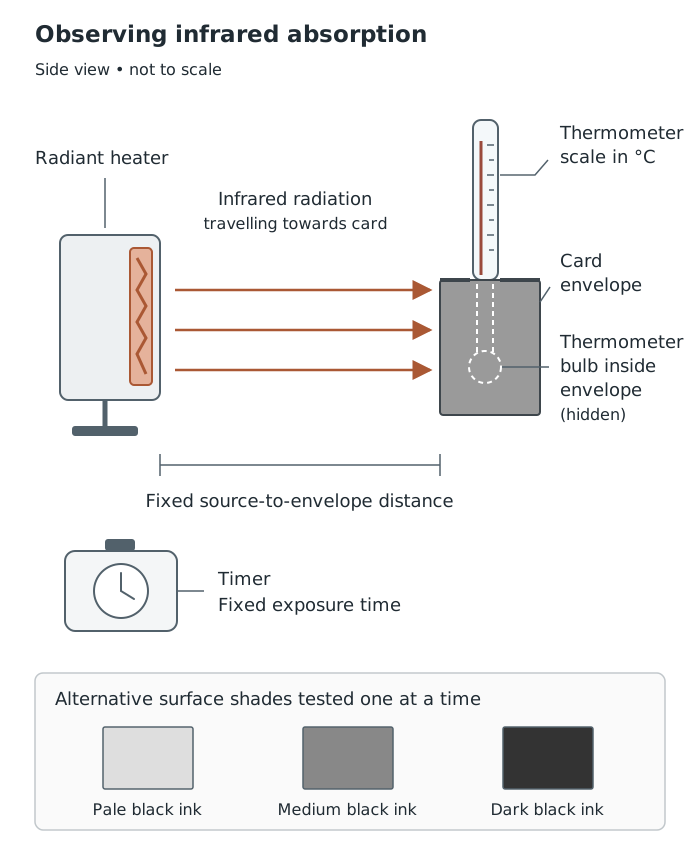
Compare surface shades using the same distance and exposure time. The thermometer detects warming after radiation is absorbed.
Use the following comparison:
The independent variable is the intensity of black ink. The dependent variable is the temperature rise. Keep the envelope size and card material, thermometer, distance, orientation, source output and exposure time the same. This makes differences in warming more reasonably attributable to the surface shade.
Record results in a table with columns for surface shade, exposure time in seconds, starting temperature in °C, final temperature in °C and temperature rise in °C. Calculate:
The exposure ends at the chosen time, not when a particular temperature is reached. A darker black surface is expected to absorb infrared radiation more readily and show a greater temperature rise under the same conditions. The rise is evidence of energy transfer to the material; it is not a direct measurement of the total radiation absorbed, because energy can also be transferred to the surroundings.
Use teacher supervision for the heater or hot lamp. Keep card clear of the hot source, do not touch hot surfaces, and let the apparatus cool before changing its arrangement. Infrared radiation cannot be seen: any visible glow comes from visible light emitted alongside it.
Record what happens before explaining it. For example, ‘the darker envelope had a larger temperature rise’ is an observation. ‘The darker surface absorbed radiation more readily under these conditions’ is a conclusion supported by that observation.
Repeated observations strengthen a conclusion. If repeats disagree, check the positioning, timing and starting temperature rather than selecting only the result that fits your expectation.
Change the surface shade; measure temperature rise. Keep material, size, distance, orientation, source output, starting temperature and exposure time constant. Repeat and record results with units.
Darker black surfaces absorb infrared more readily. Infrared is invisible. Keep beams away from eyes and allow hot apparatus to cool before handling.
Separate an observation from its explanation: ‘the temperature increased’ is an observation; ‘the surface absorbed radiation’ is the explanation.
For a fair absorption comparison, keep the source distance, exposure time, starting temperature and card material the same.
Compare temperature rises, not just final temperatures. Record temperatures in °C and times in seconds.
Infrared radiation is invisible. A glowing lamp may emit both visible light and infrared radiation.
Measure angles of incidence and reflection from the normal, not from the surface.
It can see this note and what your specification asks for.
Answers are free with an account.
1 free note left this week
Get more free notesYour answer sets when this note comes back for review, or marks it complete.
Was this note helpful?
Log in to tell us whether it helped, or to report a problem.
Last updated
Electromagnetic wave
A wave consisting of oscillating electric and magnetic fields that transfers energy. Visible light and infrared radiation are examples.
Absorption
The transfer of energy from an electromagnetic wave to matter.
Reflection
The return of a wave from a surface, changing its direction of travel.
Transmission
The passage of a wave through a material.
Refraction
A change in the direction of a wave as it crosses a boundary between materials because its speed changes, except when it travels along the normal.
Infrared radiation
Invisible electromagnetic radiation with frequencies just below those of red visible light.
Control variable
A factor kept the same during an investigation so that it does not affect the comparison.
Put your knowledge into practice — try past paper questions for Combined Science B
Electromagnetic wave
A wave consisting of oscillating electric and magnetic fields that transfers energy. Visible light and infrared radiation are examples.
Absorption
The transfer of energy from an electromagnetic wave to matter.
Reflection
The return of a wave from a surface, changing its direction of travel.
Transmission
The passage of a wave through a material.
Refraction
A change in the direction of a wave as it crosses a boundary between materials because its speed changes, except when it travels along the normal.
Infrared radiation
Invisible electromagnetic radiation with frequencies just below those of red visible light.
Control variable
A factor kept the same during an investigation so that it does not affect the comparison.