

Loading…
Loading…
Loading…
OCR GCSE Combined Science B · J260
OCR J260 · P4 Wave Phenomena Check the specification (PDF) (opens in a new tab)
A wave travels through a material while the material itself vibrates. In a ripple tank, the water surface rises and falls as waves travel across it. On a stretched string, sections of string move up and down as waves travel along the string. Measuring the motion of one piece of the material is therefore different from measuring how fast the wave travels.
Three measurements describe the wave. Wavelength, , is the distance between equivalent points on consecutive waves, such as neighbouring crests. Frequency, , is the number of complete waves passing a fixed point each second. Wave speed, , is the distance the wave travels each second.
These quantities are linked:
Use frequency in hertz (Hz) and wavelength in metres (m) to calculate speed in metres per second (m/s). The connection makes sense: if several waves pass each second, and each occupies one wavelength, their total length gives the distance travelled in that second.
Choose an instrument whose range covers the measurement and whose scale is fine enough to distinguish the changes you expect. Check its actual resolution rather than assuming every instrument has the same scale.
| Quantity | Suitable apparatus and technique |
|---|---|
| Length | Use a ruler or tape measure. Align it with the distance and read straight at the scale. If the starting point is not zero, subtract the two end readings. |
| Area | For a rectangular surface, measure its length and width with a ruler and multiply them. Record area in squared units, such as cm². |
| Mass | Use a balance. Zero it first, or tare it with the empty container in place. |
| Time | Use a stopwatch for events slow enough to follow. Start and stop at clearly defined events. |
| Volume | Use a measuring cylinder. Read the bottom of water's curved surface at eye level. |
| Temperature | Use a thermometer. Immerse its bulb without touching the vessel and wait for the reading to settle. |
Not every quantity needs measuring in every wave investigation. Length and time are central; water depth, temperature or the mass used to tension a string may need recording to keep conditions consistent.
Record raw readings before calculating results. Put quantities and units in table headings, such as distance / m, time / s, frequency / Hz and wavelength / m. Repeat measurements and compare them before finding a mean.
A ripple tank is a shallow transparent tray of water. A vibrating dipper produces waves, while a lamp projects their pattern onto a screen below. This makes the wavefronts easier to observe than looking directly at the water.
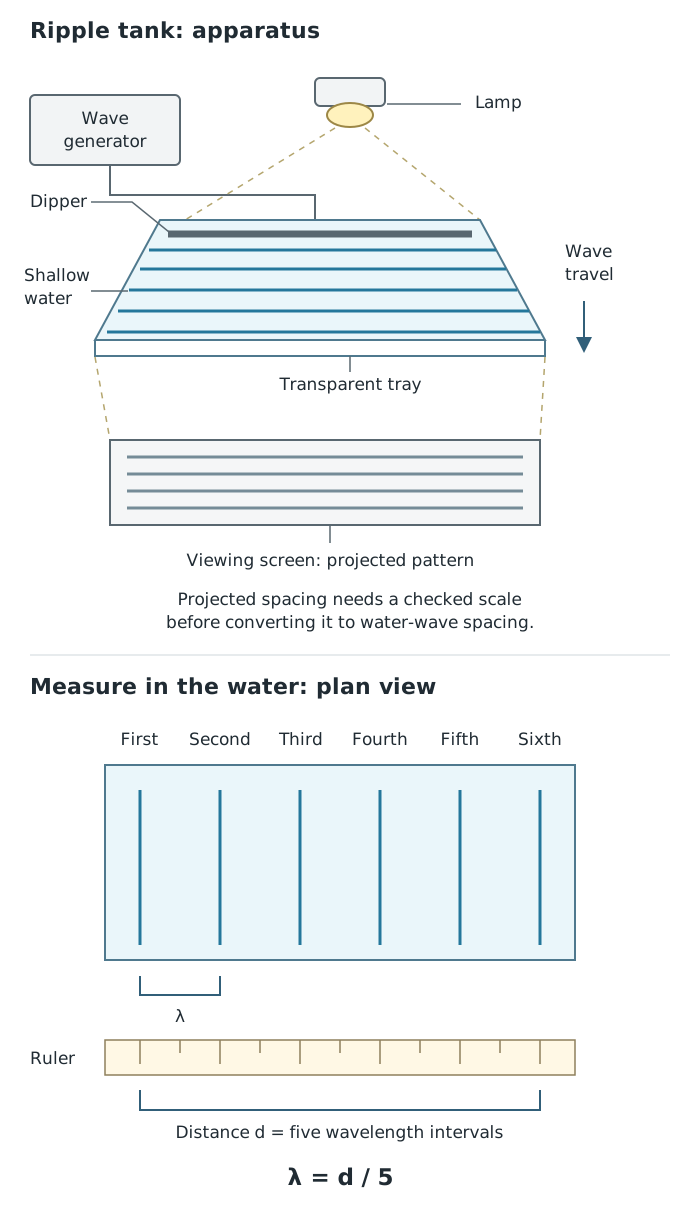
Measure across complete wavelength intervals, perpendicular to the wavefronts. Six crests span five wavelengths.
Set the tank level and add shallow water, no more than about 1 cm deep for this method. Switch on the lamp and wave generator. Wait until a regular, clearly visible wave pattern is produced before measuring.
To find wavelength, measure perpendicular to the wavefronts across several complete wavelength intervals, then divide by the number of intervals. For example, a measurement from the first crest to the sixth crest spans five wavelengths. Measuring a longer distance reduces the relative effect of uncertainty in placing the ruler.
A projected pattern can be enlarged. Use the ruler to measure the spacing of the actual water waves, or check the projection scale before converting screen distances into wavelengths. The screen is useful for seeing the pattern, but its distances are not automatically the same as distances in the water.
To find frequency, choose a fixed point and time a number of complete waves passing it:
Start with a crest at the point and count that starting crest as zero. Each following crest completes another cycle. Time enough cycles to reduce the relative effect of starting and stopping the stopwatch. If the waves pass too quickly to count reliably, hand timing is unsuitable.
A teacher-controlled stroboscope can make the pattern appear stationary when its flashes are synchronised with the waves. This helps identify wavefront positions; it does not mean the waves have stopped travelling. When correctly synchronised, its frequency setting can also be used to determine the wave frequency.
Record frequency and wavelength, then calculate . Repeat the measurements. If investigating how frequency affects wavelength, change the generator frequency while keeping water depth and temperature the same.
Keep water away from electrical connections and deal with spills promptly under the teacher's direction. Before using a stroboscope, the teacher must check whether flashing light poses a risk to anyone, including someone with photosensitive epilepsy.
A stretched string or elastic cord provides a visible wave in a solid. A vibration generator, driven by a signal generator, moves one end of the string. A pulley and hanging masses can keep the string under tension.
Adjust the signal-generator frequency slowly until a clear, steady pattern of vibrating loops appears. The points between loops remain still: these are nodes. The pattern is a stationary wave, produced by waves travelling along the string and reflected waves returning along it.
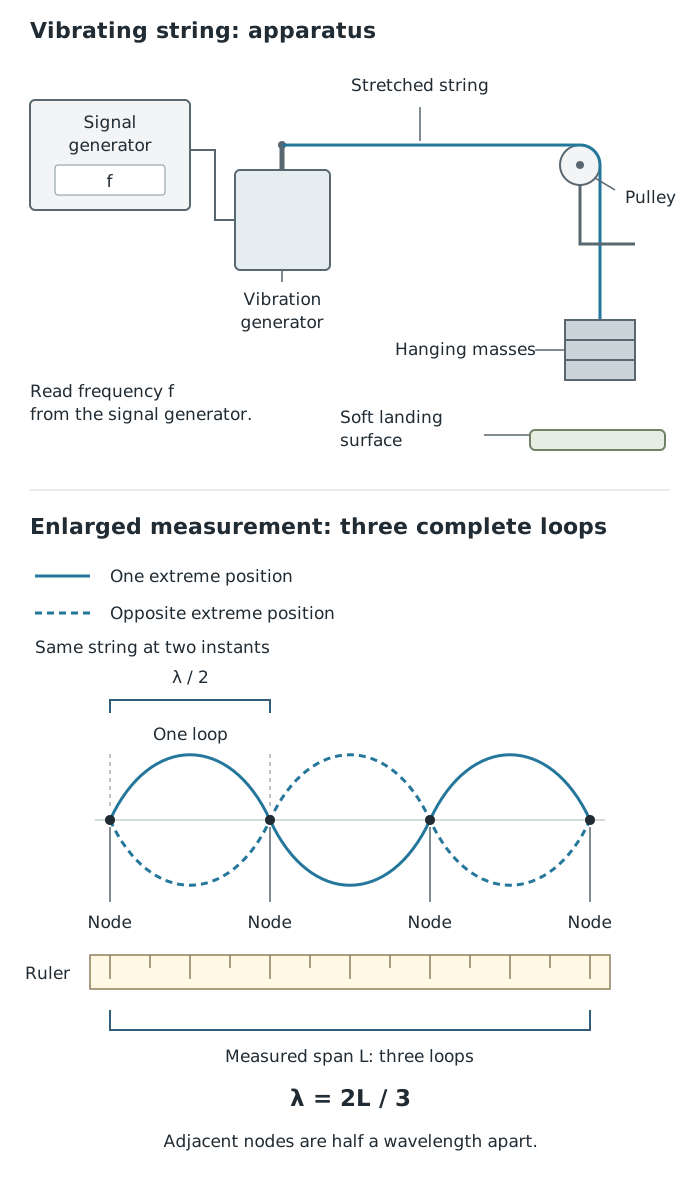
Each complete loop is half a wavelength long. Read frequency from the signal generator and measure the node spacing.
Read the frequency from the signal generator. A stopwatch is usually unsuitable here because the string vibrates too rapidly for reliable counting.
Measure the distance between nodes with a ruler. Adjacent nodes are half a wavelength apart, so one complete loop has length . If a measured length contains complete loops:
Measuring across several loops reduces the relative effect of uncertainty in locating a node. Calculate wave speed using . Although the overall pattern stays in place, the waves forming it travel along the string.
Repeat by adjusting away from the clear pattern and then returning to it. This checks how consistently you can identify the appropriate frequency. Keep the string, vibrating length and hanging masses unchanged when comparing patterns at different frequencies.
Use string or elastic cord rather than metal wire, wear eye protection, and keep clear of hanging masses. Place a soft landing surface beneath them in case they fall. Stop the generator before making adjustments to the string or masses.
Suitability depends on what the apparatus lets you observe and measure reliably. A ripple tank makes water wavefronts visible, but rapidly moving patterns are difficult to measure without a suitable viewing method. A vibrating string gives fixed nodes that are convenient for length measurements, while the signal generator supplies a frequency that is too fast to count by eye.
A fine instrument scale alone is not enough. Blurred wavefronts, uncertain node positions, projection enlargement and human reaction time can all limit accuracy. Choose an improvement that addresses the actual limitation, then use repeated readings to check whether the method gives consistent results.
Choose suitable range and resolution, check zero, avoid parallax, and record raw readings with units in headings. Compare repeats before averaging. Measuring several wavelengths and timing many cycles reduce relative measurement uncertainty.
Count wavelength intervals, not crests: from the first crest to the sixth crest there are five wavelengths.
Convert wavelength to metres before using v = fλ to obtain speed in m/s.
On a stationary string pattern, adjacent nodes are half a wavelength apart, not one wavelength.
Explain why an improvement helps: measuring several wavelengths reduces the relative effect of ruler-reading uncertainty; timing many waves reduces the relative effect of reaction time.
A stopwatch displaying hundredths of a second does not make hand timing accurate to 0.01 s.
Investigate repeats that disagree before averaging them. Repeating measurements does not remove a shared zero error.
It can see this note and what your specification asks for.
Answers are free with an account.
1 free note left this week
Get more free notesYour answer sets when this note comes back for review, or marks it complete.
Was this note helpful?
Log in to tell us whether it helped, or to report a problem.
Last updated
Wavelength
The distance between equivalent points on consecutive waves, such as neighbouring crests. Its symbol is and its SI unit is the metre (m).
Frequency
The number of complete oscillations, or complete waves passing a fixed point, each second. Its symbol is and its unit is hertz (Hz).
Wave speed
The distance travelled by a wave each second, measured in metres per second (m/s). Wave speed is calculated using .
Wavefront
A line joining points at the same stage of a wave, such as a line of crests across the surface of water.
Node
A fixed point on a stationary wave where there is no vibration.
Stationary wave
A wave pattern with fixed nodes and vibrating sections between them, formed when waves travelling in opposite directions overlap.
Resolution
The smallest change in a quantity that an instrument can display or distinguish.
Parallax error
An incorrect scale reading caused by viewing the scale at an angle rather than straight on.
Put your knowledge into practice — try past paper questions for Combined Science B
Wavelength
The distance between equivalent points on consecutive waves, such as neighbouring crests. Its symbol is and its SI unit is the metre (m).
Frequency
The number of complete oscillations, or complete waves passing a fixed point, each second. Its symbol is and its unit is hertz (Hz).
Wave speed
The distance travelled by a wave each second, measured in metres per second (m/s). Wave speed is calculated using .
Wavefront
A line joining points at the same stage of a wave, such as a line of crests across the surface of water.
Node
A fixed point on a stationary wave where there is no vibration.
Stationary wave
A wave pattern with fixed nodes and vibrating sections between them, formed when waves travelling in opposite directions overlap.
Resolution
The smallest change in a quantity that an instrument can display or distinguish.
Parallax error
An incorrect scale reading caused by viewing the scale at an angle rather than straight on.