

Loading…
Loading…
Loading…
OCR GCSE Combined Science B · J260
OCR J260 · B1 Microscopy Techniques Check the specification (PDF) (opens in a new tab)
Biological investigations often depend on measuring a change: a seedling grows longer, a sample changes mass, or a reaction produces gas. A useful measurement needs an appropriate instrument, a careful technique and a recorded value with its unit.
Accuracy means closeness to the true value. Resolution is the smallest change an instrument can distinguish. A finer scale can help you detect small changes, but it does not prevent mistakes such as reading from an angle or failing to zero a balance. Choose an instrument with a suitable range and a scale fine enough for the change you expect.
Before reading a scale, work out what each small division represents. For example, if a thermometer has ten equal intervals between 10 °C and 20 °C, each interval represents 1 °C. Check the instrument you are actually using rather than assuming that all scales are the same.
Use a ruler to measure lengths such as the height of a seedling. Align the starting point with the zero mark, rather than assuming the end of the ruler is zero. Keep the ruler alongside and parallel to the length being measured and view the scale directly from above the finishing point. Record the result in millimetres or centimetres, using the same starting and finishing points when comparing specimens. A flexible measuring tape is more suitable for a curved measurement, such as the circumference of a stem.
A leaf has an irregular outline, so measuring its length and width alone does not give its actual area. Trace its outline onto transparent paper, then place the tracing over squared paper. Count the complete squares and estimate the combined area of the partly covered squares. Multiply the total number of squares by the area of one square. For example, if each square represents 1 cm² and the tracing covers about 18 squares altogether, the leaf area is about 18 cm².
To measure only the green part of a variegated leaf, trace the boundaries of the green regions and count squares within those regions. Decide whether the investigation needs the area of one face or both faces of the leaf; these are different quantities.
Use a digital balance for mass, usually recorded in grams for small biological samples. Place an empty container on the balance and tare it before adding the sample. This removes the container's mass from the reading. Wait until the display settles before recording the value.
For a comparison, treat samples consistently. For example, surface water left on one sample but not another would affect the measured mass. A stable reading tells you that the balance is ready to be read; it does not prove that the sample has been prepared correctly.
Measure elapsed time with a stopwatch or stopclock, in seconds or minutes. Define the start and finish clearly before beginning: for example, start when the reactants are mixed and stop when a specified visible change occurs. Use the same rule for every repeat. Human reaction time can affect a manually timed result even when the stopwatch displays hundredths of a second.
Measure temperature with a thermometer or digital temperature probe, in degrees Celsius. Put the sensing part into the material being measured and allow the reading to stabilise. When measuring a liquid, avoid resting the sensing part against the sides or bottom of the container, which may be at a different temperature.
Keep a liquid-in-glass laboratory thermometer upright, with its bulb immersed. Wait until the liquid column stops changing, then read the top of the column at eye level while the bulb is still in the liquid. Removing it before reading allows it to begin changing towards the temperature of the surrounding air. Read promptly once it settles, as the sample itself may be cooling.
If a practical uses hot water, support the apparatus securely and avoid touching hot glass or spilling the water. Follow the teacher's instructions for heating and handling hot apparatus.
A measuring cylinder is suitable for many school biological investigations. Choose a size appropriate to the volume: a small volume is easier to read accurately in a smaller cylinder with finer divisions than in a large cylinder.
Stand the cylinder upright on a level surface. Bring your eye level with the liquid surface and read the bottom of the meniscus for water and most aqueous solutions. Looking down at the scale can introduce parallax error.
Where a more accurate fixed volume is needed, use a volumetric pipette with a pipette filler. A burette can measure a variable volume delivered: subtract the initial reading from the final reading. Its scale increases downwards. Never pipette by mouth.
Liquid volumes may be recorded in millilitres or cubic centimetres: 1 mL = 1 cm³.
Gas produced in a biological reaction can be collected in a gas syringe. Connect the reaction vessel to the syringe using an airtight bung and delivery tube. The tube must pass through the bung, with its open end in the gas space above the reaction mixture. As gas enters the syringe, it pushes the plunger outwards; read the collected volume from the syringe scale. Leaks would allow gas to escape and make the measured volume too low.
Alternatively, fill a measuring cylinder with water and invert it with its opening beneath the water surface. Feed gas into it through a delivery tube that enters through the submerged open end. The gas displaces water, and its volume is read from the cylinder. This method is unsuitable for gases that dissolve significantly in water.
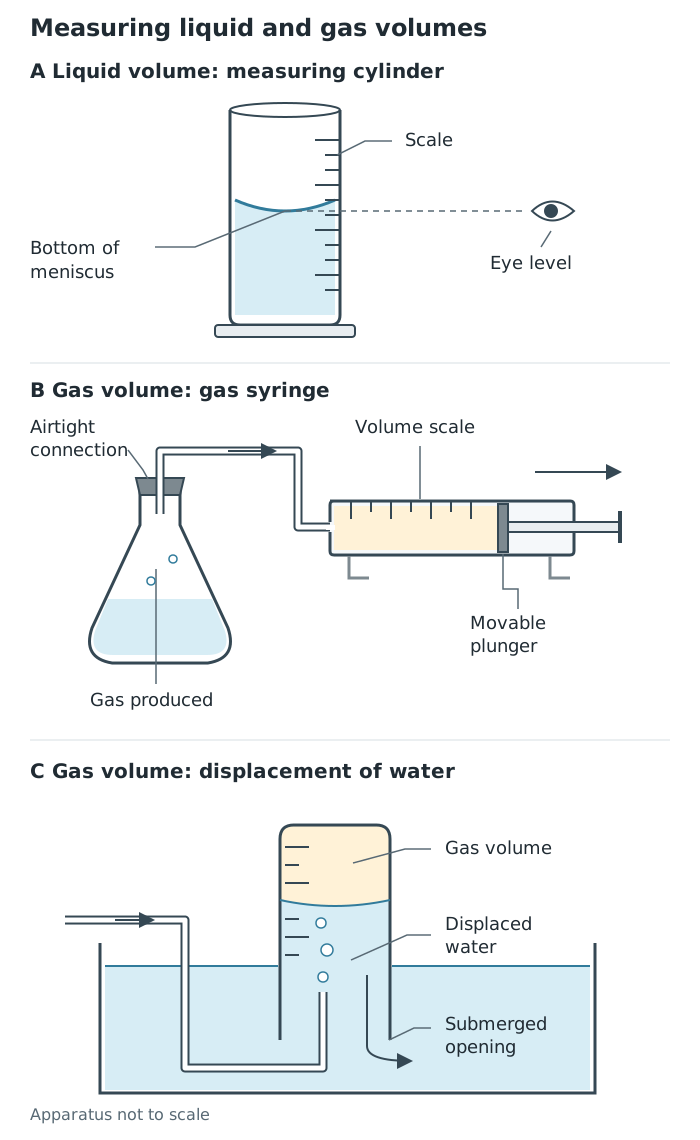
Read liquid volume at eye level. Gas reaches the syringe through a tube open to the flask's gas space, or enters an inverted cylinder through its submerged opening.
Secure glassware and tubing, wear eye protection where splashes are possible, and stop before a gas syringe reaches its capacity. Do not allow gas production to continue in a blocked apparatus.
pH describes how acidic or alkaline a solution is. A solution with pH below 7 is acidic, pH 7 is neutral and pH above 7 is alkaline. Indicator paper gives an approximate numerical pH by changing colour; compare that colour with the chart supplied with the paper.
Place a fresh strip of pH paper on a clean, dry white tile. Use a clean dropper to put a drop of the sample onto the strip without touching it with the dropper. Allow the colour to develop for the time instructed, then match it promptly to the supplied chart in good lighting. Record the closest pH value indicated by the chart, without a unit.
Use a fresh strip and a separate clean dropper for each sample. Transferring traces of one solution into another could change its pH. Handle samples according to their hazards, avoid skin contact and wear eye protection when using solutions that could damage the eyes.
Prepare a results table before starting. Give each measured quantity a heading and unit, then record readings immediately rather than relying on memory. Keep the number of decimal places consistent with the instrument's scale or display.
Repeating measurements helps you identify unusual results and judge how consistent the method is. However, repeating a faulty method does not remove a persistent error: a leaking gas apparatus can repeatedly give values that are too low.
| Quantity | Suitable apparatus | Unit |
|---|---|---|
| Length | Ruler or measuring tape | mm or cm |
| Area | Tracing and squared paper | mm² or cm² |
| Mass | Digital balance | g |
| Time | Stopwatch or stopclock | s or min |
| Temperature | Thermometer or temperature probe | °C |
| Liquid volume | Measuring cylinder; pipette or burette when appropriate | mL or cm³ |
| Gas volume | Gas syringe or inverted measuring cylinder over water | cm³ |
| pH | pH indicator paper and its colour chart | No unit |
Use table headings with units and record readings immediately. Resolution is the smallest distinguishable change; accuracy is closeness to the true value. Repeats check consistency but do not necessarily remove a persistent error.
1 mL = 1 cm³; 1 min = 60 s; 1 kg = 1000 g.
Give both the apparatus and how you would use it accurately; naming a measuring cylinder alone does not explain the measurement.
Put units in table headings, for example mass / g. Area needs squared units such as cm²; volume needs units such as cm³.
A stopwatch display of 1 minute 30 seconds means 90 seconds, not 1.30 minutes.
More decimal places do not automatically mean greater accuracy. Record only the detail the instrument can actually measure.
Gas collection over water is unsuitable if the gas dissolves significantly in water.
It can see this note and what your specification asks for.
Answers are free with an account.
1 free note left this week
Get more free notesYour answer sets when this note comes back for review, or marks it complete.
Was this note helpful?
Log in to tell us whether it helped, or to report a problem.
Last updated
Accuracy
How close a measurement is to the true value.
Resolution
The smallest change in a quantity that an instrument can distinguish.
Parallax error
An apparent change in the position of a scale reading caused by viewing it from an angle.
Meniscus
The curved surface of a liquid in a container.
Tare
Setting a balance to zero with an empty container on it, so that the subsequent reading gives the mass of its contents.
pH
A measure of how acidic or alkaline a solution is. Acidic solutions have pH below 7, neutral solutions have pH 7 and alkaline solutions have pH above 7.
Put your knowledge into practice — try past paper questions for Combined Science B
Accuracy
How close a measurement is to the true value.
Resolution
The smallest change in a quantity that an instrument can distinguish.
Parallax error
An apparent change in the position of a scale reading caused by viewing it from an angle.
Meniscus
The curved surface of a liquid in a container.
Tare
Setting a balance to zero with an empty container on it, so that the subsequent reading gives the mass of its contents.
pH
A measure of how acidic or alkaline a solution is. Acidic solutions have pH below 7, neutral solutions have pH 7 and alkaline solutions have pH above 7.