

Loading…
Loading…
Loading…
OCR GCSE Combined Science B · J260
OCR J260 · Biomass Transfer and Nutrient Cycling Check the specification (PDF) (opens in a new tab)
A woodland contains individual trees and animals, but these organisms do not live independently. We can describe their surroundings at four increasingly inclusive levels of organisation.
An organism is a single living thing, such as one grey squirrel. A population consists of all the organisms of one species living in the same area at the same time: for example, all the grey squirrels in a woodland.
A community includes all the populations of different species living and interacting in that area. The woodland community includes its squirrels, trees, other plants, birds and microorganisms—not just its animals.
An ecosystem includes this community and its interactions with the non-living environment. Organisms are its biotic, or living, components. Water, soil and light are examples of abiotic, or non-living, components. Plants taking up water from the soil are therefore interacting with an abiotic component of their ecosystem.
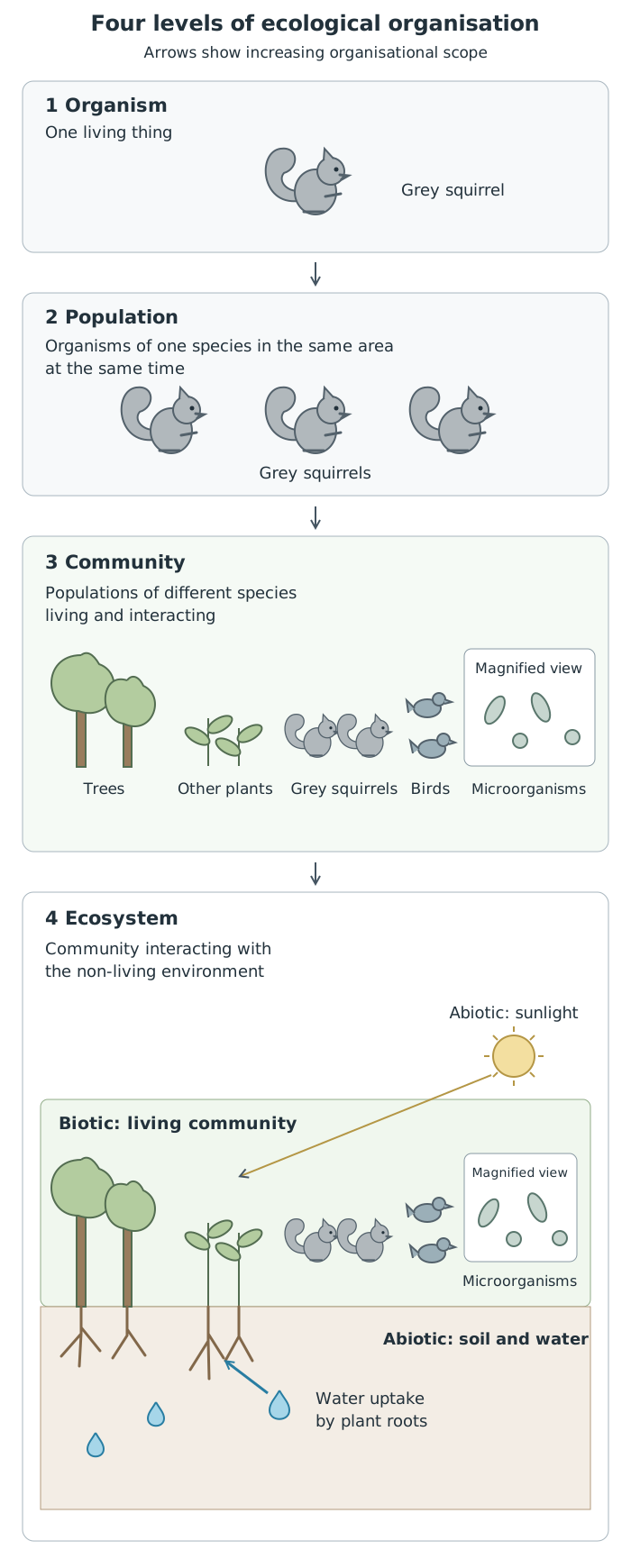
Each level includes more relationships. An ecosystem includes the living community and its interactions with non-living surroundings.
The key change from community to ecosystem is not simply adding more species: it is including the non-living environment and its interactions with the community. Ecosystems can also differ greatly in size; a garden pond and a woodland are both ecosystems.
Interdependence means that organisms depend on other organisms within their community. These connections help organisms obtain what they need to survive and reproduce, so a change in one population can affect others.
Feeding is one important connection. Herbivores depend on plants for food, while predators depend on prey. Photosynthetic organisms produce the food and biomass that support these feeding relationships. When an organism eats another, biomass is transferred between them. A food web models the many connected feeding relationships in a community.
Interdependence is not limited to feeding. Bees obtain food from flowers and transfer pollen between flowers as they visit them. This helps the plants reproduce. Animals can also disperse seeds: an animal eats a fruit and later passes its seeds in its faeces, carrying them away from the parent plant.
Interdependence does not mean every interaction benefits both organisms. A predator gains food by killing prey, whereas a bee and the plant it pollinates can both benefit from their interaction.
Because populations are connected, the effects of a change can spread beyond the species first affected. If a prey population decreases, its predators may have less food available. Fewer predators may then survive or reproduce, causing their population to decrease too. A predator with alternative food sources may be less affected than one that depends on that prey alone.
Similarly, fewer pollinating bees could reduce the reproduction of plants that depend on them. That could eventually affect animals relying on those plants for food.
In a stable community, population sizes remain fairly constant over time because interactions between species and environmental conditions are in balance. This does not mean that numbers never fluctuate. Interdependence helps explain both how a community functions and why a disturbance can affect several populations.
Competition occurs when organisms need the same resource but there is not enough available to meet all their needs. It can occur between organisms of the same species or between different species. Two grey squirrels may compete with one another, while grey and red squirrels may also compete for shared resources.
Plants compete for light, water, mineral ions and space. Light and water are needed for photosynthesis. Mineral ions support growth: for example, nitrate ions are needed to make proteins. Space allows leaves to reach light and roots to obtain water and mineral ions. If a plant is shaded by its neighbours, it may photosynthesise less and grow less successfully.
Animals compete for food, mates and territory. Food supplies materials and energy for growth and reproduction. Mates are needed for sexual reproduction, while a territory can provide access to food, water and shelter.
Competition affects which organisms survive and reproduce successfully, and therefore influences population sizes and the composition of a community. Organisms can depend on one another while also competing: interdependence describes their connections, whereas competition concerns their access to shared, limited resources.
Organism → population → community → ecosystem
Distinguish a population from a community: a population contains one species; a community contains populations of different species.
For an ecosystem, include both the living community and its interactions with the non-living environment.
When explaining competition, name the limited resource and explain how reduced access affects survival, growth or reproduction.
When predicting a population change, give a linked reason. Use ‘may increase’ or ‘may decrease’ rather than assuming a species will become extinct.
It can see this note and what your specification asks for.
Answers are free with an account.
1 free note left this week
Get more free notesYour answer sets when this note comes back for review, or marks it complete.
Was this note helpful?
Log in to tell us whether it helped, or to report a problem.
Last updated
Organism
A single living thing.
Population
All the organisms of one species living in the same area at the same time.
Community
All the populations of different species living and interacting in the same area.
Ecosystem
A community of organisms interacting with one another and with the non-living parts of their environment.
Biotic component
The living components of an ecosystem.
Abiotic component
A non-living part of an ecosystem, such as water, soil or light.
Interdependence
The dependence of organisms on other organisms in their community, for example for food, pollination or seed dispersal.
Competition
An interaction in which organisms need the same resource but its supply is limited.
Food web
A model showing the interconnected feeding relationships within a community.
Put your knowledge into practice — try past paper questions for Combined Science B
Organism
A single living thing.
Population
All the organisms of one species living in the same area at the same time.
Community
All the populations of different species living and interacting in the same area.
Ecosystem
A community of organisms interacting with one another and with the non-living parts of their environment.
Biotic component
The living components of an ecosystem.
Abiotic component
A non-living part of an ecosystem, such as water, soil or light.
Interdependence
The dependence of organisms on other organisms in their community, for example for food, pollination or seed dispersal.
Competition
An interaction in which organisms need the same resource but its supply is limited.
Food web
A model showing the interconnected feeding relationships within a community.
Organisms depend on others for food, pollination and seed dispersal. Food webs model feeding connections and biomass transfer.
A change in one population can affect others: fewer prey → less food for predators → predator numbers may decrease.
A stable community has population sizes that remain fairly constant, although they can fluctuate.
Competition occurs when organisms need the same limited resource, within or between species.
Access to resources affects growth, survival and reproduction, shaping population sizes and the community.