

Loading…
Loading…
Loading…
OCR GCSE Combined Science B · J260
OCR J260 · Biomass Transfer and Nutrient Cycling Check the specification (PDF) (opens in a new tab)
An ecosystem contains biotic components, such as plants, animals and microorganisms, and abiotic components, such as air, water and soil. Substances move between these components. Water, carbon and nitrogen-containing substances are all examples of materials that cycle.
Cycling means that substances become available for reuse rather than being used once and disappearing. For example, a carbon atom can move from atmospheric carbon dioxide into a plant, then into an animal that eats the plant, and eventually return to the environment. Its chemical form changes along the way.
Carbon is needed to make biological molecules, including carbohydrates, lipids and proteins. The carbon cycle keeps carbon available to organisms that need these molecules for growth and other life processes.
Photosynthetic organisms take in carbon dioxide and use it, together with water and light energy, to make glucose. Carbon that was in an abiotic component—the atmosphere—therefore becomes part of living biomass. Plants can use glucose to make other biological molecules.
Feeding transfers this carbon through a community. For example, when a rabbit eats grass, carbon-containing substances in the grass enter the rabbit. Some of this material becomes part of the rabbit's biomass.
Plants, animals and microorganisms all respire. During aerobic respiration, carbon-containing food molecules are broken down and carbon dioxide is released. This returns carbon to the environment, where it can be taken up again by photosynthetic organisms.
Dead organisms and waste material also contain carbon. Decomposers break down this material and use some of its products. Their respiration releases carbon dioxide, linking decomposition back to photosynthesis. Carbon can also remain stored in fossil fuels formed from ancient organisms. Burning these fuels releases carbon dioxide into the atmosphere.
Many bacteria and fungi act as decomposers. They break down dead organisms and organic waste, making substances available for reuse rather than leaving them locked inside dead biomass.
Decomposers secrete digestive enzymes onto the material around them, so digestion happens outside their cells. These enzymes break large, insoluble biological molecules into smaller, soluble molecules, such as sugars and amino acids. The microorganisms absorb these products. Some absorbed substances are used for growth, while others are used in respiration.
Decomposition returns mineral nutrients to soil or water. Plant roots can absorb dissolved mineral ions and use them to make new biological molecules. Decomposer respiration returns carbon dioxide to the atmosphere. Microorganisms therefore connect dead material with the resources needed by new living organisms. Without this recycling, dead material and waste would accumulate and fewer essential substances would remain available for growth.
For example, bacteria and fungi break down a fallen leaf. Some of its carbon becomes part of microbial biomass, while some returns to the atmosphere as carbon dioxide during microbial respiration. Mineral nutrients also become available for plants to take up again.
Microorganisms are especially important in recycling carbon and nutrients. The main movements of water, however, depend on physical processes such as evaporation and condensation rather than decomposition.
Water is a raw material for photosynthesis. It also provides a medium for reactions in cells and allows dissolved substances to be transported, for example in blood plasma or plant sap. The water cycle redistributes water and replenishes supplies available to organisms.
Energy from the Sun causes liquid water to evaporate from surfaces such as seas, lakes and rivers. Water enters the atmosphere as water vapour. Plants also take water up through their roots and lose water vapour from their leaves by transpiration.
As moist air rises and cools, water vapour condenses into tiny liquid droplets, forming clouds. Water returns to Earth's surface as precipitation, including rain and snow.
Some water flows over the land into streams and rivers, eventually returning to lakes or seas. Some enters the soil, where it can be taken up by plant roots or move through the ground. Evaporation can then continue the cycle.
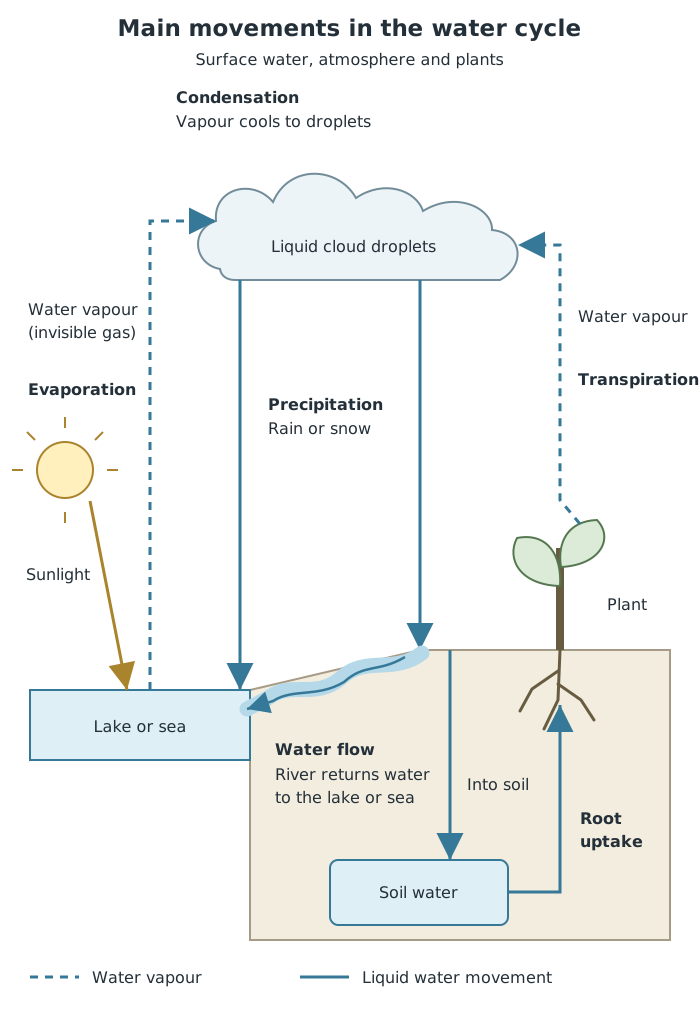
Water cycles between Earth's surface, the atmosphere and plants through evaporation, condensation, precipitation, water flow, root uptake and transpiration.
These processes connect abiotic stores of water with living organisms. Rain can replenish soil water, plants can absorb it, and transpiration can return it to the atmosphere. The cycle maintains water supplies and aquatic habitats, although water is not equally available everywhere.
A mass percentage tells you how much of a relevant total mass is represented by a particular part:
For example, suppose a sample of plant material has a total mass of 250 g and contains 40 g of carbon. The percentage of its mass that is carbon is . This means that carbon accounts for 16 out of every 100 parts of the sample's mass.
The same method can describe the percentage of an initial biomass transferred to another organism. Choose the denominator from the question: for a percentage transferred, it is the starting biomass; for the percentage of a sample made up of a substance, it is the whole sample's mass.
Evaporation and transpiration → condensation → → flow through land, rivers and seas, with uptake by plants.
When describing a cycle, name the process and state where the substance moves from and to.
Plants respire as well as photosynthesise. Photosynthesis removes carbon dioxide from the atmosphere; respiration releases it.
Decomposition breaks down dead material; respiration by decomposers releases carbon dioxide.
For a mass percentage, identify the relevant whole, put both masses in the same unit, then divide the part by the whole and multiply by 100.
It can see this note and what your specification asks for.
Answers are free with an account.
1 free note left this week
Get more free notesYour answer sets when this note comes back for review, or marks it complete.
Was this note helpful?
Log in to tell us whether it helped, or to report a problem.
Last updated
Biotic component
A living component of an ecosystem, such as a plant, animal or microorganism.
Abiotic component
A non-living component of an ecosystem, such as water, air or soil.
Material cycling
The movement and reuse of substances between the living and non-living components of an ecosystem.
Decomposer
An organism, such as a bacterium or fungus, that obtains nutrients by breaking down dead organisms or organic waste.
Evaporation
The change of liquid water into water vapour.
Condensation
The change of water vapour into liquid water.
Precipitation
Water falling from clouds to Earth's surface, for example as rain or snow.
Transpiration
The loss of water vapour from a plant's leaves.
Put your knowledge into practice — try past paper questions for Combined Science B
Biotic component
A living component of an ecosystem, such as a plant, animal or microorganism.
Abiotic component
A non-living component of an ecosystem, such as water, air or soil.
Material cycling
The movement and reuse of substances between the living and non-living components of an ecosystem.
Decomposer
An organism, such as a bacterium or fungus, that obtains nutrients by breaking down dead organisms or organic waste.
Evaporation
The change of liquid water into water vapour.
Condensation
The change of water vapour into liquid water.
Precipitation
Water falling from clouds to Earth's surface, for example as rain or snow.
Transpiration
The loss of water vapour from a plant's leaves.
Importance: replenishes water needed for photosynthesis, cellular reactions, transport and habitats.
Decomposers secrete enzymes outside their cells, then absorb the soluble breakdown products. They return mineral nutrients to the environment and carbon dioxide through respiration, allowing reuse.
Use the same units for both masses.