

Loading…
Loading…
Loading…
OCR GCSE Combined Science A · J250
OCR J250 · B2.2a Check the specification (PDF) (opens in a new tab)
An organism needs to take in substances from its surroundings and remove waste products. These substances must cross an exchange surface. Its surface area determines how much area is available for exchange, while its volume represents the amount of living material that needs supplying.
The surface area:volume ratio, often shortened to SA:V, compares these quantities. A high ratio means there is plenty of surface for each unit of volume. A low ratio means each unit of volume has less surface available to supply it.
A single-celled organism such as an amoeba has a high surface area:volume ratio. Substances can cross its cell membrane, and the distances from the surface to the rest of the cell are short. Diffusion can therefore supply the cell and remove wastes quickly enough.
Simple shapes can model the relationship between size and exchange. For a cube with side length , each face has area . There are six faces, so:
Calculate both quantities before finding the ratio:
For a cube with sides of 1 cm, the surface area is and the volume is . Its ratio is .
For a cube with sides of 3 cm, the surface area is and the volume is . Dividing both parts of by 27 gives .
The larger cube has more surface area overall, but only one-third as much surface per unit of volume. This is the important distinction for exchange.
For a cuboid with lengths , and , there are three pairs of matching faces:
For example, a block measuring 4 cm by 2 cm by 1 cm has surface area and volume . Its ratio is , or .
Use one length unit throughout: lengths in centimetres give areas in square centimetres and volumes in cubic centimetres. The numerical ratios above use this convention.
When an organism becomes larger without changing its shape, its surface area increases with the square of its length, but its volume increases with the cube. Doubling every length therefore multiplies surface area by four and volume by eight. The surface area:volume ratio falls.
A larger volume contains more cells needing supplies and producing wastes. The outer surface does not increase quickly enough to meet that demand on its own.
There is a second problem: cells deep inside a large organism are further from its outer surface. Diffusion is the net movement of particles from higher to lower concentration. It works effectively over short distances, but takes much longer over long distances. Diffusion from the body surface to internal cells would be too slow to meet their needs.
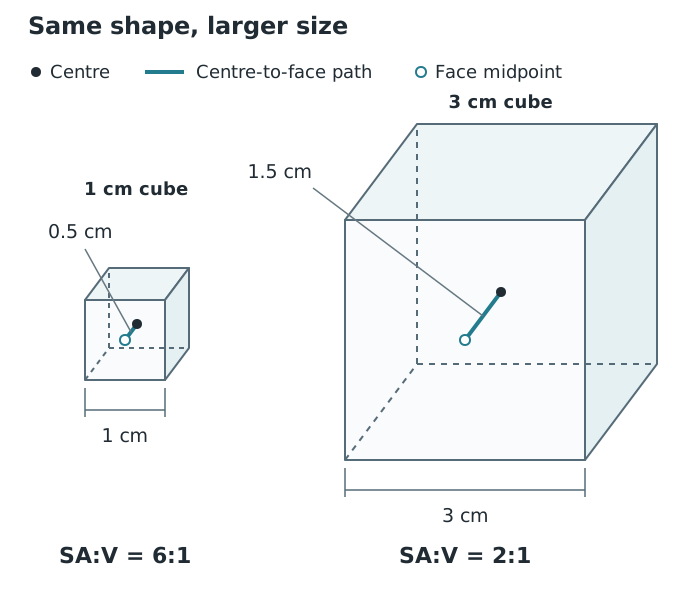
Increasing cube size gives less surface per unit of volume and a longer path from the surface to the centre.
Shape matters as well as size. A flattened shape has more surface area for a given volume than a compact shape, and its centre is closer to a surface. The cubes show the effect of increasing size while keeping shape the same; real organisms need not have the same proportions.
Large multicellular organisms need specialised exchange surfaces to provide enough area for substances to enter and leave. An efficient exchange surface has a large area, allowing many particles to cross at once, and a thin barrier, keeping the diffusion distance short.
In humans, the lungs contain many small air sacs called alveoli. Together they provide a large area for gas exchange. Their walls and the walls of nearby capillaries are only one cell thick, giving a short diffusion path between air and blood.
An exchange surface alone does not deliver substances to distant cells. A transport system carries them over the long distances within the organism. In humans, the circulatory system moves blood between the lungs and body tissues. Capillaries bring blood close to cells, so diffusion only needs to cover the final short distance.
Blood flow also carries absorbed substances away from exchange surfaces. Together with ventilation of the lungs, this maintains differences in concentration, keeping diffusion rapid. Plants likewise use transport tissues, xylem and phloem, to connect their exchange surfaces with other parts of the plant.
The two adaptations work together: exchange surfaces allow rapid movement across a boundary, while transport systems move substances efficiently between that boundary and cells throughout the organism.
Distinguish total surface area from surface area:volume ratio: a larger organism can have a larger surface area but a smaller ratio.
Show surface area and volume separately before dividing surface area by volume. Use squared units for area and cubed units for volume.
Use the same length unit throughout a calculation and when comparing ratios. Write the final ratio in the form requested.
Link a small surface area:volume ratio to insufficient exchange for the volume of cells, and a long diffusion distance to slow diffusion.
It can see this note and what your specification asks for.
Answers are free with an account.
1 free note left this week
Get more free notesYour answer sets when this note comes back for review, or marks it complete.
Was this note helpful?
Log in to tell us whether it helped, or to report a problem.
Last updated
Surface area
The total area of an object's outer surface.
Volume
The amount of three-dimensional space occupied by an object.
Surface area:volume ratio
The surface area of an object divided by its volume: a measure of how much surface is available per unit of volume.
Diffusion
The net movement of particles from a region of higher concentration to a region of lower concentration, due to their random motion.
Diffusion distance
The distance particles must travel by diffusion between two regions.
Exchange surface
A surface across which substances pass between an organism and its surroundings.
Transport system
A system that carries substances between exchange surfaces and cells within an organism.
Put your knowledge into practice — try past paper questions for Combined Science A
Surface area
The total area of an object's outer surface.
Volume
The amount of three-dimensional space occupied by an object.
Surface area:volume ratio
The surface area of an object divided by its volume: a measure of how much surface is available per unit of volume.
Diffusion
The net movement of particles from a region of higher concentration to a region of lower concentration, due to their random motion.
Diffusion distance
The distance particles must travel by diffusion between two regions.
Exchange surface
A surface across which substances pass between an organism and its surroundings.
Transport system
A system that carries substances between exchange surfaces and cells within an organism.