

Loading…
Loading…
Loading…
OCR GCSE Combined Science A · J250
OCR J250 · B6.3f Specific Infections and Diseases Check the specification (PDF) (opens in a new tab)
Plants can be infected by viruses, fungi and bacteria. A pathogen is an organism or infectious agent that causes disease. Plant diseases can damage leaves, take nutrients from living tissue or disrupt transport within the plant. These effects may reduce growth and the amount of crop harvested, called the yield.
Three examples show how different pathogens produce different symptoms: tobacco mosaic virus, barley powdery mildew and crown gall disease.
Tobacco mosaic virus (TMV) infects tobacco plants and can also infect other plants, including tomatoes and cucumbers. Infected leaves develop patchy discolouration, giving them a mosaic-like appearance. Leaves may turn yellow and curl, and the plant's growth is reduced.
To understand the effect on growth, recall that chlorophyll is the green pigment in chloroplasts that absorbs light for photosynthesis. Photosynthesis makes glucose, which plants use in respiration and to make materials needed for growth.
TMV causes the plant to produce less chlorophyll. The affected leaves absorb less light, so photosynthesis is reduced. Less glucose is made, leaving less available for growth. A farmer therefore has less crop to harvest and sell.
TMV can spread through contact between infected and healthy plants. People handling plants can also transfer the virus from one plant to another. Avoiding contact between plants and removing infected plants or leaves helps limit its spread. There is no known cure: removing infected material protects other plants rather than curing the infected tissue.
Barley powdery mildew is caused by the fungus Erysiphe graminis. This is the name used in the specification; the fungus is now called Blumeria graminis, with the barley-infecting form named Blumeria graminis f. sp. hordei.
The fungus depends on living plant tissue for growth and reproduction. Infection begins when a fungal spore lands on a barley leaf and germinates. The fungus penetrates the leaf's surface cells and takes nutrients from them.
About 7–10 days after infection, small white, fluffy, circular growths appear on the upper surface of the leaf. These patches expand and join together, producing a grey-white powdery covering containing many spores. In heavy infections, leaves may turn yellow as the plant becomes stressed.
A spore is a reproductive unit that can develop into new fungal growth under suitable conditions. Powdery mildew produces many lightweight spores that are easily carried by wind to other leaves and plants. Warm, humid conditions favour disease development.
The infection reduces the quantity and quality of barley grain, lowering the crop's value. Control combines timely applications of fungicides, chemicals that control fungi, with growing resistant barley varieties. Resistance means that a variety is better able to withstand the disease; it does not necessarily mean that infection is impossible. The fungus can also evolve resistance to particular fungicides, making those treatments ineffective.
Crown gall disease is caused by the bacterium Agrobacterium tumefaciens, also known as Rhizobium radiobacter. It affects many plant species, including roses and fruit trees.
The bacteria live in soil and enter plants through wounds in roots or stems. They stimulate plant cells to grow in a disorganised way, forming knobbly swellings called galls. Galls commonly develop on roots or near the base of a stem, but can also occur on trunks and branches.
Growing galls can disrupt the plant's transport tissues. Xylem carries water and mineral ions, while phloem transports dissolved sugars. Disruption of these pathways can reduce the movement of substances needed by the rest of the plant, restricting growth. The effect varies: a plant with a small amount of galling may continue to grow well, whereas severe galling can cause greater damage.
Contaminated soil and tools can spread the bacteria. Cleaning tools and avoiding damage to roots and stems help reduce the risk of infection. Badly affected plants can be removed and carefully disposed of to help limit spread. Removing leaves alone does not address a disease centred on infected roots or stems.
The location and appearance of symptoms help distinguish these diseases. TMV produces a mosaic pattern of leaf discolouration; barley powdery mildew produces fluffy patches that become a powdery leaf covering; crown gall produces swollen masses of plant tissue.
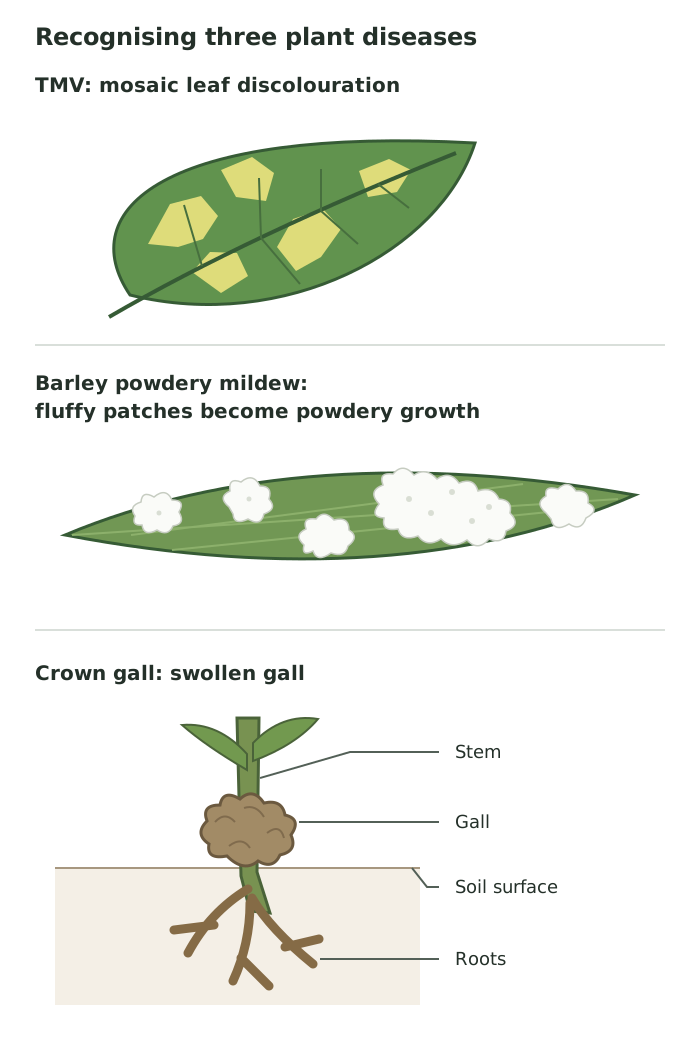
Leaf discolouration, powdery fungal growth and swollen galls are the characteristic symptoms to distinguish.
These symptoms also connect to different effects. TMV chiefly reduces photosynthesis, powdery mildew takes nutrients from living tissue and damages leaves, and crown gall can disrupt transport. All three can reduce growth, but they do so in different ways.
| Disease | Pathogen type and name | Distinguishing symptoms |
|---|---|---|
| Tobacco mosaic virus | Virus: TMV | Mosaic leaf discolouration; leaves may yellow and curl; reduced growth |
| Barley powdery mildew | Fungus: Erysiphe graminis (now Blumeria graminis) | White fluffy leaf patches → grey-white powdery covering; leaves may yellow in heavy infections |
| Crown gall | Bacterium: Agrobacterium tumefaciens | Knobbly swollen galls on roots, stems or branches |
Link each disease to its named pathogen and pathogen type: TMV—virus; Erysiphe graminis—fungus; Agrobacterium tumefaciens—bacterium.
When explaining reduced growth from TMV, give the chain: less chlorophyll → less light absorbed → less photosynthesis → less glucose available for growth.
Describe the distinguishing symptoms: mosaic leaf discolouration, white powdery leaf growth, or swollen galls.
Match control measures to the pathogen. Fungicides control fungi, not viruses; antibiotics do not treat TMV.
It can see this note and what your specification asks for.
Answers are free with an account.
1 free note left this week
Get more free notesYour answer sets when this note comes back for review, or marks it complete.
Was this note helpful?
Log in to tell us whether it helped, or to report a problem.
Last updated
Pathogen
An organism or infectious agent that causes disease.
Tobacco mosaic virus (TMV)
A viral pathogen that causes mosaic-like leaf discolouration and reduced growth in tobacco and other plants.
Barley powdery mildew
A fungal disease of barley caused by Erysiphe graminis, now called Blumeria graminis, which produces white or grey powdery growth on leaves.
Crown gall disease
A bacterial plant disease caused by Agrobacterium tumefaciens that produces swollen, disorganised growths on roots or stems.
Gall
A swollen growth of plant tissue; in crown gall disease, it forms when bacteria stimulate disorganised cell growth.
Spore
A reproductive unit of a fungus that can develop into new fungal growth in suitable conditions.
Fungicide
A chemical used to kill or control fungi.
Yield
The amount of useful crop harvested.
Put your knowledge into practice — try past paper questions for Combined Science A
Pathogen
An organism or infectious agent that causes disease.
Tobacco mosaic virus (TMV)
A viral pathogen that causes mosaic-like leaf discolouration and reduced growth in tobacco and other plants.
Barley powdery mildew
A fungal disease of barley caused by Erysiphe graminis, now called Blumeria graminis, which produces white or grey powdery growth on leaves.
Crown gall disease
A bacterial plant disease caused by Agrobacterium tumefaciens that produces swollen, disorganised growths on roots or stems.
Gall
A swollen growth of plant tissue; in crown gall disease, it forms when bacteria stimulate disorganised cell growth.
Spore
A reproductive unit of a fungus that can develop into new fungal growth in suitable conditions.
Fungicide
A chemical used to kill or control fungi.
Yield
The amount of useful crop harvested.