

Loading…
Loading…
Loading…
OCR GCSE Combined Science A · J250
OCR J250 · C2.3d Check the specification (PDF) (opens in a new tab)
A solid’s particles are held close together in fixed positions, although they vibrate. In a liquid, the particles remain close together but can move past one another. In a gas, they are much further apart and move freely.
To change a solid into a liquid, or a liquid into a gas, energy must be transferred to the substance. This allows particles to overcome attractions that hold them together. Melting lets particles move past one another; boiling separates them much further so that they form a gas.
Different substances have different attractions between their particles. Stronger attractions require more energy to overcome, so substances with stronger attractions generally have higher melting and boiling points. The important question is not just whether a substance has strong bonds, but which attractions must be overcome when it changes state.
When a substance is heated without changing state, its particles gain kinetic energy: they move or vibrate faster, and its temperature rises.
During melting or boiling of a pure substance at constant pressure, energy continues to enter, but the temperature stays constant until the change is complete. The transferred energy is used to overcome attractions and change the particles’ arrangement and separation, rather than increase their average kinetic energy.
For example, ice melts at 0 °C under normal atmospheric conditions. While it is melting, ice and liquid water can both be present at 0 °C. Once all the ice has melted, further heating raises the liquid’s temperature.
The reverse changes transfer energy from the substance to its surroundings. During freezing, particles become held in fixed positions; during condensation, gas particles come together to form a liquid. At the same pressure, a pure substance freezes at its melting point and condenses at its boiling point.
A simple molecular substance contains separate molecules. Each molecule has strong covalent bonds holding its atoms together, but the attractions between separate molecules are weaker intermolecular forces.
When a simple molecular substance melts or boils, it is these intermolecular forces that are overcome. The covalent bonds within its molecules remain intact. Only a relatively small amount of energy is needed to overcome the weak forces, so these substances generally have low melting and boiling points.
Water makes this distinction clear. Each H₂O molecule contains covalent bonds between oxygen and hydrogen atoms. Boiling separates water molecules from one another; it does not split them into hydrogen and oxygen. Water vapour still consists of H₂O molecules.
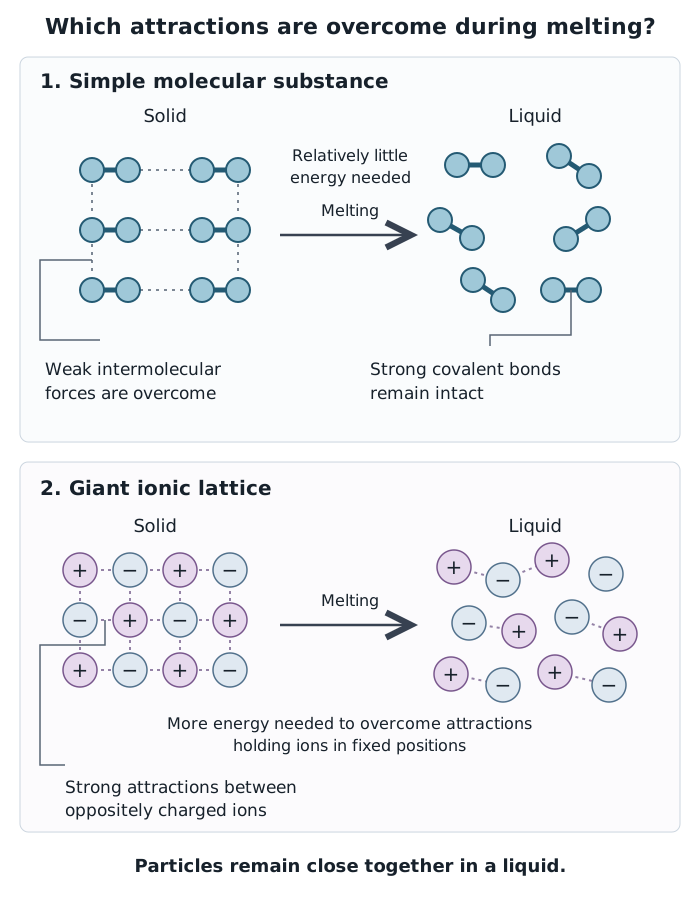
Melting separates intact molecules in a molecular substance, but disrupts the ordered arrangement of strongly attracted ions in an ionic lattice.
Among similar molecular substances, larger molecules generally have stronger intermolecular forces. More energy is then needed to separate their molecules, so their melting and boiling points tend to be higher. This is a trend, not a rule that size alone determines every substance’s melting point.
A giant ionic lattice is an extended arrangement of oppositely charged ions held together by strong electrostatic attractions. There are no separate molecules with weak forces between them. Melting requires enough energy to overcome the attractions that hold the ions in fixed positions, allowing the ions to move past one another. Ionic substances therefore generally have high melting points.
In a giant covalent structure, atoms are joined by strong covalent bonds throughout an extended network. Unlike a simple molecular substance, there are no separate small molecules that can be moved apart while leaving the network intact. Changing this structure requires breaking strong covalent bonds, which needs a large amount of energy. Giant covalent substances therefore have very high melting temperatures.
The comparison follows one chain of reasoning: structure determines the attractions that must be overcome; their strength determines the energy needed; this helps explain the temperature at which the substance changes state.
Stronger attractions → more energy needed to overcome them → higher transition temperatures.
For a melting- or boiling-point explanation, link the strength of the attractions to the energy needed to overcome them, then to the temperature required.
Name the attraction being overcome. Simple molecular substances have strong covalent bonds within molecules but weak intermolecular forces between molecules.
Do not say that boiling water breaks its covalent bonds: water vapour still contains H₂O molecules.
A larger sample needs more energy to change state, but its melting and boiling points do not increase simply because there is more of it.
It can see this note and what your specification asks for.
Answers are free with an account.
1 free note left this week
Get more free notesYour answer sets when this note comes back for review, or marks it complete.
Was this note helpful?
Log in to tell us whether it helped, or to report a problem.
Last updated
Melting
The change of state from a solid to a liquid.
Boiling
The change of state from a liquid to a gas throughout the liquid, with bubbles of gas forming.
Melting point
The temperature at which a pure substance changes between solid and liquid at a given pressure.
Boiling point
The temperature at which a pure liquid boils at a given pressure.
Intermolecular force
An attraction between separate molecules, weaker than the covalent bonds within those molecules.
Covalent bond
A chemical bond in which two atoms share a pair of electrons.
Simple molecular substance
A substance made of separate, small molecules, with covalent bonds within each molecule and intermolecular forces between molecules.
Put your knowledge into practice — try past paper questions for Combined Science A
Melting
The change of state from a solid to a liquid.
Boiling
The change of state from a liquid to a gas throughout the liquid, with bubbles of gas forming.
Melting point
The temperature at which a pure substance changes between solid and liquid at a given pressure.
Boiling point
The temperature at which a pure liquid boils at a given pressure.
Intermolecular force
An attraction between separate molecules, weaker than the covalent bonds within those molecules.
Covalent bond
A chemical bond in which two atoms share a pair of electrons.
Simple molecular substance
A substance made of separate, small molecules, with covalent bonds within each molecule and intermolecular forces between molecules.