

Loading…
Loading…
Loading…
OCR GCSE Combined Science A · J250
OCR J250 · B1.4b Check the specification (PDF) (opens in a new tab)
Plants make carbohydrates in their leaves by . This process uses energy transferred by light to make , a simple sugar, from carbon dioxide and water. Oxygen is also produced.
Carbon dioxide and water are the reactants: the substances used in the reactions. Glucose and oxygen are the products: the substances formed. The overall process can be summarised by the word equation:
The substances on the left are changed into the substances on the right. Light supplies energy rather than matter, so it is shown over the arrow rather than listed as a reactant.
Carbon dioxide comes from the atmosphere and diffuses into leaves through small pores called stomata. Water is absorbed by the roots and transported to the leaves through xylem vessels. These routes bring both raw materials to the cells where photosynthesis occurs.
Photosynthesis takes place inside chloroplasts, specialised structures within cells. Many cells inside a leaf contain numerous chloroplasts.
Chloroplasts contain chlorophyll, a green pigment that absorbs light energy. The chloroplast is therefore the location of photosynthesis, while chlorophyll helps capture the energy needed for the process.
The word equation summarises the overall change, but photosynthesis is not one single reaction. A useful model divides it into two main stages, both occurring within chloroplasts.
In the first stage, energy transferred by light is used to split water. This produces oxygen gas and hydrogen ions. The oxygen produced during photosynthesis therefore comes from water, not from carbon dioxide.
In the second stage, carbon dioxide combines with the hydrogen ions to make glucose. The hydrogen ions formed in the first stage are used in the second, connecting the two stages. They are intermediate substances, so they do not appear in the overall word equation.
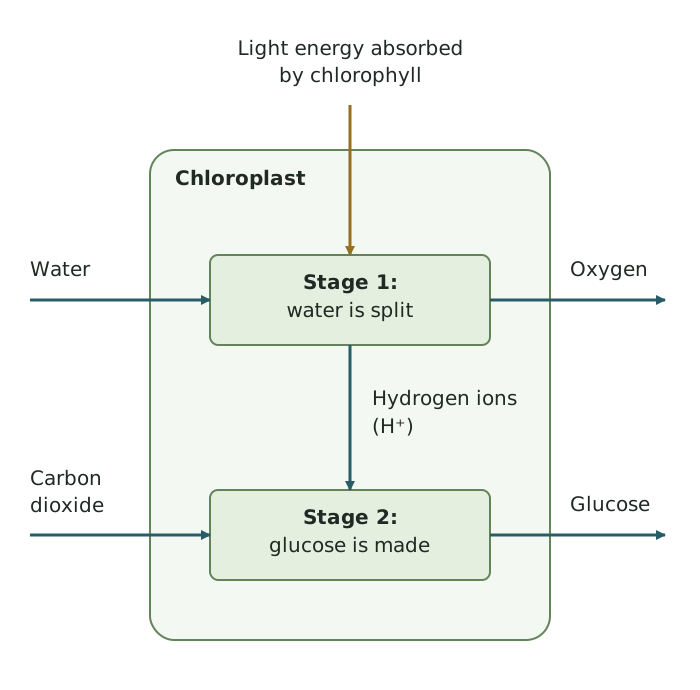
Inside chloroplasts, water is split using light energy. The hydrogen ions are then used with carbon dioxide to make glucose.
Following the arrows shows the connection: water supplies the hydrogen ions needed for glucose production, while carbon dioxide enters the second stage. Oxygen leaves the process as a separate product. This is a simplified model of a series of reactions, rather than a picture of every chemical step.
Glucose can be used in respiration to release energy or to make other substances needed by the plant. Oxygen can also be used in respiration, or it can diffuse out of the leaf through the stomata. Plants therefore respire as well as photosynthesise: making glucose and using glucose are different processes.
Photosynthesis makes glucose using light energy. It occurs in chloroplasts, which contain the light-absorbing pigment chlorophyll.
The hydrogen ions link the stages. The oxygen produced comes from water.
For the word equation, put carbon dioxide and water on the reactant side, and glucose and oxygen on the product side.
Light supplies energy; it is not a chemical reactant. Chlorophyll absorbs light and is not a product.
When describing the two stages, link them: hydrogen ions produced by splitting water are used with carbon dioxide to make glucose.
Distinguish chloroplasts, the structures where photosynthesis happens, from chlorophyll, the pigment that absorbs light.
It can see this note and what your specification asks for.
Answers are free with an account.
1 free note left this week
Get more free notesYour answer sets when this note comes back for review, or marks it complete.
Was this note helpful?
Log in to tell us whether it helped, or to report a problem.
Last updated
Photosynthesis
The process by which plants make carbohydrates from carbon dioxide and water using energy transferred by light, producing oxygen.
Reactant
A substance used up in a chemical reaction.
Product
A substance formed in a chemical reaction.
Chloroplast
A sub-cellular structure in which photosynthesis takes place.
Chlorophyll
A green pigment in chloroplasts that absorbs light energy for photosynthesis.
Glucose
A simple sugar made during photosynthesis; it is a carbohydrate.
Hydrogen ion
A positively charged hydrogen particle, written as , produced when water is split in the first stage of photosynthesis.
Put your knowledge into practice — try past paper questions for Combined Science A
Photosynthesis
The process by which plants make carbohydrates from carbon dioxide and water using energy transferred by light, producing oxygen.
Reactant
A substance used up in a chemical reaction.
Product
A substance formed in a chemical reaction.
Chloroplast
A sub-cellular structure in which photosynthesis takes place.
Chlorophyll
A green pigment in chloroplasts that absorbs light energy for photosynthesis.
Glucose
A simple sugar made during photosynthesis; it is a carbohydrate.
Hydrogen ion
A positively charged hydrogen particle, written as , produced when water is split in the first stage of photosynthesis.