

Loading…
Loading…
Loading…
Eduqas GCSE Sociology · C200
Eduqas C200 Check the specification (PDF) (opens in a new tab)
Official statistics are numerical information produced by government departments or other public bodies. Sociologists use them to investigate the amount and types of crime, compare areas and examine changes over time.
A major source is police-recorded crime. In England and Wales, police forces supply crime records to the Home Office, which checks the data before passing them to the Office for National Statistics (ONS) for publication. These figures concern England and Wales, not the whole UK.
The published counts cover specified categories of offences, rather than every incident brought to police attention. They include crimes against people, such as robbery, crimes against property, such as burglary, and offences without a specific victim, such as possession of drugs.
These figures are quantitative data because they take a numerical form. For sociologists using the published figures, they are also secondary data: the records were originally collected by other organisations, rather than through the sociologist's own research.
Official crime statistics are not limited to police records. ONS publications also include the Crime Survey for England and Wales (CSEW), which asks people about their experiences of crime. It can identify some crimes that never reached the police. The two sources measure crime differently and should not be treated as interchangeable.
A crime must come to police attention and be recorded before it can appear in police-recorded statistics. It may be reported by a victim or witness, or discovered through police activity.
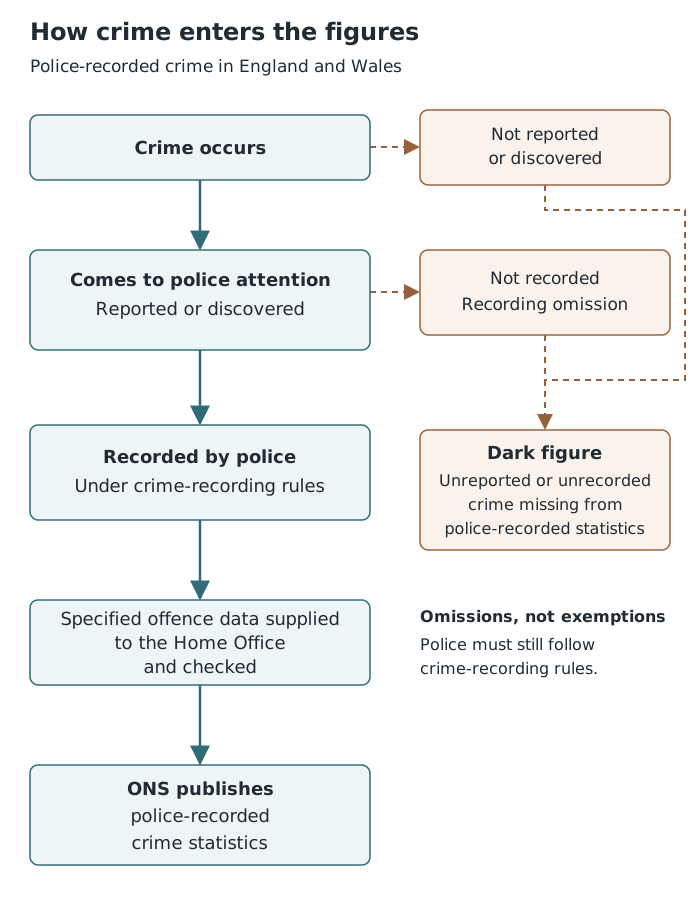
Police-recorded statistics count crimes that reach the recording stage; unreported or unrecorded crimes are missing.
Each stage affects what the final figures show. A theft dealt with privately by an employer may never reach the police. A victim of domestic abuse may fear further harm if they report it. Someone who has experienced an online scam may feel embarrassed, while a victim of minor vandalism may believe reporting it is not worthwhile.
Even crimes brought to police attention may be missing because of recording failures or inconsistent decisions. However, this does not mean police are entitled simply to ignore crimes they consider trivial. Recording standards require allegations that amount to a crime in law to be recorded unless credible evidence to the contrary is immediately available.
The dark figure of crime is crime that is not reported to or recorded by the police. Its existence means police statistics cannot provide a complete count of all crime committed.
Police records provide extensive numerical information without sociologists having to collect every record themselves. They allow researchers to compare offence types, examine local differences and follow recorded crime over time. They can also inform decisions about where crime-prevention resources are needed.
They are particularly useful for offences that are usually reported and reliably recorded, such as homicide. Police records also cover crimes against businesses, offences involving tourists and residents of institutions, and some offences without a specific victim. These are not all covered by the CSEW.
Common recording rules aim to make figures consistent across police forces. This supports reliability, although the existence of rules does not guarantee that every force applies them equally well.
The validity of police statistics as a measure of all crime is limited by the dark figure. The missing crimes are not necessarily a random selection: some offences are more likely to be reported or discovered than others. The recorded mix of offences may therefore differ from the actual mix.
Changes in recorded crime may reflect changes in reporting, recording or policing rather than changes in offending. For example, greater confidence that police will handle sexual assault sensitively may encourage more victims to report it. Increased police activity targeting drug possession may uncover more offences.
A concrete example is the introduction of the National Crime Recording Standard in April 2002. It promoted more consistent, victim-oriented recording across England and Wales and increased the number of crimes recorded. A rise associated with this change cannot simply be interpreted as a rise in crimes committed.
Likewise, statistics about arrests or convictions describe people who have passed through particular stages of the criminal justice system, not everyone who has offended. Policing priorities and decisions about cases influence these figures.
Overall, official statistics are valuable evidence about recorded crime, especially locally and for well-reported offences. A justified evaluation recognises these strengths while using other evidence, including victim surveys, to build a fuller picture.
Useful for studying recorded crime, but not a complete measure of crime committed. Interpret alongside other evidence.
Distinguish crime committed from crime recorded: an increase in police-recorded crime does not necessarily mean more offending.
Explain limitations through a chain of reasoning: fear may prevent victims reporting domestic abuse, so police figures may underestimate it.
Balance your evaluation. Police records are useful for local comparisons and well-reported offences, but cannot measure all crime.
Do not treat arrest or conviction figures as direct measures of who commits crime: policing and criminal justice decisions also affect them.
It can see this note and what your specification asks for.
Answers are free with an account.
1 free note left this week
Get more free notesYour answer sets when this note comes back for review, or marks it complete.
Was this note helpful?
Log in to tell us whether it helped, or to report a problem.
Last updated
Official statistics
Numerical information produced by government departments or other public bodies, such as published counts of police-recorded offences.
Police-recorded crime
Offences entered into police crime-recording systems and included in published crime counts.
Quantitative data
Data expressed as numbers, allowing researchers to calculate totals and compare patterns.
Secondary data
Information already collected by someone else, which a researcher uses for a new investigation.
Dark figure of crime
Crime that is not reported to or recorded by the police and is therefore missing from police-recorded crime statistics.
Validity
The extent to which a measure accurately represents what it is intended to measure.
Reliability
The consistency of a measurement, including whether comparable procedures are used across places and over time.
Put your knowledge into practice — try past paper questions for Sociology
Official statistics
Numerical information produced by government departments or other public bodies, such as published counts of police-recorded offences.
Police-recorded crime
Offences entered into police crime-recording systems and included in published crime counts.
Quantitative data
Data expressed as numbers, allowing researchers to calculate totals and compare patterns.
Secondary data
Information already collected by someone else, which a researcher uses for a new investigation.
Dark figure of crime
Crime that is not reported to or recorded by the police and is therefore missing from police-recorded crime statistics.
Validity
The extent to which a measure accurately represents what it is intended to measure.
Reliability
The consistency of a measurement, including whether comparable procedures are used across places and over time.