Loading…


Loading…
Loading…
Loading…
Eduqas GCSE Religious Studies · C120
Eduqas C120 · Rituals Check the specification (PDF) (opens in a new tab)
In Judaism, marriage is regarded as a blessing from God and the basis of family life. It brings together love, companionship and practical responsibility. Both partners are expected to enter marriage with sincere intentions, respect one another and remain faithful. Marriage is therefore more than a celebration: it establishes a committed relationship and a shared home.
Genesis 2:24 teaches:
“Hence a man leaves his father and mother and clings to his wife, so that they become one flesh.”
This passage describes a new family bond. Leaving father and mother means establishing a new household, not abandoning care for parents. “Clings to his wife” expresses a close attachment, while “one flesh” conveys the intimate union of married life. The teaching helps explain why Jewish weddings celebrate both the joining of two people and the beginning of a family.
A Jewish wedding can take place in a synagogue or another suitable venue, and a rabbi usually conducts it. The ceremony has two stages: kiddushin and nisuin. Historically, these could take place separately; today they are normally combined in one wedding.
Kiddushin means sanctification: setting something apart as holy. It establishes a binding marriage relationship, setting the partners apart for one another. Although often translated as ‘betrothal’, it is more binding than an ordinary engagement. Nisuin completes the marriage and marks the beginning of their married life together.
The couple stand beneath a chuppah, also spelt huppah: a cloth canopy supported by four poles. It represents the home they will build together. Its open sides also symbolise hospitality, suggesting that their home will welcome others.
This gives a visible form to Genesis 2:24. Two people are establishing a new household, with responsibilities towards each other and a place within the wider Jewish community.
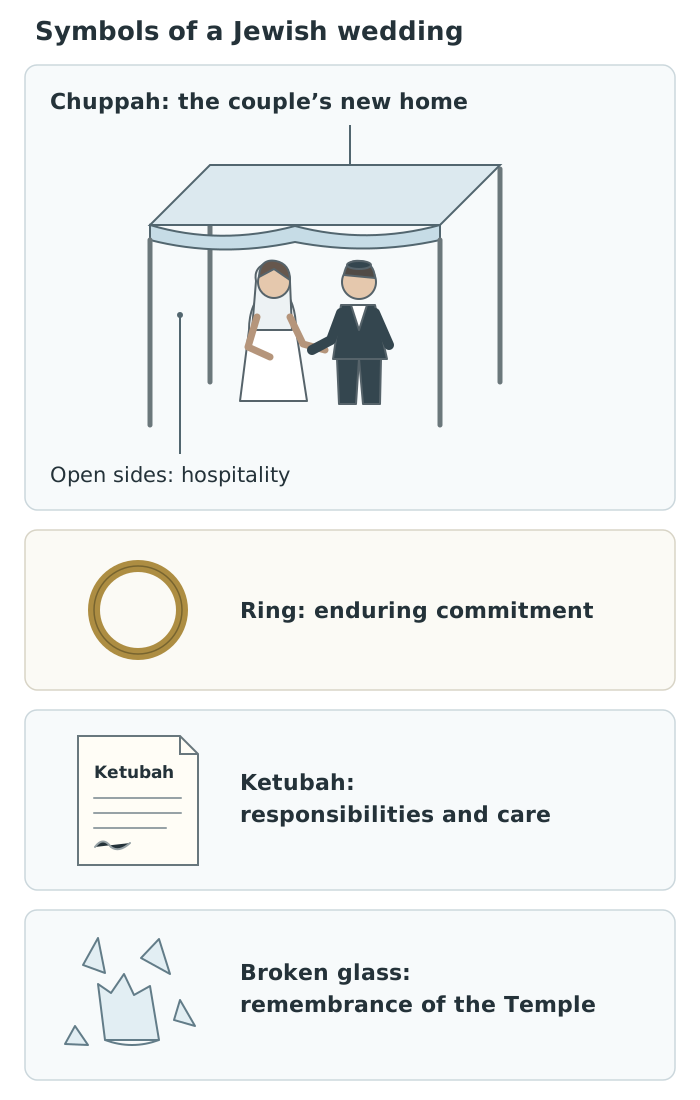
Jewish wedding features connect the celebration with a shared home, commitment, responsibility and remembrance.
During kiddushin, two blessings are said: one over wine and another concerning the marriage commitment. Blessing God connects the couple’s happiness with their religious faith.
Traditionally, the groom places a ring on the bride’s index finger and declares that she is consecrated to him with this ring ‘according to the law of Moses and Israel’. Her acceptance of the ring expresses her consent. The declaration places their commitment within Jewish religious law, rather than presenting it simply as a private promise. The ring’s unbroken circle symbolises an enduring bond.
The ketubah, or marriage contract, is read aloud. Traditionally, it sets out the husband’s duties towards his wife, including providing for her. The wife keeps it throughout the marriage. The contract shows that commitment involves concrete responsibilities: caring for a partner requires action as well as affection.
During nisuin, the sheva brachot, or seven wedding blessings, are recited. They praise God for creation and humanity, refer to human beings being made in God’s image, express hope for joy in Zion, and celebrate the happiness of bride and groom. One blessing recalls the first man and woman in the Garden of Eden, connecting this new marriage with the biblical account of human companionship.
The blessings place the couple’s personal joy within a larger religious story. Their relationship is celebrated alongside God’s creation and the life of the Jewish people. The blessing that praises God for bringing bride and groom together ‘to rejoice in each other’ particularly emphasises love and companionship.
At the end of the ceremony, the groom traditionally breaks a glass beneath his foot. This recalls the destruction of the Temple in Jerusalem: even at a joyful moment, Jewish people remember suffering in their shared history. Another interpretation is that the glass represents the fragility of marriage and the need to protect the relationship.
Together, the canopy, ring, contract and blessings express different aspects of marriage: a shared home, lasting commitment, practical care and a relationship blessed by God.
Get unlimited access to all revision notes, key terms, and exam tips.
Kiddushin and nisuin are normally combined in one wedding today.
Get unlimited access to all revision notes, key terms, and exam tips.
For a ceremony feature, explain both what happens and what it means: for example, the chuppah represents the couple’s new home.
Use Genesis 2:24 to explain the close union of marriage, rather than quoting it without linking it to the question.
Distinguish kiddushin, the binding betrothal, from nisuin, which completes the marriage. The seven wedding blessings belong to nisuin.
Describe traditional practices carefully rather than assuming that every Jewish wedding is identical.
Chuppah
A cloth canopy supported by four poles under which a Jewish wedding takes place; it symbolises the couple’s new home.
Ketubah
A Jewish marriage contract setting out the husband’s responsibilities towards his wife, including her financial support.
Kiddushin
The first stage of Jewish marriage: a legally binding betrothal that sets the couple apart for one another. Its name means sanctification.
Nisuin
The second stage of Jewish marriage, which completes the marriage and begins the couple’s married life together.
Sheva brachot
The seven Jewish wedding blessings, praising God and celebrating creation, marriage and the couple’s happiness.
Put your knowledge into practice — try past paper questions for Religious Studies
Chuppah
A cloth canopy supported by four poles under which a Jewish wedding takes place; it symbolises the couple’s new home.
Ketubah
A Jewish marriage contract setting out the husband’s responsibilities towards his wife, including her financial support.
Kiddushin
The first stage of Jewish marriage: a legally binding betrothal that sets the couple apart for one another. Its name means sanctification.
Nisuin
The second stage of Jewish marriage, which completes the marriage and begins the couple’s married life together.
Sheva brachot
The seven Jewish wedding blessings, praising God and celebrating creation, marriage and the couple’s happiness.